





 Portuguese
  English
  Spanish
  4 min of reading
  0 comments


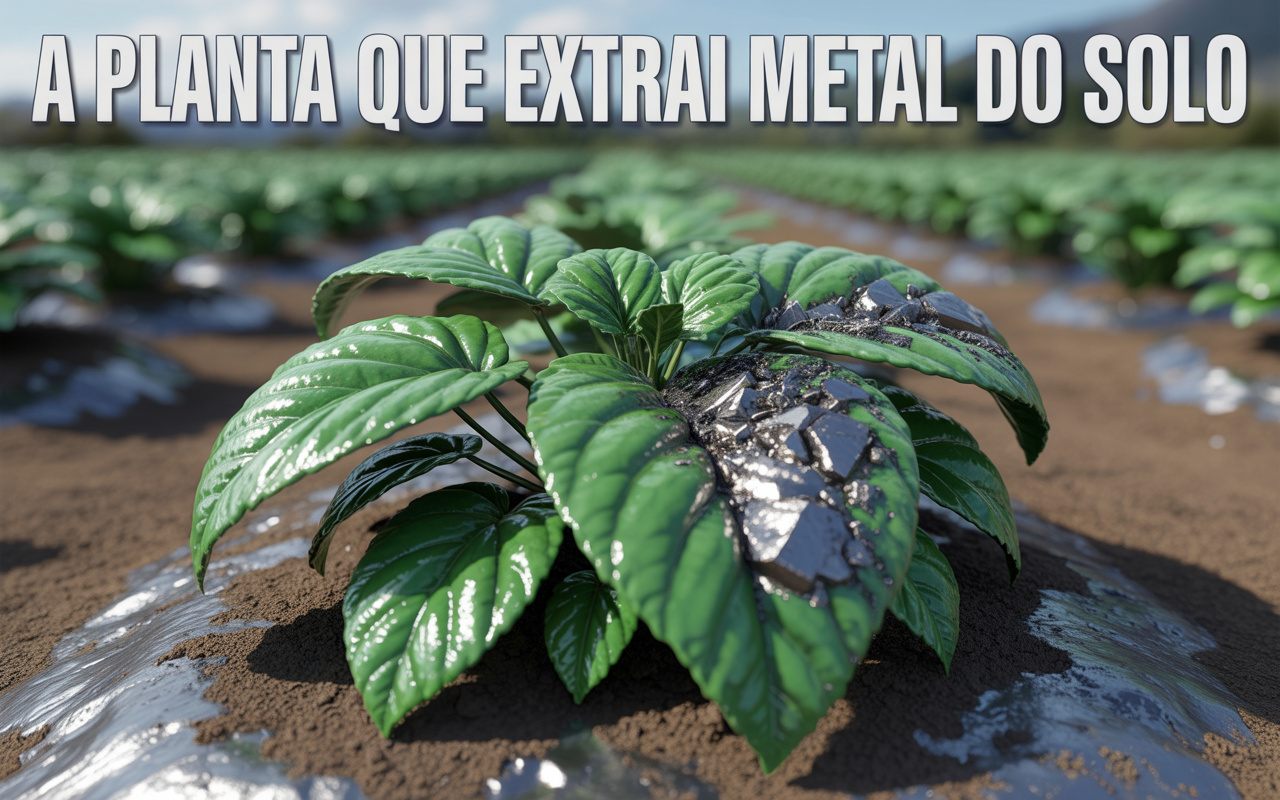
Hyperaccumulator Plants Remove Metals From The Soil And Accumulate Nickel, Cobalt, And Zinc In The Leaves. Agromining Is Already Generating “Biological Ore” On A Real Scale.
Plants capable of absorbing, transporting, and storing heavy metals at extremely high levels have been studied for decades by science, but only recently have they begun to be regarded as a real technological alternative to conventional mining. These species, known as hyperaccumulator plants, can extract elements such as nickel, cobalt, and zinc directly from the soil and concentrate them in plant tissues, especially in the leaves, in proportions that would be lethal to most common plants.
Agricultural trials and scientific studies demonstrate that this process, called agromining or phytomining, has already surpassed the theoretical phase and presents measurable results in the field, with documented productivity per hectare, energy balance, and metal recovery.
Where, When, And By Whom Agromining Was Tested
Agricultural experiments with nickel hyperaccumulator plants were conducted in ultramafic soils of Albania, in southeastern Europe, in the Balkans region, where this type of soil is naturally rich in nickel and poor in conventional agricultural nutrients. These field trials are described in scientific articles published between 2007 and 2015, including works led by researchers such as R. L. Chaney and A. Bani, widely cited in international literature.
-
Friends have been building a small “town” for 30 years to grow old together, with compact houses, a common area, nature surrounding it, and a collective life project designed for friendship, coexistence, and simplicity.

-
This small town in Germany created its own currency 24 years ago, today it circulates millions per year, is accepted in over 300 stores, and the German government allowed all of this to happen under one condition.

-
Curitiba is shrinking and is expected to lose 97,000 residents by 2050, while inland cities in Paraná such as Sarandi, Araucária, and Toledo are experiencing accelerated growth that is changing the entire state’s map.

-
Tourists were poisoned on Everest in a million-dollar fraud scheme involving helicopters that diverted over $19 million and shocked international authorities.



The research appears in indexed scientific journals and is referenced by academic institutions and European research centers, in addition to being included in global databases such as the Global Hyperaccumulator Database, organized by researchers linked to the University of Queensland in Australia and publicly released in 2017.
The Symbolic Plant of Nickel Agromining
Among the most studied species is Alyssum murale, an herbaceous plant that naturally grows in serpentine and ultramafic soils. Under conditions documented in the scientific literature, this plant was able to concentrate more than 2% of nickel by dry weight in the leaves, a value hundreds of times higher than that observed in conventional plants grown in the same soils.
Studies in ultramafic areas of Serbia recorded foliar concentrations greater than 13,000 mg of nickel per kilogram of dry matter, confirming the extreme biological capacity of these species to deal with potentially toxic metals.
How The Metal Exits The Soil And Accumulates In The Plant
The hyperaccumulation mechanism involves specific physiological processes. These plants absorb metal ions through their roots, transport the metal through the xylem, and store it in cellular compartments or chemical complexes that reduce internal toxicity. This process enables the plant to grow normally even in environments where the metal concentration makes other forms of vegetation unfeasible.
This evolutionary behavior was not developed for human mining but for survival in hostile soils. Science has only begun to explore this adaptation as a technological tool in recent decades.
Technical Data On Productivity Per Hectare
The viability of agromining depends on concrete numbers, and these numbers already exist in the scientific literature.
A widely cited study reports that crops of hyperaccumulator plants, under optimized agricultural management, achieved production of up to 20 tons of dry biomass per hectare, resulting in an estimated extraction of approximately 400 kg of nickel per hectare in a single agricultural cycle (Chaney et al., 2007).
In trials conducted specifically in Albania, the application of fertilizers raised productivity to around 9 tons of dry biomass per hectare, with an estimated extraction of 105 kg of nickel per hectare (Bani et al., 2015). These numbers highlight that yield varies according to species, soil, climate, and agronomic management.
From Plant To “Biological Ore”
After harvest, the metal remains incorporated into the plant biomass. To make it economically useful, the plant needs to be processed. The most common method involves the conversion of biomass into ashes, drastically reducing the volume and concentrating the metal.
Studies describe the production of ashes with nickel contents between 15% and 20%, material known as bio-ore (biological ore). This concentrate can then undergo conventional metallurgical processes for metal recovery, reducing the need for traditional mining under certain conditions.
Other Metals Besides Nickel
Although nickel is the most documented case, hyperaccumulation is not limited to this element. The Global Hyperaccumulator Database, released in 2017, catalogs hundreds of species capable of accumulating cobalt, zinc, manganese, and other metals, providing a solid scientific basis for the expansion of the agromining concept.

The existence of this database is essential for separating biologically proven cases from speculation, as only a minimal fraction of the plants on the planet possesses this extreme capability.
Technical Limits And Real Application Conditions
Agromining does not replace large-scale conventional mining but can be viable in specific contexts. Among the observed advantages are the productive use of unproductive ultramafic soils for traditional agriculture and the possibility of gradual recovery of metal-rich areas.
On the other hand, studies also point out clear limitations: dependence on soils with adequate chemical availability, the need for infrastructure to process biomass, and significant yield variation according to agricultural management.
A Hybrid Technology Between Agriculture, Chemistry, And Mining
The available data indicates that agromining is a hybrid technology that relies on both agronomic knowledge and process engineering and metallurgy. It is not a spontaneous solution based solely on plant cultivation but an integrated system that involves species selection, soil management, harvesting, processing, and metal recovery.
In this context, hyperaccumulator plants cease to be merely a botanical curiosity and come to represent a real alternative pathway for the production of strategic metals in specific scenarios, already documented and measurable by science.










-

-

-

-

-

6 pessoas reagiram a isso.