





 Portuguese
  English
  Spanish
  8 min of reading
  1 comment


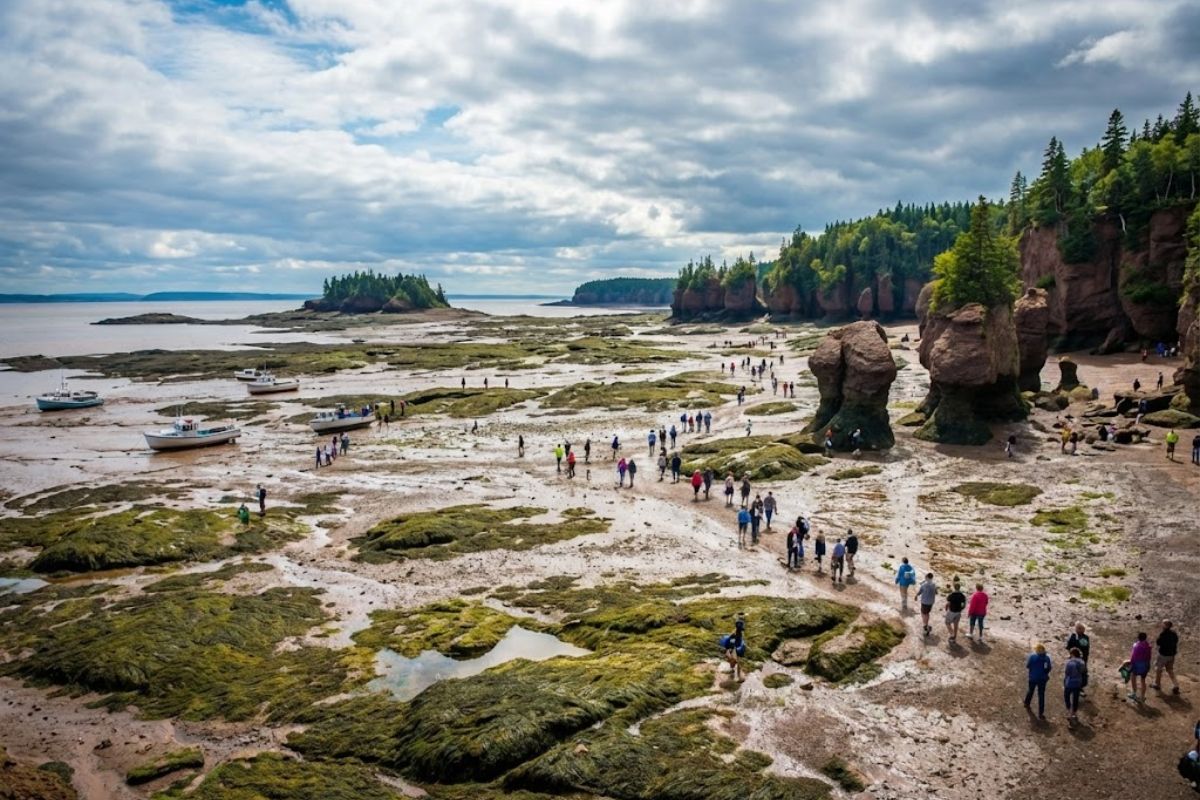


Island Linked to the World’s Largest Tidal Range Becomes an Attraction in the Bay of Fundy Between New Brunswick and Nova Scotia Where the Ocean Rises and Falls in Six-Hour Cycles Exposing Mudflats, Marine Life, Trails, and Safe Temporary Access.
The island that seems to disappear twice a day in Canada is at the center of a phenomenon that confuses those who see it for the first time: the ocean recedes with such force that it reveals mud, marine creatures, and trails on the ocean floor, allowing one to walk where there was water just a few hours earlier, in the Bay of Fundy.
This island and its surroundings have turned into an extreme and unpredictable natural spectacle for those visiting the region because the Bay of Fundy, located between the provinces of New Brunswick and Nova Scotia, has the largest tidal range in the world, with rises and falls averaging up to 16 meters.
Where the Island Is and Why the Bay of Fundy Became a Global Phenomenon

The Bay of Fundy is located on the Atlantic coast of North America, in Canada, between New Brunswick and Nova Scotia.
-
Italian researchers have detected what appears to be a second Sphinx buried under the sands of Egypt, and satellite scans reveal a gigantic underground megastructure hidden beneath the Giza Plateau for over 3,000 years.

-
There are 4,223 drums and 1,343 metal boxes concreted with 50-centimeter walls that store the radioactive waste from Cesium-137 in the worst radiological accident in Brazil, just 23 kilometers from Goiânia, with environmental monitoring every three months.

-
Giant Roman treasure found at the bottom of Lake Neuchâtel in Switzerland reveals an advanced trade system, circulation of goods, and armed escort in the Roman Empire about two thousand years ago.

-
He buried 1,200 old tires in the walls to build his own self-sufficient house in the mountains with glass bottles, rainwater, and an integrated greenhouse.

The location is important because it is precisely where the combination of geographic and oceanographic factors generates the largest tidal range on the planet.
What makes the place unique is the radical change in landscape over short intervals. At one moment, the water dominates everything, covering areas that appear permanently submerged.
Hours later, the water recedes, revealing a completely different scenario with exposed ground, mud, small channels, marks on the seabed, and an almost surreal feeling that the ocean “has gone away.”
It is in this context that the island became famous. It doesn’t disappear by magic, but because the sea level rises and falls so much that the human perception is of disappearing.
For tourists and nature lovers, this creates an attraction that is hard to compare with ordinary beaches, where the tide changes but does not completely redesign the landscape.
What It Means for the Sea to Recede Up to 16 Meters and Why This Changes Everything

The Bay of Fundy has an average water elevation and fall that can reach 16 meters.
This number is enormous when compared to most beaches around the world, where the variation is usually much smaller and, in many cases, goes almost unnoticed by those who do not pay attention.
In practice, receding 16 meters in height is not just “going down a bit.”
It is enough to expose extensive areas of the ocean floor, transforming what was sea into a large field of mud and sediments, with visible marine life, natural trails, and spaces that become temporary pathways for walking.
This recession gives rise to the most impressive visual effect: the visitor looks at an area that was once water and, hours later, sees a complete ground, being able to walk where there was only sea before.
In terms of experience, this causes a shock because the brain associates ocean with permanence, not with something that “opens space” so quickly.
The Funnel Shape and the Resonance Phenomenon that Amplifies the Tides
The explanation presented for this record amplitude lies in the shape and dynamics of the Bay of Fundy. The bay is funnel-shaped, which causes the ocean to be “channeled” in and out with high intensity.
This shape favors a resonance phenomenon, in which the movement of the water is amplified.
Instead of the sea just gently advancing and receding, it comes in and out forcefully, creating an elevation and fall effect that is much above the global average.
This combination of geography and oceanography transforms the Bay of Fundy into a natural system that seems to be always in motion, as if it were a gigantic lung breathing twice a day.
And that is what makes the island appear to disappear, reappear, and change its relationship with the mainland in just a few hours.
The Island that Disappears Twice a Day and the Sensation of Walking on the Ocean Floor
The described sensation is as if standing before an island that disappears twice a day, as the ocean repeatedly covers and uncovers the land in intense cycles.
When the tide is high, the water advances and occupies everything, hiding the ocean floor and creating the traditional coastal scene.
When the low tide comes in, the sea recedes and the ocean bed emerges.
At that moment, the island and its surroundings gain a different identity: mud appears, trails form on the seabed, and marine life becomes visible in many places.
The visitor sees what is normally hidden and, for a few hours, is able to walk in a space that seems forbidden by logic itself.
The most impressive detail is the time. This is not a phenomenon of days but of hours. The water recedes and returns on the same day, making the spectacle repeatable and, at the same time, unsettling because the visitor knows that the window is short and the sea will return.
Exposed Marine Life and What Appears When the Tide Is Low
When the tide is low, the exposed ground is filled with mud and local marine life. It is in this scenario that the visitor finds a variety that draws attention precisely because it becomes visible outdoors for a limited time.
The report highlights that it is possible to find marine creatures and observe details of the ocean bed, such as marks, small pathways, and trails formed by the water’s movement and the presence of organisms in the sediment.
The landscape is not just “empty” mud but a living environment, with signs of biological activity and relief forms that disappear when the tide returns.
This contrast creates a dual experience. First, the visitor sees the sea as the sea. Then, they see the sea as ground, with life and texture, realizing that there is an entire universe hidden beneath the water.
Burntcoat Head Park and the Experience of Descending to the Ocean Floor
A specific spot in Nova Scotia: Burntcoat Head Park. In certain areas of the park, there is a pathway that allows for trails and steps that lead directly to the ocean bed.
This structure helps transform the natural phenomenon into an accessible experience. The staircase takes the visitor down, as if they are entering another level of the landscape.
Down there, they walk on the “exposed ocean,” observe mud, trails, and marine life, and stay for a few hours until the water returns to reclaim the ground.
The idea of “walking on the ocean” is the main emotional trigger of the visit. It is a break from expectation: the place that normally imposes a limit becomes a pathway.
But this pathway is temporary, and the return of the sea serves as a constant reminder that nature is in control.
The Tide Cycle and the Natural Clock that Rules Everything
The locals are already aware of the tide calendar, which follows a well-defined cycle. In 24 hours, there are usually recorded two high tides and two low tides, with about six hours between each.
This rhythm creates predictability in the macro sense, but unpredictability for those who do not know.
For an unsuspecting visitor, the scene may seem “crazy,” as if the ocean decided to disappear out of nowhere. For those who keep track of the calendar, the cycle is routine.
It is this natural clock that makes the island seem to disappear twice a day. With each high tide, the water covers what was exposed.
With each low tide, the water recedes and returns the landscape of mud, trails, and marine creatures.
Tourists, Adventure, and the Breathtaking Photo Effect
The Bay of Fundy has become one of the favorite places for tourists and nature lovers precisely because it delivers an extreme visual experience.
The rapid change of scenery, the scale of the recession, and the possibility of being where water was just hours earlier create a perfect context for impactful photos.
The appeal is the sensation of “impossible.”
The visitor captures the contrast between high tide and receded tide, between a water horizon and a muddy bed that looks like a natural road.
This transforms into memory, into adventure, and into narrative because not every day can someone say they walked on the ocean floor.
Mud as a Real Risk and Why the Walk Requires Caution
Despite the beauty, the exposed ground requires attention.
The mud alters the body’s rhythm and can cause slips, falls, and difficulties in mobility.
For this reason, it is recommended to wear appropriate clothing for walking in the area, just to deal with the uneven and damp terrain.
This risk adds to another inherent element of the phenomenon: time.
Since the window is a few hours, misjudging the return time or underestimating the terrain could turn the walk into a problem.
The beauty of the place is accompanied by a simple rule: entering is easy, but leaving needs to be planned.
What Makes the Bay of Fundy an Extreme and Unpredictable Spectacle
The extreme lies in the record amplitude and the speed at which the scenery changes.
The unpredictable is the human sensation in the face of something too big to be controlled, even if the cycle is known to the locals.
The island disappears twice a day because the sea dominates and then returns the space, and the visitor experiences this “back and forth” as if it were a giant choreography of nature.
In just a few hours, the same area goes from ocean to ground and back to ocean, with mud, trails, and marine life entering and exiting the scene.
That is what transforms the Bay of Fundy into an extraordinary natural spectacle.
It is not just a beautiful place. It is a place that changes, surprises, and forces the visitor to respect the tidal clock and the power of the sea.
In your opinion, would you go to the Bay of Fundy to walk where there was water hours before, or would the combination of slippery mud and quickly returning sea be a limit to adventure?









Já estive lá. É um passeio maravilhoso, uma sensação única caminhar no “fundo” do mar, entrar em cavernas “submarinas” e olhar para cima e ver até onde o mar chegou poucas horas antes. É real o cuidado que se deve ter para não passar do tempo, pois o mar retorna rapidamente.