





 Portuguese
  English
  Spanish
 5 min of reading
  0 comments


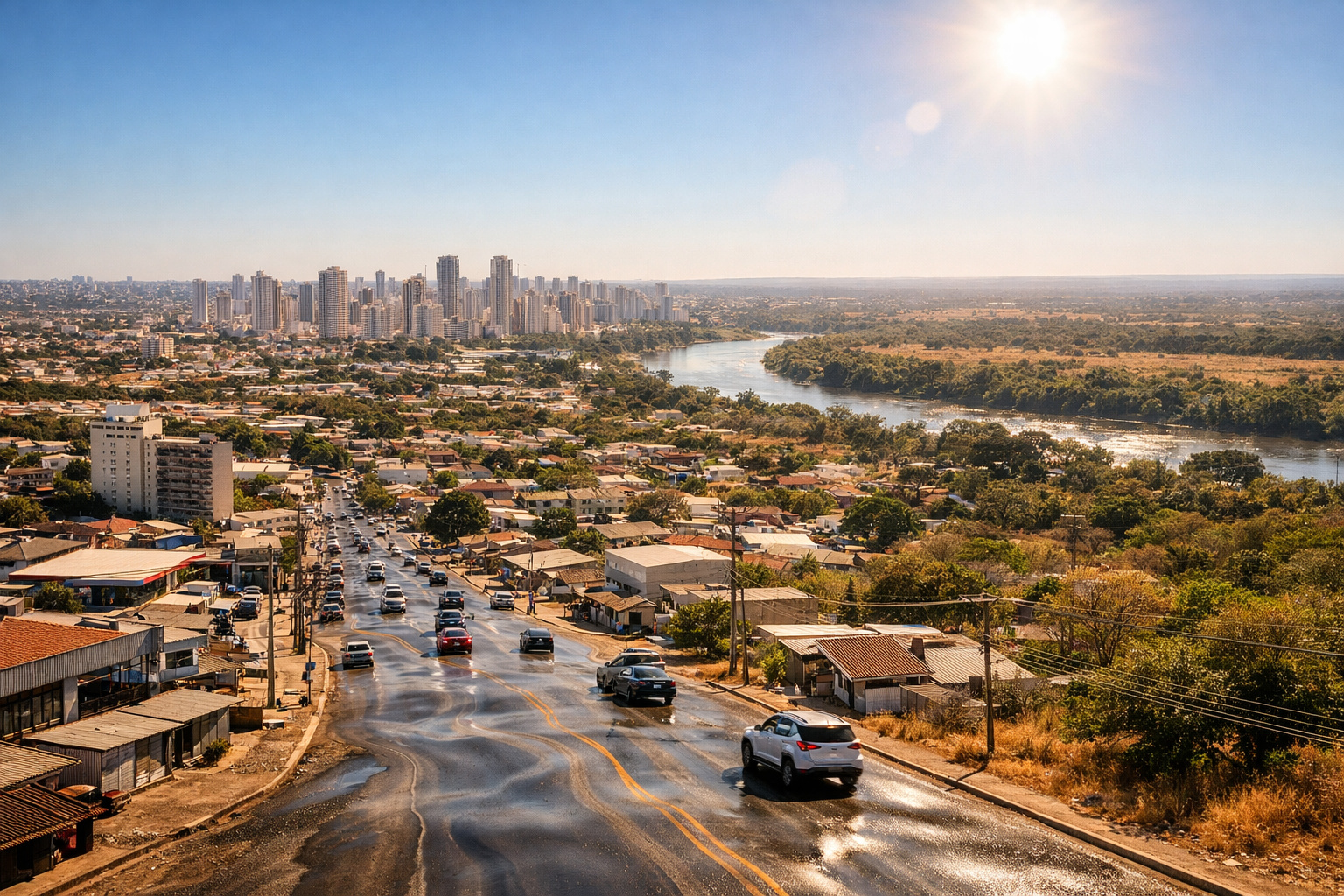
Strategic City in the Heart of the Continent Connects Biomes, History, and Extreme Climates That Shape Urban Daily Life
Capital of Mato Grosso, Cuiabá occupies a unique geographic position on the map of Brazil and South America. Historically known as the “Green City,” the capital of Mato Grosso is located at a rare convergence point where three of the country’s main biomes meet: the Cerrado, the Pantanal, and the Amazon. This condition transforms the city into a natural link between distinct ecosystems, as well as boosting its economic, environmental, and cultural relevance.
Furthermore, the strategic location makes Cuiabá an important logistical hub in Brazil’s Midwest. The city serves as a gateway to the Pantanal of Mato Grosso and Chapada dos Guimarães, two of the country’s most iconic natural destinations. At the same time, its economy is heavily influenced by agribusiness, a sector that generates billions and sustains much of the regional dynamics.
However, it is not just the geographic position that puts Cuiabá in the national spotlight. The extreme climate, with temperatures that frequently exceed 40 °C in the shade, has become part of the local identity and directly influences the way of life of the population.
-
Friends have been building a small “town” for 30 years to grow old together, with compact houses, a common area, nature surrounding it, and a collective life project designed for friendship, coexistence, and simplicity.

-
This small town in Germany created its own currency 24 years ago, today it circulates millions per year, is accepted in over 300 stores, and the German government allowed all of this to happen under one condition.

-
Curitiba is shrinking and is expected to lose 97,000 residents by 2050, while inland cities in Paraná such as Sarandi, Araucária, and Toledo are experiencing accelerated growth that is changing the entire state’s map.

-
Tourists were poisoned on Everest in a million-dollar fraud scheme involving helicopters that diverted over $19 million and shocked international authorities.


Why Cuiabá Is Considered the Heart of South America

The title of “Heart of South America” is not merely symbolic. It is based on well-defined technical and geographic criteria. Cuiabá is home to the so-called Geodesic Center of South America, a point considered equidistant from the Atlantic and Pacific Oceans. This historical location is marked by an obelisk situated in Praça Pascoal Moreira Cabral, in the city center.
In the early 20th century, Marshal Cândido Rondon officially confirmed this strategic geographic position, reinforcing the importance of Cuiabá in the continental context. Since then, the landmark has become a symbol of identity and pride for the people of Cuiabá, as well as an integral part of the urban historical heritage.
This information was disclosed through historical surveys and official geographic records, widely cited in academic publications and institutional materials regarding the occupation and cartography of Brazilian territory. According to studies from that time, the exact location of Cuiabá gives the city a unique role in the physical integration of South America.
This geographic factor, combined with the simultaneous presence of three biomes, explains why the capital of Mato Grosso is often cited as one of the most strategic points on the continent.
Extreme Heat, Melted Asphalt, and a Lifestyle Shaped by the Climate
If geography places Cuiabá at the center of the continent, the extreme climate sets the rhythm of the city. This is not an exaggeration or an urban legend: during periods of intense heat waves, thermometers have recorded temperatures exceeding 40 °C in the shade. On specific days, residents have even reported the melting of asphalt on urban roads, a phenomenon associated with a combination of intense heat, direct solar radiation, and low humidity.
For this reason, the nickname “Cuiabrasa” has become popular and widely accepted. The hot climate directly influences the daily habits of the population. Nighttime activities gain prominence, while the consumption of cold drinks, such as the traditional tereré, is part of the local culture. On the sidewalks, it is common to see groups of residents chatting at dusk when the temperature starts to drop.
Moreover, Cuiabá’s cuisine adapts to the climatic conditions and riverbank environment. Dishes like mojica de pintado and pacu assado are a constant presence in traditional fish markets along the Cuiabá River. This regional cuisine combines flavor, tradition, and the use of local ingredients, strengthening the city’s cultural identity.
According to data from Climatempo, during the dry season, relative humidity can reach levels similar to those of desert regions, dropping to around 15%. Therefore, authorities and specialists recommend constant hydration and heightened health precautions, especially during the more critical times of the year.
What to Do and Visit in Cuiabá Despite the High Temperatures


Even under intense heat, Cuiabá offers a variety of tourist attractions and public spaces that serve as cultural and climatic refuges. The city combines preserved colonial architecture with modern urban parks, essential for the leisure of both locals and visitors.
Among the main tourist spots, the following stand out:
- Mãe Bonifácia Park: a green area with trails amidst the native vegetation of the Cerrado, ideal for hiking and nature contact.
- Sesc Arsenal: located in a restored historic building, it offers cultural, sports, and educational programming for all ages.
- Church of Our Lady of the Rosary and Saint Benedict: a colonial construction that preserves the religious and cultural history of the city.
- Cuiabá River Museum: located along the Porto waterfront, with exhibitions on the historical formation of the capital and a privileged view of the river.
- Water Park: a modern space with dancing fountains and areas for nighttime walks, frequently visited by the local population.
Those planning to visit the capital can check specialized audiovisual content. The channel Estevam Pelo Mundo, for example, features videos in which Lucas Estevam shows what to do in Cuiabá, highlighting tourist attractions, cuisine, and city curiosities.
Population, Urban Growth, and Quality of Life
According to data from the Brazilian Institute of Geography and Statistics (IBGE), Cuiabá has a population exceeding 600 thousand inhabitants. This number solidifies the capital as one of the main urban centers in Brazil’s Midwest, with orderly growth and a diversified economy.
The municipality maintains a strong agribusiness presence, but also stands out in the commerce and services sectors. Urban infrastructure, coupled with the hospitality of the Cuiabá people, has attracted residents from other regions seeking economic opportunities and quality of life, even in the face of climatic challenges.
Ultimately, Cuiabá asserts itself as a strategic city for living or visiting. Its privileged geographic position, proximity to the Pantanal and Chapada dos Guimarães, and the unique coexistence among three biomes make the capital of Mato Grosso one of the most singular destinations in Brazil. For those seeking nature, history, culture, and an urban experience marked by extremes, the “Green City” continues to enchant residents and visitors.
Could you live in a city where three biomes meet, where the heat exceeds 40 °C in the shade and even the asphalt has melted — or would this climatic extreme be a limit for you?









Seja o primeiro a reagir!