





 Portuguese
  English
  Spanish
  6 min of reading
  5 comments


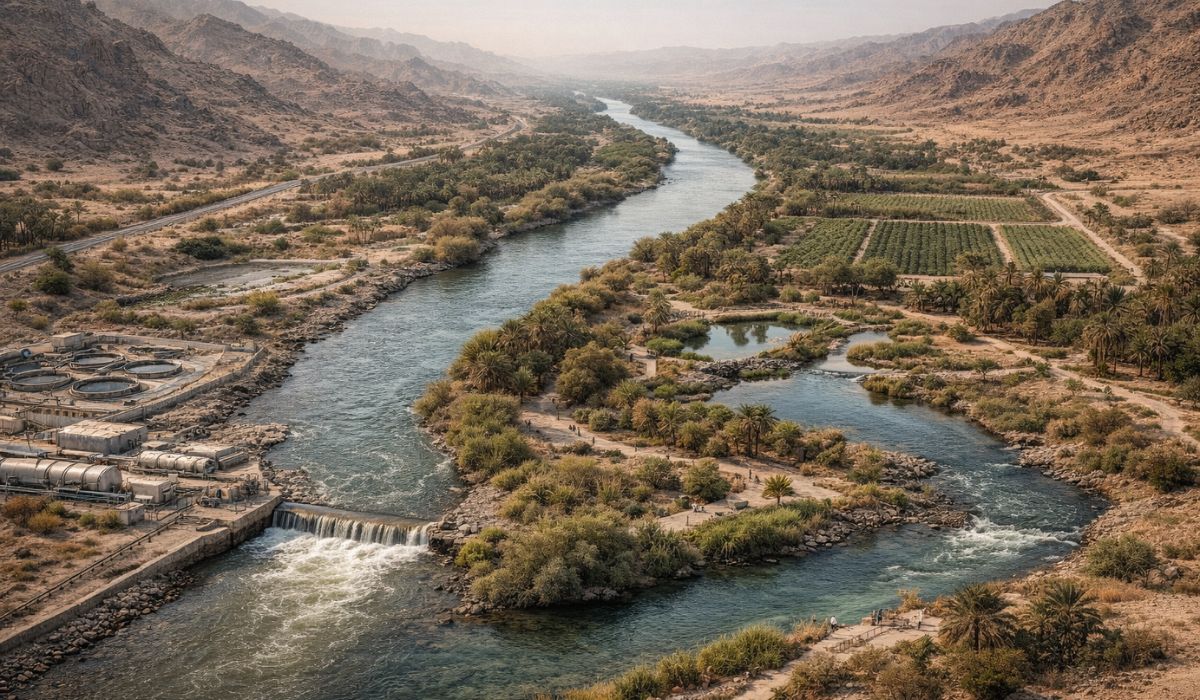


An Artificial Watercourse Supported By Treated Sewage Reuse Is Changing The Landscape In The Riyadh Region And Reignites The Debate On Hydraulic Mega Engineering, Water Quality, And Ecological Impacts In Arid Areas, With Special Attention To Wadi Hanifah.
Artificial River In Riyadh And Reuse Of Treated Water
An artificial watercourse that flows through the Riyadh region, the capital of Saudi Arabia, has established a nearly permanent flow over approximately 100 km in a desert climate, with contributions from treated sewage effluent.
Research and institutional descriptions relate the phenomenon to the Wadi Hanifah system, a valley approximately 120 km long that crosses the metropolitan area and has been included in an environmental rehabilitation program aimed at restoring water quality and reducing the impacts of urbanization.
The dynamics draw attention as they occur in a region where surface watercourses tend to be seasonal.
-
Motorola launched the Signature with a gold seal from DxOMark, tying with the iPhone 17 Pro in camera performance, Snapdragon 8 Gen 5 that surpassed 3 million in benchmarks, and a zoom that impresses even at night.

-
Satellites reveal beneath the Sahara a giant river buried for thousands of kilometers: study shows that the largest hot desert on the planet was once traversed by a river system comparable to the largest on Earth.

-
Scientists have captured something never seen in space: newly born stars are creating gigantic rings of light a thousand times larger than the distance between the Earth and the Sun, and this changes everything we knew about stellar birth.

-
Geologists find traces of a continent that disappeared 155 million years ago after separating from Australia and reveal that it did not sink, but broke into fragments scattered across Southeast Asia.

In cities with low availability of rivers and lakes, the reuse of treated wastewater appears in technical studies as one of the strategies to support non-potable uses, reduce pressure on water sources, and maintain flows in channels already altered by urban interventions.
Experts in water management observe that this type of solution depends on a continuous operational chain, from consumption to treatment and controlled return to the environment.
When there are failures in the process, the same infrastructure can concentrate sanitary and environmental risks, which makes monitoring and regulation a central part of the project.
Hydraulic Mega Engineering In The Desert And The Water Cycle
Hydraulic mega engineering encompasses large-scale works aimed at water management, such as dams, transpositions, canals, and reuse systems.
In arid regions, the goal described in studies is to reduce losses and reuse volumes previously discarded, integrating capture, consumption, treatment, and redistribution.
In the case of Riyadh, the wadi, a term used for intermittent watercourses in arid areas, has begun to coexist with changes caused by urban drainage, straightening, and effluent discharges.
Part of the academic literature records that some stretches have begun to present perennial flow, with contributions from treated wastewater discharges, in a context of intense urbanization.

This transformation occurs because urban flow, when treated and returned steadily, can approach volumes seen in medium-sized natural rivers.
At the same time, the fact that the flow depends on continuous infrastructure and operation makes the system considered by researchers to be sensitive to interruptions and quality variations.
Treatment Plant And Continuous Flow In The Canal
For an artificial river to be maintained, the design needs to go beyond simply opening a canal.
According to technical references on projects of this type, the planning begins with the capacity of the treatment plants and extends to the definition of the layout, retention points, and mechanisms that reduce abrupt flow fluctuations.
In Riyadh, studies mention the Manfouha Sewage Treatment Plant as one of the structures historically associated with the discharge of effluent into the Wadi Hanifah.
Analyses of local water management state that part of the stretch between the north of the city and the Al-Hair region to the south has begun to record more continuous flow, mentioning the discharge of tertiary treated effluent in the valley.
With this arrangement, the water that leaves domestic and industrial use ceases to be just a waste and becomes part of a monitored flow, returned to the environment.
This return, according to researchers, tends to modify local conditions on the banks, including increased humidity and expansion of aquatic surfaces in retention areas when planned in the design.
Continuity, however, does not automatically equate to safety.
In academic works on the subject, the stability of the system is treated as a result of regular operation, quality standards, and oversight to prevent the canal from becoming a receptor of loads outside the control of the treatment plants.
Wadi Hanifah And Environmental Rehabilitation In Riyadh
The Wadi Hanifah is described by local authorities as a valley that crosses Riyadh and its surroundings, extending about 120 km.
The environmental rehabilitation program for the wadi is presented as a set of interventions to restore the valley and its tributaries, with drainage works, reorganization of stretches, and measures aimed at improving environmental conditions along the corridor.

The scientific literature also portrays the area as a system that combines natural bodies of water and artificial structures like channels and ponds, supplied by different sources.
Among these sources, studies point to rain, surface runoff, and treated wastewater, which helps to explain why some segments maintain water for longer than under natural conditions.
In this context, the term “artificial river” is often used to describe the persistence of flow and the influence of human input.
Rather than a course created from scratch, it is an existing environment that has undergone alterations in its hydrological regime, with significant participation of reuse.
Ecological Impacts: Biodiversity, Vegetation, And Water Quality
The continuous presence of water in arid regions can trigger changes in the environmental dynamics of the banks.
According to studies on wetland corridors in dry environments, increased humidity tends to favor the emergence of spontaneous vegetation and attract fauna that finds food and shelter in the area, such as insects and birds.
This process, however, is accompanied by effects that require control.
Research on water quality in the Wadi Hanifah indicates that the system receives varied contributions, which can alter physical-chemical parameters over time.
Therefore, authors emphasize the need for monitoring to reduce problems associated with excess nutrients, algal blooms, and variations in dissolved oxygen, factors that can affect aquatic organisms.
Another concern discussed by specialists involves the difference between available water and water suitable for specific uses.
Even when advanced treatment is performed, studies indicate that variables such as dissolved salts, industrial waste, and accumulation in sediments can influence the final quality, reinforcing the importance of standards, audits, and data transparency.
Moreover, the introduction of fish into such channels is treated as an issue that requires authorization and environmental assessment.
Where it occurs, researchers often analyze effects on the food chain and local biodiversity, precisely to avoid unwanted impacts on an already sensitive system.
Irrigation With Reused Water And Non-Potable Uses
In arid regions, treated wastewater can be allocated for non-potable uses, including irrigation, provided that technical and sanitary standards are respected.
Studies on reuse indicate that adequacy depends on factors such as salinity, crop type, irrigation method, and human exposure control, in addition to monitoring routines.

When there is a continuous supply, areas near the watercourse may concentrate activities compatible with this type of water, such as seedling nurseries and maintenance of green spaces, as described in analyses of territorial management in reused environments.
Still, authors often emphasize that decisions vary according to local regulation and the quality parameters defined for each application.
Operational sustainability is also a factor to consider.
Researchers associate large-scale reuse projects with energy costs, the need for ongoing maintenance, and complexity of oversight, as any irregular discharge can compromise the system and elevate sanitary risks.
Environmental Risks And Water Reuse Governance
Rivers fed by treated effluent require stable operation to reduce the risk of water degradation along the canal.
In technical analyses, prolonged stoppages, treatment failures, and illegal connections are cited as factors that can lead to changes in quality, odors, and environmental problems along the banks.
Prolonged infiltration is also treated as a sensitive point in arid regions.
Studies on hydrological impacts indicate that over time, there may be changes in soil salinity and influence on groundwater, necessitating geological and hydrological monitoring, as well as parameters for surrounding use.
In summary, the experience of Riyadh is often cited as an example of how reuse can influence flow regimes in desert areas, with observable environmental effects conditioned by treatment quality and oversight.
For researchers, the central discussion revolves around governance: what indicators should be public, what standards need to be met, and how to ensure that a water corridor sustained by urban infrastructure remains within safe limits over the years.







Well done to everyone in this project!
So if you need a poop, is it the river, or what ?
Terrorismo climático em todo resultado bom que a engenhosidade humana cria, especialistas que tem 40, 50 anos de estudo do clima da terra que garantem que o mundo não aumentou 1% a temperatura o esquentar e esfriar é cíclico, via nos anos 70 os telejornais ja diziam que no ano 2000 as cidades litorâneas iriam desaparecer, lêdo engano, bill gates comprou uma mansão a beira mar de um casal de idosos com mêdo de perder a casa por um preço baixíssimo, esse calor provocado por geoengenharia tem enganado muitos