





 Portuguese
  English
  Spanish
  3 min of reading
  0 comments


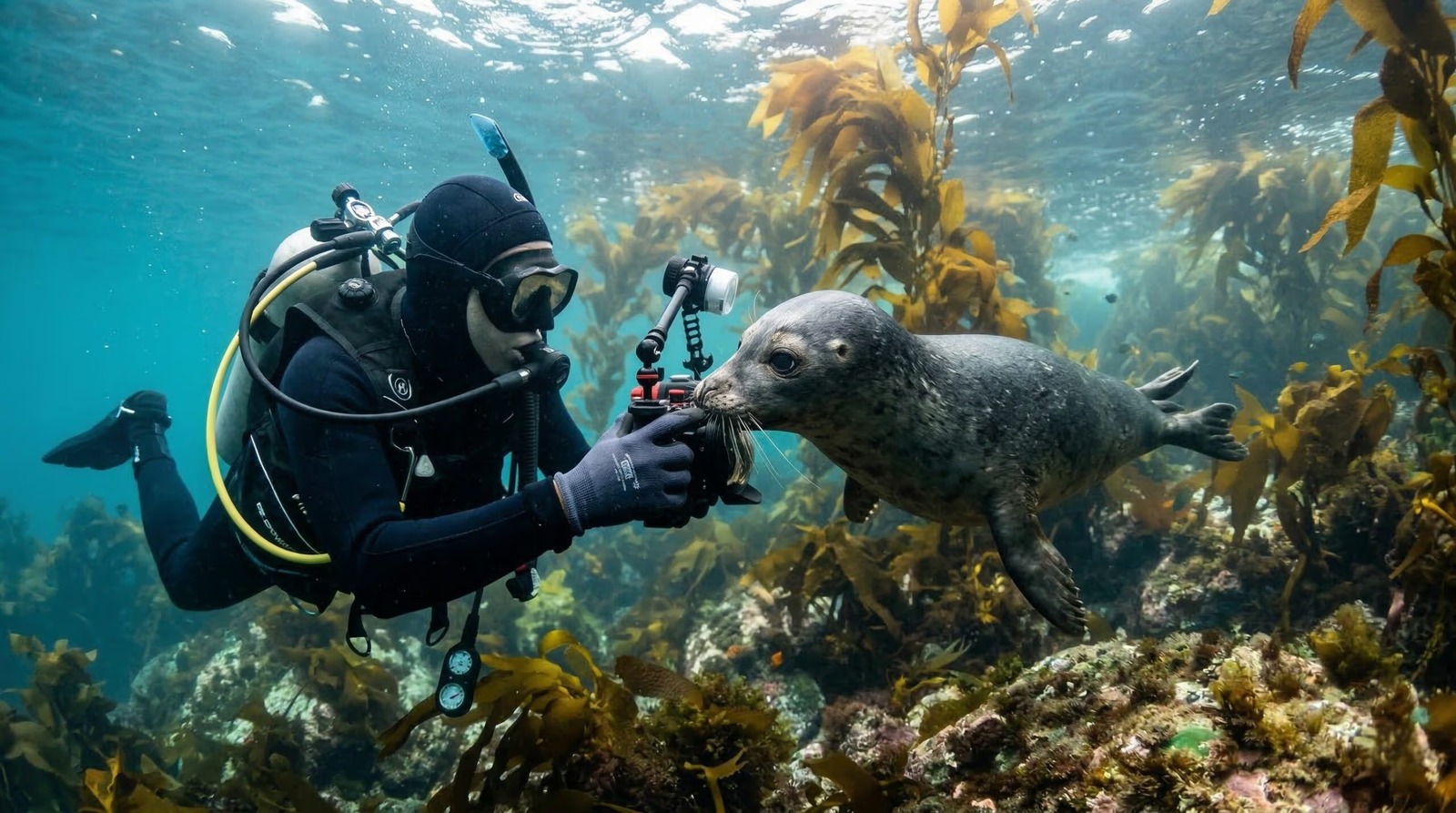
Diver Surrounded By Curious Seal In Laguna Beach And Video Reignites Debate On Encounters Between Humans And Marine Animals
An unusual encounter between a diver and a seal at the bottom of the sea in Laguna Beach, California, caught attention after the animal calmly approached, touched the equipment, and swam around her for minutes, highlighting the growing scientific interest in interactions between seals and humans in coastal areas.
Encounter Recorded At The Bottom Of The Sea, On The California Coast
Recent records made in Laguna Beach show a diver being approached by a seal that slowly approached in the sea.
The animal touched the diver’s equipment and remained circling around her for a few minutes, behavior that caught the attention of researchers and marine life observers.
-
More than one million North Americans were ordered to close their windows and stay indoors because the air in the southern United States became so toxic that pollution levels reached 18 times above the World Health Organization’s safety limit.

-
China has accumulated up to 1.4 billion barrels of oil in strategic reserves, invested 25 years in renewable energy, and purchased 80% of cheap Iranian oil: how Beijing has prepared for decades for the crisis that is now shaking the world.

-
A single lake holds 20% of the planet’s non-frozen freshwater and is also the deepest and oldest on Earth.

-
How 5,000 Indian dabbawalas manage to deliver around 200,000 lunchboxes a day in Mumbai for over 130 years using bicycles, crowded trains, and a manual system that continues to operate with impressive accuracy.

The approach reinforces discussions about how human presence in coastal regions can influence the exploratory behavior of these marine mammals.


Social Behavior Of Seals In Coastal Areas
The seal known as harbour seal occurs in temperate regions of the Northern Hemisphere and can be found in areas of the Pacific Ocean near California.
These animals alternate periods of rest on rocks and beaches with prolonged dives in search of food.
During these activities, they exhibit vocalizations, body postures, and physical contact among individuals, especially during times related to reproduction and nursing.
In coastal areas with tourism and diving, some seals show greater tolerance to human presence.
Their reaction may vary depending on age, past experiences, and the intensity of boat and human movement.
Interaction Between Seals And Divers At The Bottom Of The Sea
When encountering divers or swimmers, a seal may display curious behavior.
It approaches, sniffs the equipment, touches it with its whiskers, and observes human reactions.
In the Laguna Beach record, the animal repeatedly touched the diver and swam around her, behavior considered typical of social and sensory exploration.
Other episodes have also attracted researchers’ attention.
In 2014, in Antarctica, a seal brought a dead penguin to a diver, raising hypotheses about food offering or simple prey manipulation.
These cases illustrate the complexity of interactions between seals and humans, a topic of interest in marine ethology.
Recommendations For Encounters With Seals
Marine wildlife specialists advise that any interaction with a seal should be guided by the initiative of the animal itself.
Avoiding chases or deliberate attempts to touch helps reduce the risk of defensive bites.
It also decreases the possibility of lasting changes in the natural behavior of seals.
Among the most cited recommendations are to maintain a suitable distance, not feed the animals, and protect hoses and diving cables.
Another important point is to respect resting areas, especially where females with pups are present.
Scientific Curiosity About Seal Behavior
Researchers observe that the natural curiosity of the seal can be intensified in regions with coastal tourism and fishing.
The frequent presence of boats, divers, and fish disposal may stimulate exploratory behaviors.
Photos and videos of these encounters help scientists study communication, cognition, and adaptation of these animals to environments altered by human presence.
Following safety guidelines allows for less invasive encounters and enables new records to continue providing important data on seal behavior in different regions of the planet.
With information from O Antagonista.






Seja o primeiro a reagir!