





 Portuguese
  English
  Spanish
 7 min of reading
  2 comments


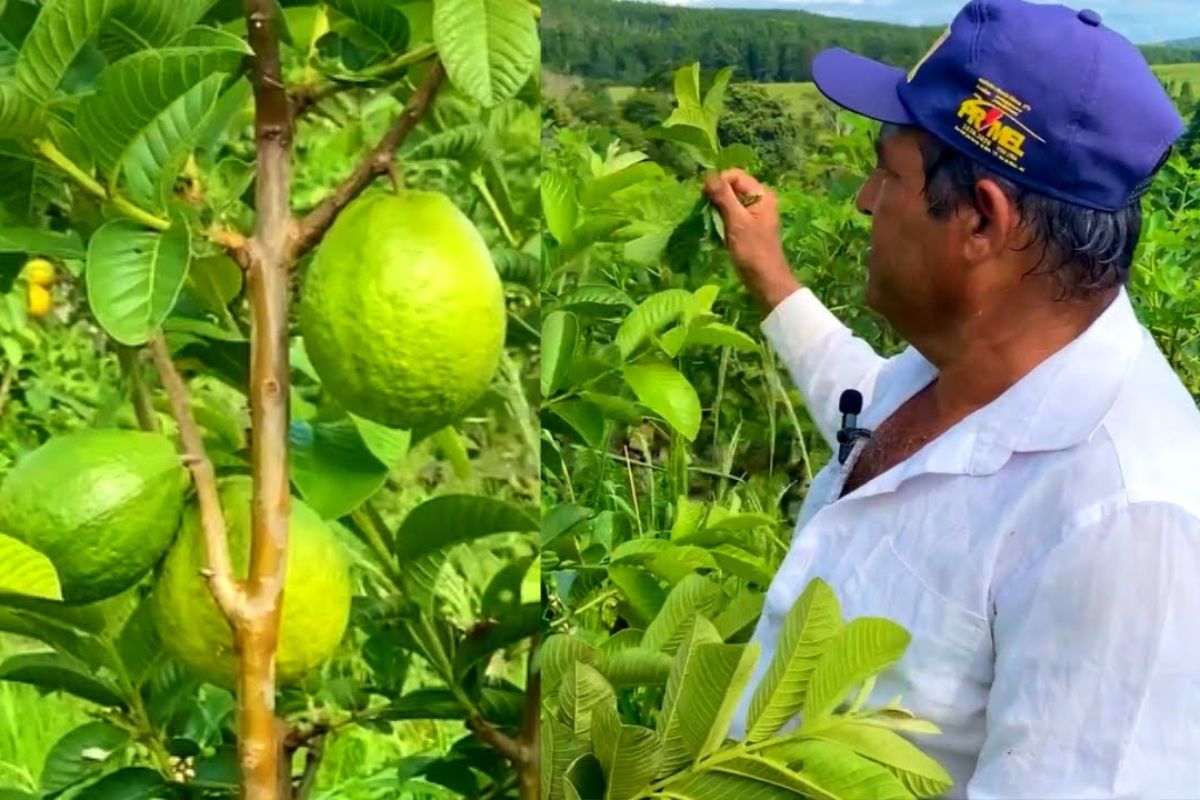


In Fortaleza de Minas, in South Minas Gerais, a Paraná producer rebuilt the orchard after frost, planted a few seedlings, and today harvests giant guavas all year round, sold by the kilo to customers and candy factories, with pruning, bud cleaning, irrigation by artesian well, and micro-sprinklers in the region
The case of the giant guavas occurs in Fortaleza de Minas, in South Minas Gerais, on the border with Pratápolis, where producer Milton maintains a property that has become a local reference for delivering fruit outside the standard and continuous harvesting. He claims that he lives solely from the income of the property, with harvests “running” throughout the year.
In the orchard, the giant guavas appear in succession, many of them so heavy that they nearly touch the ground and require management to prevent branch breakage. In Milton’s routine, bud cleaning, leaf removal, and branches close to the trunk, irrigation, and harvesting by ripeness come into play, with part of the production going to direct clients and to a candy factory.
Fortaleza de Minas, a Property on the Border and a Crop That Started from a Few Seedlings
The visit to the property starts early, with the report that Milton is from Paraná and now lives in Minas Gerais, in the city of Fortaleza de Minas, confirmed repeatedly during the conversation to avoid confusion with the name of the municipality.
-
Spain surprises the world by erecting 62 artificial dunes, mixing sand with natural remains of posidonia, and causing the structure to lose only 1.4% of its volume in 1 year.

-
With 16 Bulava missiles, improvements in acoustic stealth, and a design focused on silent patrols, Russia’s nuclear submarine was born to ensure Moscow’s invisible retaliation and has become one of the pillars of its maritime strength.

-
‘Populous’ city in Rio among the worst in Brazil in national ranking and exposes silent development crisis.
-
Couple buys house in the South Zone of São Paulo, opens a hidden door in the garage, and finds a secret wine cellar with dozens of old wines forgotten since the 1970s.

The area is close to Pratápolis, and the environment is described as rural, with diversified crops and a strong presence of agricultural activities around it.
Milton shares that the current crop started from a simple beginning: he was “bringing some seedlings” and planting “the good little plants” of guava.
The orchard went through a frost event that killed the old crop, forcing regrowth and reconstruction of the production system until it reached its current stage, where the giant guavas appear as the main product.
Giant Guavas: Real Weights, Off-the-Curve Standards, and Breaking Branches
In the midst of the plants, the size catches attention right from the first contact.
One fruit is estimated at about 600 grams, with the measurement made by direct comparison with the hand, and the producer claims there are guavas of 1 kg in the area.
In another excerpt, it’s indicated that two guavas exceed one kilo, reinforcing the scale of the fruits.
The weight brings practical consequences: branches break.
The description is straightforward, without rural romance: when the plant carries too much, if not supported, it breaks, and this is seen as a recurring situation “in the city,” attributed to the weight of the fruits.
At various points in the orchard, the giant guavas are so loaded that they touch branches, droop down, and require constant attention to prevent losses.
Harvesting All Year Round and Selling by the Kilo: Constant Inflow of Income in the Field

The harvest is described as continuous.
The repeated phrase is that “it keeps rolling and keeps harvesting, it doesn’t stop,” with production all year round.
This is presented as the basis of income: with giant guavas coming out at different times, the producer claims to keep “a little money” throughout the whole year, without depending on a single annual harvest window.
The mentioned commercialization model is simple and straightforward: the guava is sold by the kilo.
In addition to customers who buy for consumption, there is mention of sales to the candy factory, with people taking fruit “for candy.”
This detail also appears when discussing picking ripe fruits to meet the demand of a buyer who was “wanting,” necessitating a specific harvest to separate fruit at the right point.
Simple But Disciplined Management: Cleaning, Bud Removal, and Pruning to Sustain the Giant Guavas
When asked about the “secret” of the giant guavas, Milton says that “there’s not much secret,” but describes a set of practices that, when combined, create a standard of management.
He talks about removing little shoots, doing cleaning and removing “the first leaves” when the plant has guava, in addition to bud removal, keeping the trunk area cleaner.
The management appears as constant work, more akin to routine than sophisticated technique.
The conversation highlights that the producer works while speaking, harvesting, observing ripeness, and keeping the crop in order.
The visible result is the high load per plant and the repetition of large fruits, with the giant guavas becoming the signature of the property.
Irrigation and Crop Structure: Micro Sprinkler and Artesian Well Water
In the midst of the orchard, the reference to irrigation arises, mentioning micro sprinklers and the use of artesian well water.
Irrigation is described as part of the functioning of the system, mainly in the context of strong sun and the need to maintain production regularity.
This detail helps explain the constancy of the harvest, as the giant guavas are linked to an orchard that does not depend solely on rain.
The producer is seen operating in the area, and the conversation reinforces that the property has active management, with regular intervention and monitoring of the orchard.
Planting Rows, Shade, and the Decision Not to Consort Too Much
In one section, the width between one row and another is observed as about two and a half meters, raising the idea of planting something in between.
The response leans towards caution: “it increases the work,” “too much weeds grow,” especially in rainy season, and consorting is not always recommended depending on the crop.
The comparison arises with figs, where the assessment is that “it’s not good to plant” other things together and “it’s better to let it be.”
In the case of guava, there’s a comment that “the guava provides more shade,” which also influences management decisions in the interior of the crop.
All of this relates to the reality of maintaining giant guavas without losing control of the area.
Other Crops on the Same Property: 28 kg Pumpkin, Jiló, and Fig Crop
The property does not solely depend on guava.
Along the way, there is a 28 kg pumpkin, shown as a fruit from an area of compost and hot sun.
There is mention of selling pumpkins and a connection to a candy factory, indicating a logic of utilizing regional marketing channels.
Jiló also comes up, described as something planted “at the feet,” and the fig crop gets its own block: the plants are shown side by side, with reference that they have been there for about seven years, with pruning, “green pruning,” removal of shoots, and cleaning.
For the harvesting point of the fig, the criteria mentioned are practical: size and color, based on the experience of someone who “has been dealing with this for many years.”
Climate, Weeds, and Daily Maintenance: Mower, Rain, and Occasional Losses
The dialogue carries the weight of routine.
Rain is described as a “solution” and “problem” at the same time, as it helps but causes weeds to grow, requiring mowing.
The mower appears as a tool in the area, with the producer mowing and keeping the crop traversable.
There is also mention of hail rain, associated with damages and differences between parts of the crop, in addition to a comment about guavas starting to spoil at a certain point, reinforcing that continuous production requires constant harvesting to reduce losses.
In the background, the giant guavas do not appear as an agricultural miracle, but rather as a result of daily management repetition.
A Production That Sustains the Family and Keeps a Client Base in the Region
Milton claims that the income comes from the property and that “it’s enough to live on,” precisely because the guava comes out year-round and there is clientele.
He mentions that “he sells well,” with recurring buyers and constant demand, along with sales to candy.
The visitor’s perception is that “you don’t see guava like this” often, suggesting that the large size becomes a market differential.
The regional context also appears: south of Minas, a productive interior, rural neighbors, and the idea that those who come to the region often don’t want to leave, due to its tranquility and the hospitable profile described during the conversation.
At the center are the giant guavas, which sustain the family and organize the routine of the property.
Would you have the courage to bet on giant guavas as your main income in the field, or would you prefer to diversify from the start to avoid depending on a single fruit all year round?








Deve se trabalhar com a demanda da região se está dando certo continua ter muitas diversidades de frutas demanda mão de obra tempo gasto. A vantagem e que tendo frutas verduras legumes o ano todo dar pra alimentar a família e os animais vai das condições financeiras do agricultor.
Diversificação é bem melhor.