





 Português
  Inglês
  Espanhol
  6 min de leitura
  0 comentários


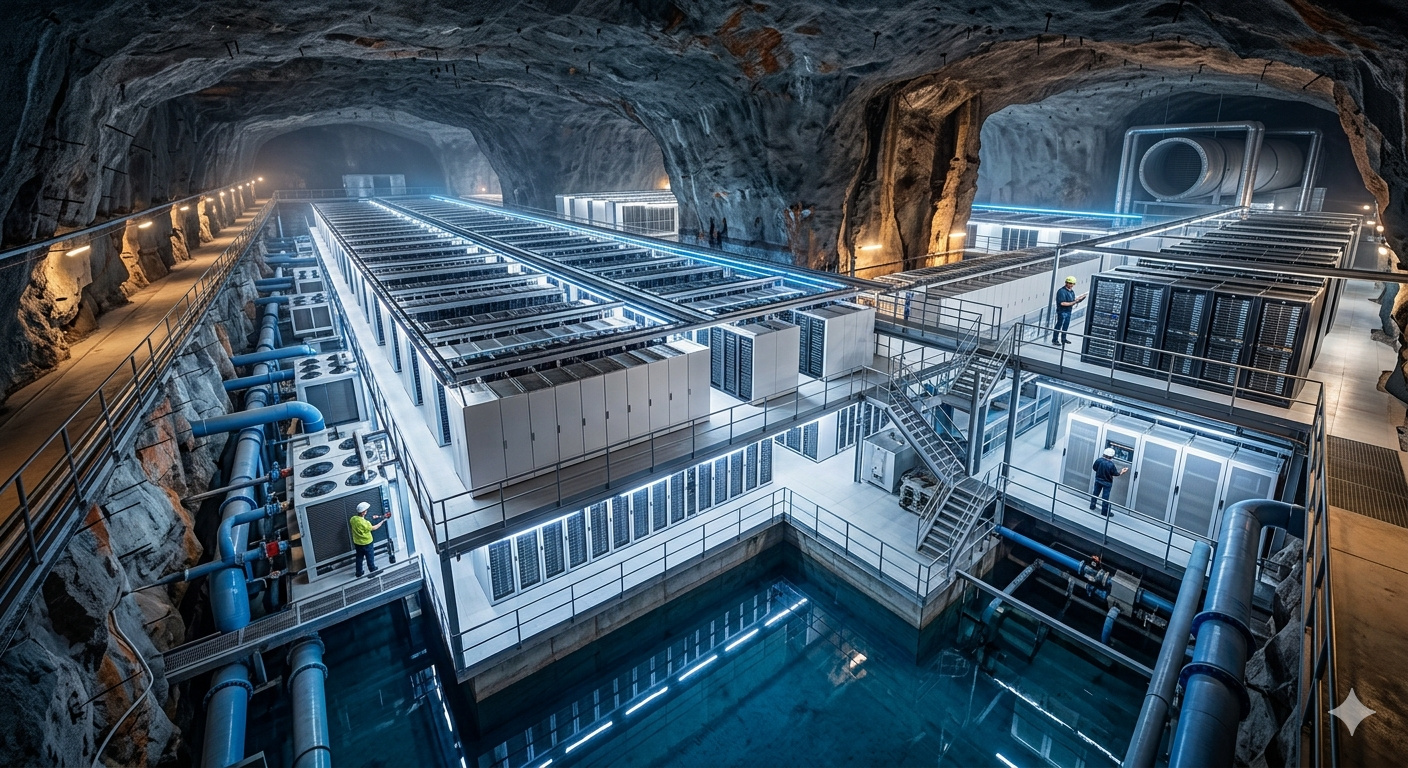
Data center in Norway uses fjord water to cool servers, operates inside a mine, and reaches extreme levels of energy efficiency.
To reach the Lefdal Mine Datacenter, visitors need to take a propeller plane from Oslo to Sandane, cross a fjord by ferry, and drive along a winding road by the water’s edge to a rock face on the western coast of Norway. There is nothing visible from the outside except for an entrance carved into the mountain, a steel door, and the silent landscape of the fjord.What is inside is one of the most unusual high-performance computing facilities in the world: a 120,000 square meter data center spread across six levels inside an old olivine mine, operating 60 meters below sea level, 700 meters deep within the mountain, cooled by the cold water of a 565-meter-deep fjord.
According to an analysis by the specialized magazine Data Center Dynamics, the complex is described by the employees themselves as a “data center city” with 14 “streets” connected by a 300-meter-long “avenue” on the third level. In June 2025, the Norwegian government inaugurated Olivia, the country’s most powerful national supercomputer, named after the mineral that had been extracted from those same galleries for decades.
How an olivine mine in Norway transformed into a high-efficiency underground data center
The story of Lefdal begins in 1971, when North Cape Minerals started extracting olivine in the region of Nordfjordeid, in Vestland county, in the northwest of Norway. At the time, the mine was considered the largest in the world in its segment.
-
44 minutes on the cosmic scale: mysterious object in the Milky Way emits simultaneous radio and X-ray signals and raises an intriguing question about what is really happening in deep space.
-
Omoda & Jaecoo and AiMOGA Robotics advance in industrial artificial intelligence with a strategic debut in Thailand and a focus on advanced automation.

-
In a scenario of rising fuel prices, Omoda & Jaecoo enhance value for consumers with a range of up to 1,200 km, energy efficiency, and a new concept of worry-free mobility.

-
Cement battery inspired by chemistry used since Ancient Rome resurfaces as a rechargeable thermal solution and enters the competition for the future of industrial heat.


Olivine is a greenish-yellow mineral primarily used in the steel industry as a refining agent in blast furnaces. In its purest and clearest form, it is known as peridot, a semi-precious stone valued in jewelry.
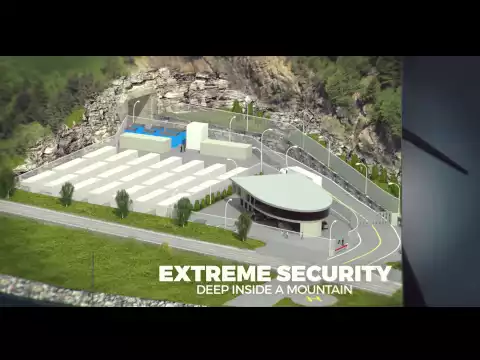

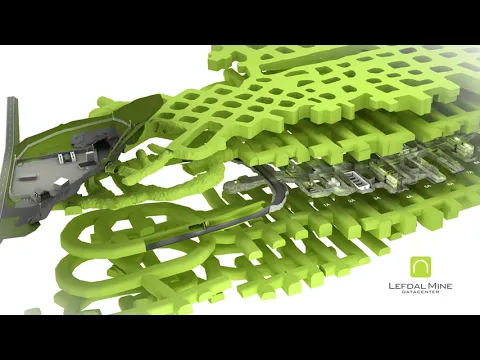
Extraction continued for nearly four decades until it was halted in 2009. What remained was a network of tunnels carved into solid rock, with structural capacity to support heavy loads, a stable internal temperature of about 9 °C year-round, and immediate access to a deep fjord just a few meters from the entrance.
The former mine foreman and his son were the first to identify the potential of that space. The geographical isolation, cold rock, controlled humidity, and available internal volume, which made mining unsustainable, were exactly the ideal characteristics for a high-energy-efficiency data center. The Lefdal Mine Datacenter began operations in 2017, with IBM among its first clients.
The structural problem of data centers: heat, energy consumption, and thermal inefficiency
To understand why building a data center inside a mountain makes sense, one must understand the main bottleneck in the technology industry: heat.
Servers generate heat as an inevitable byproduct of data processing. In conventional facilities, a significant portion of the energy consumed is dedicated solely to cooling the equipment. A high-performance rack can require between 7 and 8 kilowatts just for thermal dissipation.

This means that for every megawatt of installed computing capacity, a traditional data center needs an almost equivalent structure just for cooling, typically based on chillers, compressors, and cooling towers that consume additional energy and use large volumes of water.
The efficiency of this system is measured by the PUE index (Power Usage Effectiveness). A PUE of 2.0 indicates that half of the total energy is consumed by auxiliary systems. The best data centers in the world operate close to 1.2. Lefdal operates between 1.08 and 1.15, with configurations approaching 1.05, representing a 30% to 40% reduction in energy consumption compared to conventional facilities.
Cooling with fjord water: the technical differential that reduces energy consumption
The central element of this efficiency lies in the direct use of the local geography. The data center uses cold water from the adjacent fjord, drawn at a constant temperature of approximately 8 °C.
This water is conducted to heat exchangers installed inside the mine, where it transfers thermal energy to a closed circuit of freshwater that circulates through the servers. The system avoids direct contact between saltwater and equipment, ensuring operational safety.
The most relevant detail is the position of the facility. Since the data center is 60 meters below sea level, the fjord water arrives naturally pressurized by gravity, eliminating the need for high-power pumps. This factor drastically reduces the energy consumption of the cooling system.
The result is a WUE (Water Usage Effectiveness) close to zero, as the closed circuit does not require constant water replenishment. Thus, each rack can operate with densities of up to 50 kilowatts in air cooling, a value up to six times higher than the standard for conventional data centers.
Olivia: the supercomputer inaugurated in the mine in 2025
In June 2025, the complex received the Olivia supercomputer, operated by the state-owned Sigma2. The system was developed by HPE in partnership with Nvidia and AMD, with an investment of approximately 225 million Norwegian kroner.
The Olivia features 304 Nvidia GH200 GPUs and 64,512 AMD Epyc Turin CPU cores. Its computing capacity reaches 13.2 petaflops of sustained performance and up to 16.8 petaflops peak, equivalent to more than 16 quadrillion operations per second.
With a consumption of only 219 kilowatts, the system achieved efficiency of 60.27 gigaflops per watt, positioning it among the 25 most efficient supercomputers in the world in the Green500 ranking.
Initial tests indicated that CPU tasks are more than twice as fast compared to the previous Betzy system, while GPU tasks exceed the performance of the European supercomputer Lumi by up to three times.
The internal structure: an underground city of servers
The third level of Lefdal houses most of the operational infrastructure. The space is organized into 14 parallel corridors connected by a central avenue 300 meters long.
Each data room is about 12 meters high and receives pre-fabricated modules transported by ship to the coast and installed in the galleries in less than eight hours. Companies can operate in dedicated or shared environments, supporting different architectures, including immersion cooling.
The reuse of the mine’s structure reduced construction costs by 40% to 50%, eliminating the need for large civil works and taking advantage of the natural thermal insulation of the rock. Externally, the facility is virtually invisible, with no visual or industrial impact on the fjord landscape.
Renewable energy and low-carbon operation
All the energy used by Lefdal comes from local renewable sources, including four glacial hydroelectric plants and two wind farms. The proximity of the sources reduces transmission losses and increases the overall efficiency of the system.
Norway generates approximately 97% of its electricity from renewable sources, allowing the data center to operate with very low carbon emissions, being classified as carbon neutral.
Heat reuse: the project that could heat millions of salmon
The next step in the operation involves reusing the heat generated by the servers. Instead of dissipating this energy, the plan is to use it to heat water intended for salmon farming in the region.
The project aims to use the waste heat to raise the water temperature, accelerating fish growth and allowing the production of up to six million salmon per year without additional energy consumption.
The model follows a circular logic: the data center uses cold water from the fjord, returns heated water for productive use, and integrates biogas and fertilizer generation systems from aquaculture waste. According to Lefdal’s management, a 60-megawatt data center could replace up to 12 megawatts of energy consumption from aquaculture, creating a potentially carbon-negative system.
The Nordfjordeid mine began by extracting olivine from the rock. Today, it extracts energy efficiency from the space it left behind.
The Lefdal Mine Datacenter represents a convergence of geography, engineering, and technology, where natural characteristics such as depth, temperature, and access to water — are used to solve one of the greatest challenges of modern computing.
The logic is not futuristic. It is already in operation. And it shows that the next generation of digital infrastructure may not be built above ground, but within it.




Seja o primeiro a reagir!