





 Portuguese
  English
  Spanish
  2 min of reading
  1 comment


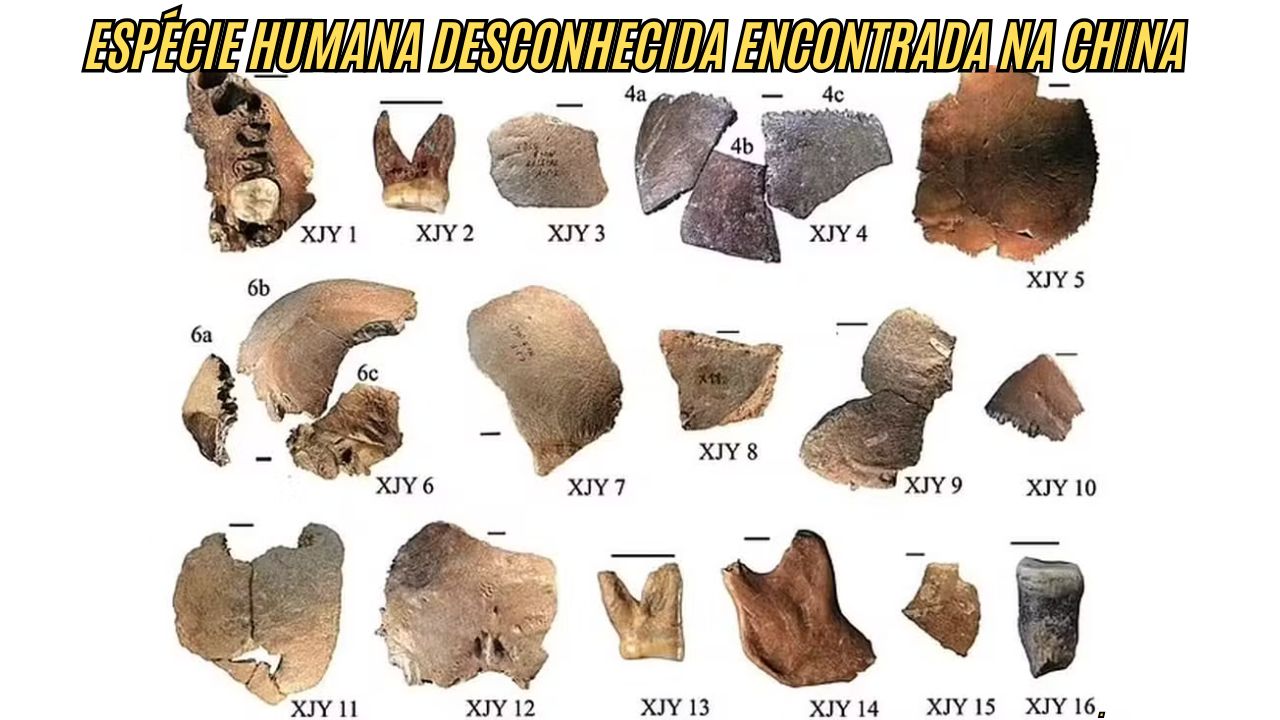


The New Discovery in China of Fossils Dated to 300,000 Years Suggests the Existence of an Unknown Human Species Called Homo Juluensis.
A new discovery in China is shaking the foundations of human evolution history. Scientists revealed that fossils found in the 1970s in the regions of Xujiayao and Xuchang, in Henan province, may belong to an unknown human species. Named Homo Juluensis, this possible new lineage of hominids was presented in a research published in the journal Nature Communications.
The fossils, dated to about 300,000 years, include bone fragments from 16 individuals. Their physical features are striking: broad skulls, large heads, and impressively large teeth. These primitive humans appear to have lived in small groups and used stone tools and animal bones for hunting. Among the foods consumed, wild horses were on the menu, and animal skins were used for protection against the extreme cold of the time.
Denisovans May Be Reclassified as Part of This New Discovery in China

The study also highlights a fascinating discovery: the teeth of Homo Juluensis exhibit surprising similarities to those of Denisovans, another extinct lineage of hominids, whose fossils were found in Siberia. For Christopher J. Bae, the research leader and professor at the University of Hawaii, this raises the possibility that Denisovans may actually be reclassified as part of this new discovery in China. However, he emphasizes that more investigations are needed to confirm this hypothesis.
-
Friends have been building a small “town” for 30 years to grow old together, with compact houses, a common area, nature surrounding it, and a collective life project designed for friendship, coexistence, and simplicity.

-
This small town in Germany created its own currency 24 years ago, today it circulates millions per year, is accepted in over 300 stores, and the German government allowed all of this to happen under one condition.

-
Curitiba is shrinking and is expected to lose 97,000 residents by 2050, while inland cities in Paraná such as Sarandi, Araucária, and Toledo are experiencing accelerated growth that is changing the entire state’s map.

-
Tourists were poisoned on Everest in a million-dollar fraud scheme involving helicopters that diverted over $19 million and shocked international authorities.


Does Not Mean They Were More Intelligent
Despite the skulls of this unknown human species being larger than those of Neanderthals and even Homo sapiens, with volumes between 1,700 and 1,800 cubic centimeters, scientists warn that this does not mean they were more intelligent. The species likely disappeared about 50,000 years ago, possibly merging with Homo sapiens who arrived in the region.
This new discovery in China promises to rewrite important chapters of evolutionary history while opening new questions about how our ancestors interacted and survived in such a challenging world.










Monumental descoberta!!!