





 Portuguese
  English
  Spanish
  6 min of reading
  2 comments


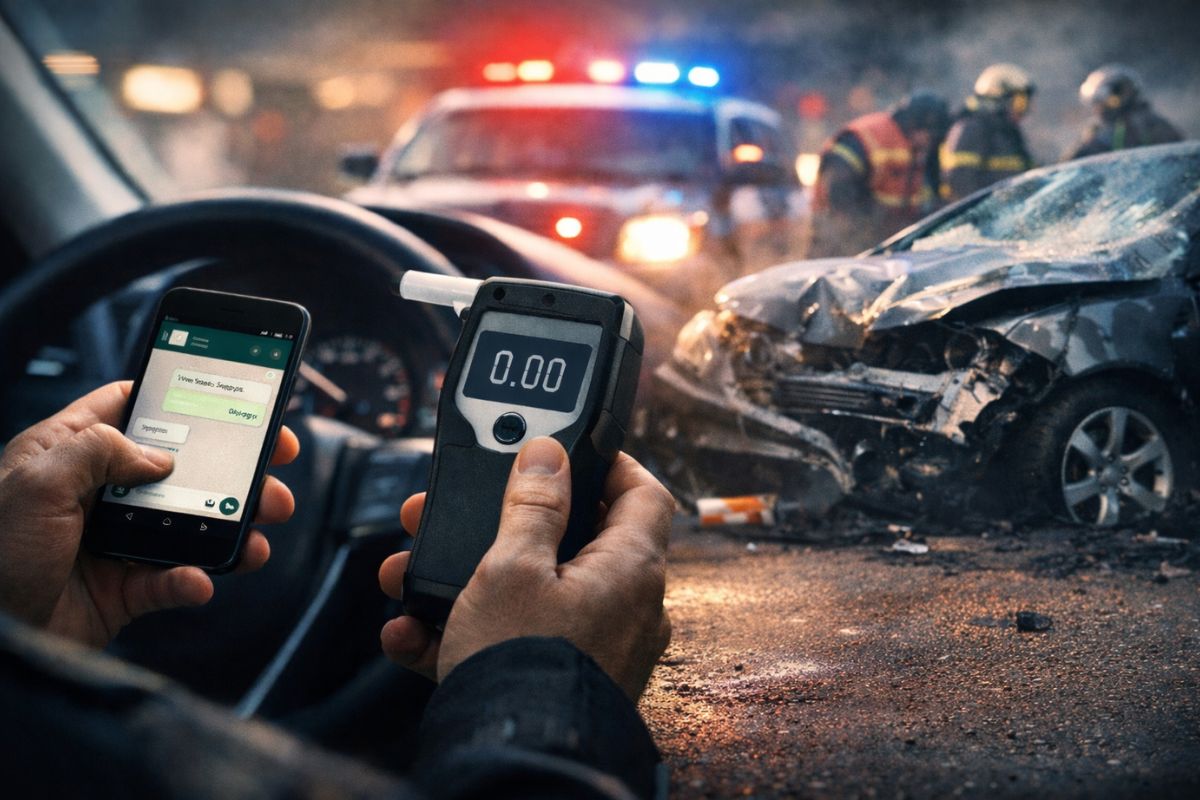


The New Traffic Law of 2026 Tightens the Fight Against Cell Phones While Driving, Treats Distraction as Equivalent to Drunk Driving, Raises Fines, Maintains Seven Points on the Driver’s License, and Warns That a Single Message on WhatsApp Can Result in a Fatal Accident in Seconds in Any Brazilian City or Highway
Starting from the new traffic law of 2026, the use of a cell phone while driving ceases to be treated as mere negligence and is classified with the same severity as driving under the influence of alcohol. The goal is clear: to create zero tolerance for any handling of a phone with the vehicle in motion, directly reducing collisions and pedestrian deaths caused by distracted drivers.
The change consolidates a trend that gained strength in 2025, when road safety data confirmed cell phones as one of the main risk factors on Brazilian streets and highways. The new traffic law of 2026 transforms messages on WhatsApp, quick calls, and checking social media into actions treated as serious violations of the duty to pay attention, with heavy fines and a record of seven points on the National Driver’s License.
Why Cell Phones Became the Central Target of the New Traffic Law of 2026
The use of cell phones while driving is today one of the most critical problems of road safety.
-
Banco do Brasil sues famous influencer for million-dollar debt and intensifies debate on delinquency, risks of seizure, and direct impact on Gkay’s credibility.

-
The Senate approves a bill that criminalizes misogyny, hatred, or aversion towards women, and includes the crime in the Racism Law with a penalty of up to 5 years.

-
Chamber Approves Bill That Allows Pepper Spray for Women Over 16 and Imposes Strict Rules for Purchase, Possession, and Use as Self-Defense
-
Chamber Approves Law to Combat Leucaena, Fast-Growing Plant That Dominates Land and Threatens Native Species in Various Regions of the Country


The driver who insists on keeping the pocket television on the dashboard combines three types of distraction at the same time: visual, because their eyes are off the road; manual, because their hands are off the wheel; and cognitive, because it diverts their reasoning to another task.
Traffic safety research shows that, when sending or reading messages while in motion, reaction time decreases significantly.
In just a few seconds of not looking ahead, the vehicle travels dozens of meters “on autopilot.”
It is precisely this dynamic that leads the new traffic law of 2026 to equate cell phone distraction with the impact of drunk driving, considering that any delay in reaction at high speeds can be enough to hit another car, a pedestrian, or a defenseless cyclist.
What the New Traffic Law of 2026 Changes in Fines and Points
From a legal standpoint, the new traffic law of 2026 does not create the problem but hardens the response.
The Traffic Code already classifies holding or handling a cell phone with the vehicle in motion as a serious infraction, with a fine of about R$ 293.47 and a record of seven points on the driver’s license.
With the new traffic law of 2026, this conduct is explicitly treated as a risky situation equivalent to driving drunk, reinforcing campaigns, enforcement, and a stricter interpretation by traffic authorities.
Holding the device in one hand, typing messages, scrolling the screen, or driving with the cell phone resting between the shoulder and the ear all fall under the same zero-tolerance policy.
Talking on the phone using the device or headphones, even though classified under different infraction categories, remains under the same umbrella: any use that diverts attention from the task of driving is subject to citation, regardless of the excuse presented during the approach.
Cell Phone Use in Congestion, Red Lights, or Long Lines is Prohibited
A common question is whether the new traffic law of 2026 relaxes cell phone use in congestion, at red lights, or in long lines.
The answer is straightforward: no.
The legislation makes it clear that driving includes all moments when the vehicle is on the road, even if momentarily stopped.
This means that handling a cell phone at a red light, in a toll line, or in traffic jams continues to be an infraction, as the driver needs to monitor the surroundings to restart safely.
With the new traffic law of 2026, a quick message in line is seen as part of the same risky behavior, capable of causing sudden starts, delays in departure when the light turns green, and a lack of awareness of approaching pedestrians and motorcyclists.
Concrete Risks That Justify Zero Tolerance for Cell Phones
Among the risk factors associated with using a phone while driving, some are repeated in studies and police reports and help explain the tough stance adopted by the new traffic law of 2026:
Loss of attention to the road: a fixed gaze on the screen prevents reading signs, traffic lights, lanes, and the movements of other vehicles.
Increased reaction time: in emergency situations, the driver takes longer to notice danger and begin braking.
Trajectory deviations: poorly executed minor corrections can lead the car into another lane or onto the shoulder.
Unexpected braking: switching between traffic and the screen generates accelerations and sudden stops, catching following drivers off guard.
Chronic underestimation of risk: many drivers believe they have control of the situation and maintain the habit even after campaigns and citations.
The new traffic law of 2026 starts from the premise that there is no message urgent enough to justify putting a crowded bus, a family in another car, or a cyclist next to you at the risk of death in a few seconds of distraction.
How to Adapt Your Habits and Comply with the New Traffic Law of 2026 in Practice
From a behavioral standpoint, the new traffic law of 2026 will only be effective if accompanied by a change in routine.
Road safety experts suggest simple measures that do not rely on advanced technology but on basic discipline when getting into the car.
One of them is to activate blocking or silent modes whenever the vehicle is in motion, reducing the temptation to check notifications.
Another is to plan routes and navigation apps before starting the journey, avoiding touching the device during the trip. Answering calls should only occur with the vehicle parked in a safe location, never stopped in line or on the shoulder of a highway.
Even hands-free systems and screen mirroring should be used with caution.
The new traffic law of 2026 does not prohibit embedded technology but reinforces that no resource justifies diverting eyes, hands, or attention from the primary task of driving safely.
On short journeys, the rule is even simpler: arrive at the destination first, respond to messages later.
Education, Enforcement, and Cultural Change in Traffic
The new traffic law of 2026 does not rely solely on radars and checkpoints.
It requires a combination of enforcement, educational campaigns, and a cultural shift similar to the one that occurred when drunk driving became the target of stricter rules.
Schools, transportation companies, mobility apps, and public campaigns can reinforce the message that using a cell phone while driving is not a sign of productivity, but of recklessness, with direct impacts on real lives and not just on fines on paper.
At the same time, traffic authorities will gain a more robust legal basis to intensify operations and treat cell phones as a priority risk factor in accident statistics.
The message of the new traffic law of 2026 is explicit: either the driver chooses the screen, or they choose to drive safely, never both at the same time.
In light of this new traffic law of 2026, which equates the use of cell phones to drunk driving and toughens the penalties for texting while driving, do you think people will finally change their habits or will they only take the risk seriously after the first heavy fine on their driver’s license?








A lei só serve para motoristas de carro, pq os motoboys são livres pra pilotar motos e ao mesmo tempo olhar o celular. É direto isso. Nem sei como enxergam a tela do celular com a luz do sol.
Demorou! As madames e os motoboys dirigem olhando para a tela do celular, colocando todos em risco. Nos sinais de trânsito se a gente nao buzina o trânsito fica parado por conta dos motoristas navegando nas redes sociais.