





 Portuguese
  English
  Spanish
  4 min of reading
  3 comments


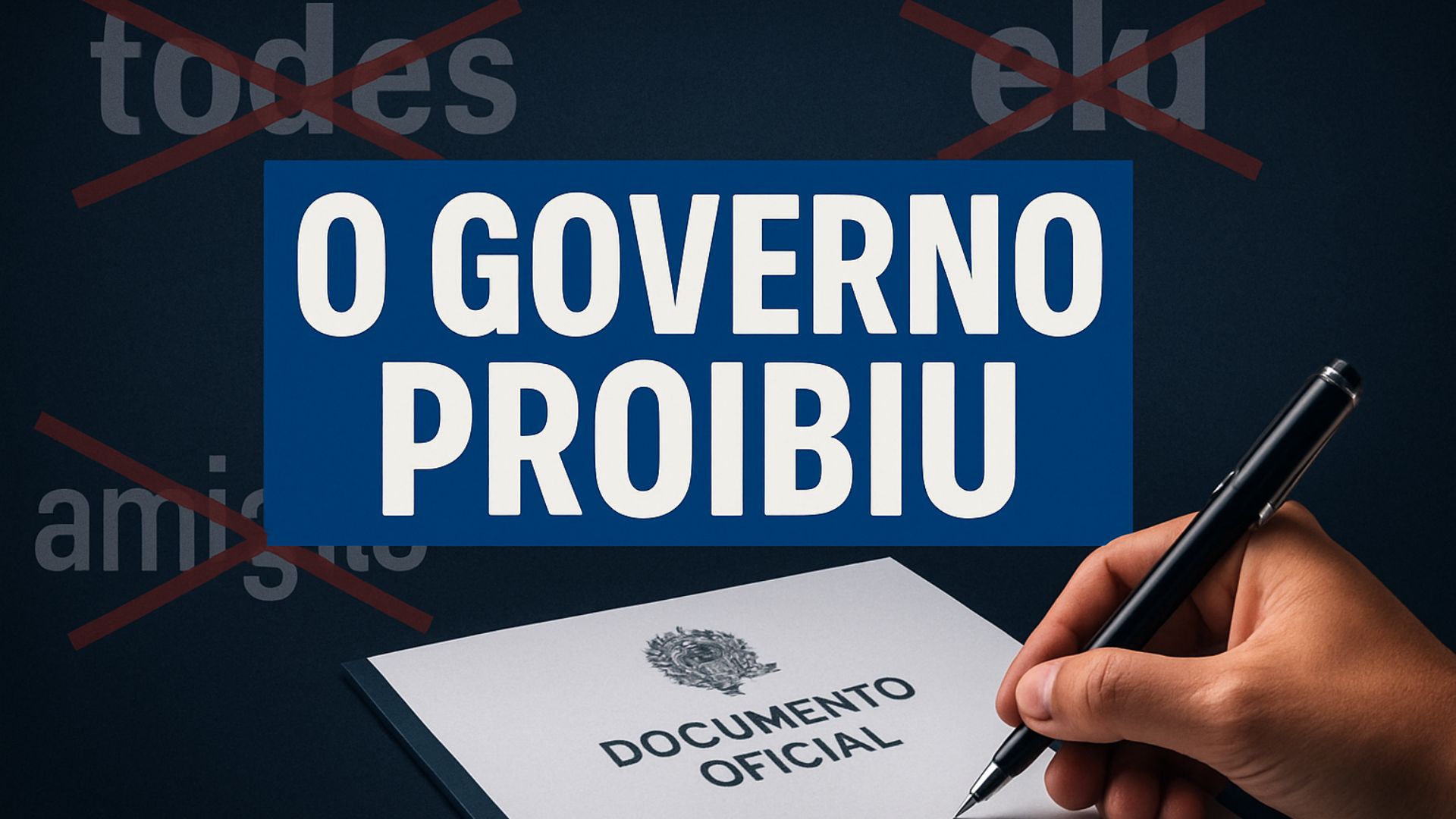


New Federal Legislation Establishes Unprecedented Rules for Official Communication, Reinforces the Use of Standard Language, and Expands the Simple Language Policy While Prohibiting Expressions Associated with Neutral Language in Public Agencies.
President Luiz Inácio Lula da Silva signed Law No. 15.263/2025, which creates the National Simple Language Policy and prohibits the use of forms associated with neutral language in public administration at all levels of government.
The rule applies to the Union, States, Federal District, and municipalities and was published in the Official Gazette of the Union on November 17, 2025.
The law mandates that public agencies and entities use the standard Portuguese language, linked to the Orthographic Vocabulary of the Portuguese Language and the current Orthographic Agreement.
-
It’s not São Paulo or Rio de Janeiro, but a state in the South completely dominated the happiness ranking of Brazil with three cities in the top positions and excellent scores above 8.9.

-
Brazil on the radar of the space race in Latin America: what NASA’s new phase with the Artemis Program reveals about Alcântara, the best address in the world for rocket launches.

-
How a 100 m² rudder controls ships carrying 21 thousand containers and reveals the part that keeps the giants of the sea on course.

-
China is using colored laser lights on highways to prevent drivers from falling asleep at the wheel, and the technology acts as a silent alarm that is already reducing fatal accidents due to fatigue.

In practice, the wording rules out the use of expressions like “todes,” pronouns like “elu,” and other graphic and pronominal forms that are not found in the official references of the language.
Although the text does not cite specific examples, the central provision prohibits “new forms of gender and number inflection of words in the Portuguese language”, which includes constructions associated with neutral language in administrative acts, forms, ordinances, and other official documents.
H3: Rules of Simple Language in Public Administration
The legislation establishes that simple language shall become a mandatory guideline in the communication of public authorities with the population.
The rule applies to texts published on electronic sites, forms, letters, contracts, notices, internal communications, and other pieces of institutional communication.
Among the guidelines provided, the law mandates the use of short sentences, a preference for direct order, and the adoption of active voice whenever possible.
The text advises against using very long or convoluted sentences.
It also recommends not replacing verbs with nouns, eliminating redundancies, and avoiding imprecise or excessively technical terms, unless they are explained in the document itself.
The objective is to ensure that anyone can “find, understand, and use” the information issued by the State, reducing doubts and barriers to understanding.
H3: How the Law Progressed in Congress
The new rule originates from Bill 6,256/2019, presented by Federal Deputy Erika Kokay.
In the Senate, the text was reported by Senator Alessandro Vieira and approved in March 2025.
During the processing, lawmakers included amendments that expanded the scope of the policy.
One of them made it explicit that simple language will be mandatory in all branches and at all federal levels.
Another change defined that all people with disabilities are the target audience for simple language, not just those with intellectual disabilities.
The prohibition of neutral language was included through a parliamentary amendment.
Deputy Junio Amaral, the author of the proposal, argued that neutral language would be a recent form of inflection and that it would not fulfill the purpose of promoting clear and objective communication in public service.
H3: How the Prohibition Applies to the Official Use of the Language
With the sanction, public agencies are prohibited from adopting graphic or pronominal marks that are not included in the normative instruments of the Portuguese language.
This covers expressions like “todes,” “amigxs,” the use of “@” or “x” instead of vowels, and pronouns like “elu” in official texts.
The restriction also applies to digital content, such as publications on institutional websites, transparency portals, public applications, press releases, official campaigns, and competition notices.
The law preserves the technical and scientific use of the language in research, academic publications, and strictly scientific materials.
The text does not interfere with how citizens express themselves in their individual manifestations or on social media, limiting itself to the institutional communication of the State.
H3: Judgments of the Supreme Court and the History of Prohibitions
Before the approval of the federal norm, the debate on neutral language had already reached city councils and legislative assemblies.
Various projects attempted to prohibit its use in schools and local official documents.
This movement was blocked by the Supreme Court in different rulings.
In February 2023, the Supreme Court declared unconstitutional the law of the State of Rondônia that prohibited neutral language in educational material and competitions.
The Court understood that educational guidelines are a privative competence of the Union.
In February 2025, the Court invalidated the law of the municipality of Uberlândia that banned the use of neutral language and “non-binary dialect” in schools and official documents.
The ministers reaffirmed that municipalities cannot legislate on guidelines for national education.
The decisions consolidated the understanding that state and municipal laws cannot impose general rules on the use of neutral language in education.
With the new federal law, the Union now sets parameters for the official communication of public administration, without interfering with the pedagogical content applied in the classroom.
H3: What Is Neutral Language and Why Does It Divide Opinions
Movements advocating for neutral or non-binary language gained traction in Brazil starting in the 1990s, with greater visibility in recent years.
The proposal aims to make language less sexist by replacing traditional gender markers with forms that include men, women, and non-binary people.
Expressions like “todes,” the use of “x” or “@” in place of vowels, and pronouns like “elu” are some examples spread on social media and in academic environments.
Proponents argue that these solutions enhance symbolic recognition and reduce the feeling of erasure of identities not aligned with the masculine-feminine binary.
Critics argue that such forms are not part of normative grammar, may hinder readability on screens, and compromise the accessibility of screen readers used by visually impaired individuals.
With the enactment of Law No. 15.263/2025, the use of neutral language is removed from the institutional communication of the State, but remains in public debate.
How do you assess the impact of this change on the relationship between government and society?







Esse tipo de neologismo e ABSURDO! NÃO é ideia do atual presidente porque ele não tem conhecimento de português para decidir sobre a língua pátria.
os cornos inventam e depois quer destruir. sao todos filhos de ****
achei. ótimo,essas pessoas que querem mudanças naquilo que esta fora do contexto intelectual que aceitem e se adequar e enquadre ,eles querem nos obriga a aceitar esse absurdo de linguagem. inventando moda.