





 Portuguese
  English
  Spanish
  4 min of reading
  0 comments


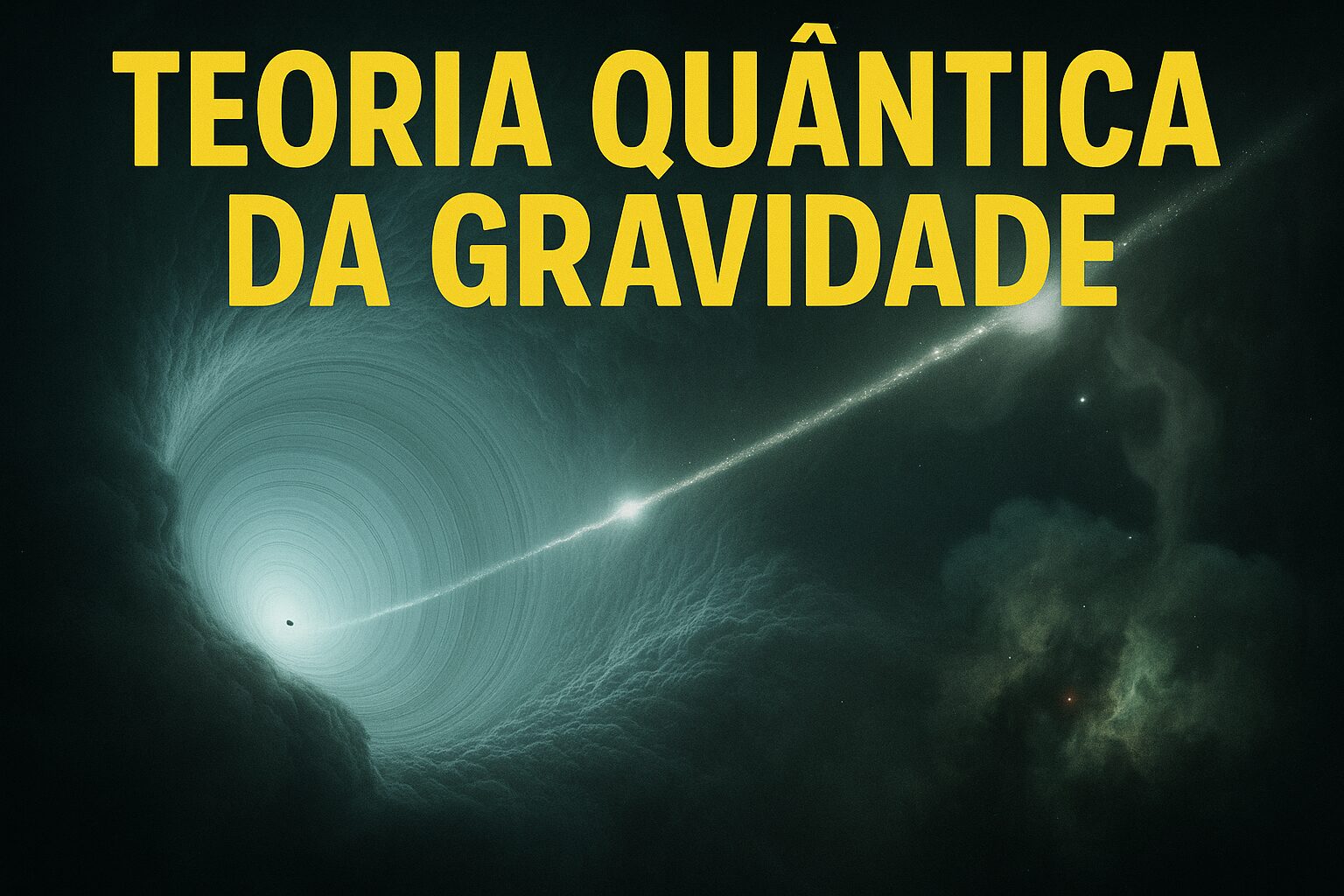
Researchers from Aalto University Propose a New Quantum Theory of Gravity That Could Unite the Fundamental Forces of Nature and Help Explain Phenomena Like Black Holes and the Big Bang.
A new theoretical proposal could change how we understand the Universe. Researchers from Aalto University, in Finland, announced the development of a quantum theory of gravity compatible with the Standard Model of particle physics.
The proposal, published in Reports on Progress in Physics, aims to unify concepts that have so far been considered incompatible.
The Search for a Theory of Everything
Modern physics still faces obstacles in fully explaining how the Universe works.
-
With a cost per shot close to zero, the DragonFire laser could change naval warfare in 2027 and provide British ships with nearly unlimited defense against drones.

-
A British startup creates tires that generate electricity in electric vehicles when passing over potholes, speed bumps, and cracks.

-
Scientists have created robots made with living cells that have their own nervous system, swim on their own, explore the environment, and self-organize without any genetic engineering, and now they want to do the same with human cells.

-
Students create a solar-powered ambulance that operates without a plug, without fuel, and still keeps medical equipment running in remote areas.

One of the main challenges is to create a theory that unifies quantum field theory, which describes the world of subatomic particles, with general relativity, which explains gravity and celestial bodies.
The new proposal attempts to address this issue.
According to Dr. Mikko Partanen, one of the study’s authors, if the theory evolves into a complete quantum field formulation of gravity, it could, in the future, provide answers to complex problems such as the singularities present in black holes and the Big Bang.
This unifying theory is known among scientists as the “Theory of Everything.”
It could explain phenomena that are still poorly understood, such as why there is more matter than antimatter in the observable Universe.
Gravity as a Gauge Theory
The researchers’ starting point was to reinterpret gravity as a gauge field, a theoretical structure where forces are described by fields that mediate interactions between particles.
“The most well-known gauge field is the electromagnetic field,” stated Dr. Jukka Tulkki. “When electrically charged particles interact, they do so through the electromagnetic field.”
Following this logic, particles with energy should interact through the gravitational field.
The researchers’ idea was to build a gauge theory with symmetries similar to those of the Standard Model, rather than following the traditional approach based on the space-time symmetry of general relativity.
Incompatibilities Have Persisted for Decades
The Standard Model successfully describes three of the four fundamental forces of nature: electromagnetic, weak nuclear, and strong nuclear. However, it does not include gravity.
General relativity, proposed by Einstein, is a classical theory.
It works very well to describe massive bodies and gravitational effects on larger scales, but it cannot handle the quantum realm.
“Without this theory, physicists cannot reconcile our two most powerful theories,” emphasized Partanen.
Both have already been confirmed through high-precision experiments, but they remain incompatible with each other.
Challenges in Renormalization
The proposal from Aalto University scientists employs a mathematical procedure called renormalization. This process is used to eliminate the infinities that arise in quantum theory calculations.
“So far, we have shown that this works for so-called first-order terms,” Tulkki said. But he warns that this verification needs to be extended. “If renormalization does not work for higher-order terms, you will get infinite results.”
Therefore, the next step in the research will be to demonstrate that the method is valid for all levels of calculation. “We still need to do a complete proof, but we believe it is very likely that we will succeed, ” the researcher stated.
The Interest of the Research
The interest in quantum gravity goes beyond the theoretical field.
Understanding how it works could reveal what happens under extreme conditions in the Universe, such as near black holes or in the initial moments of the Big Bang.
“These are the conditions where existing theories in physics stop working,” explained Partanen. For him, the work has great potential. “Just as the understanding of gravity paved the way for the creation of GPS, this theory could open new horizons.”
Caution and Continuity
Despite the enthusiasm, the authors themselves emphasize that the work is still in progress. The proposed theory needs to be tested and validated by other scientists.
“Forever fascinated by the big questions of physics, we discovered a new symmetry-based approach to the theory of gravity,” said Partanen. “There are still challenges ahead, but with time and effort, we hope to overcome them.”
For now, the scientific community is watching closely. “I can’t say when, but I can say that we will know much more about this in a few years,” concluded the physicist.








Seja o primeiro a reagir!