





 Portuguese
  English
  Spanish
  4 min of reading
  4 comments


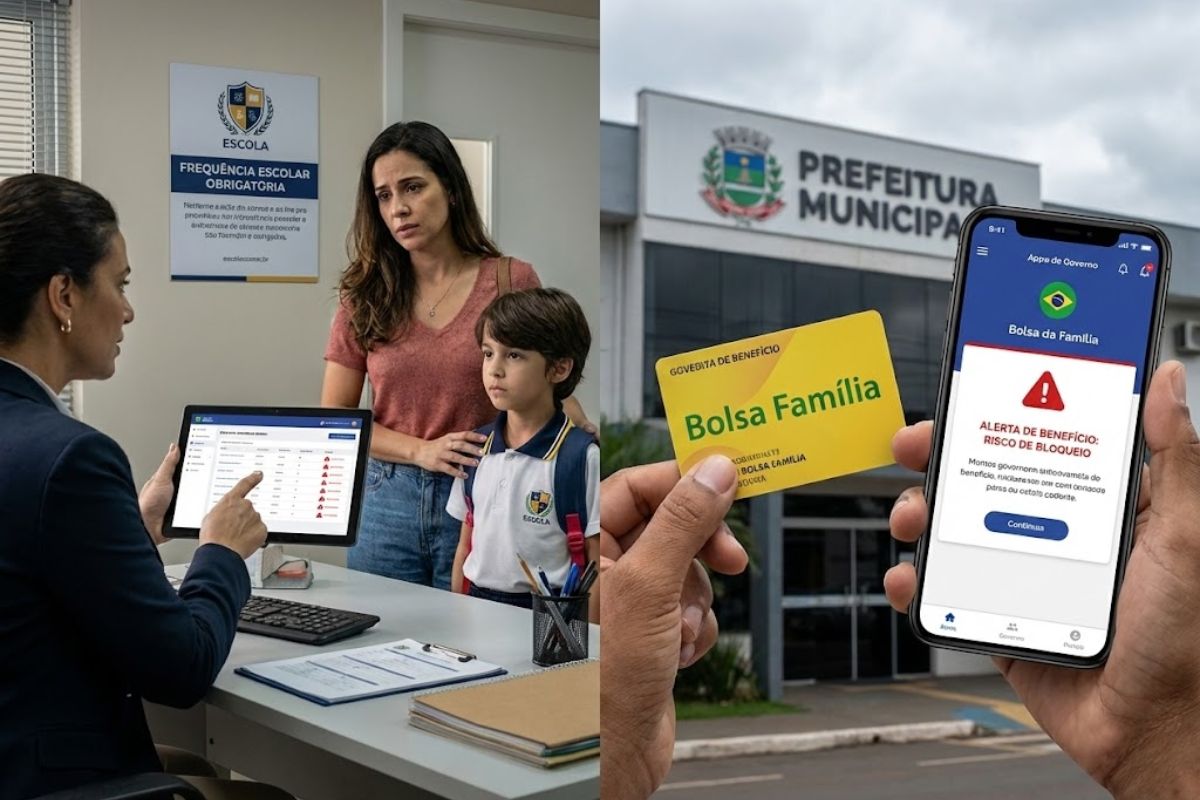


Interministerial Ordinance MEC/MDS No. 12/2025, Published on December 18, 2025, Tightens Educational Monitoring of Bolsa Família, Requires Schools to Record Bimonthly Attendance in the Attendance System, Expects Minimums of 60% and 75% Attendance and Pressures Families Who Do Not Justify Their Children’s Absences and Risk Losing Benefits.
On December 18, 2025, the Ministry of Education and the Ministry of Development and Social Assistance, Family and Hunger Combat published the Interministerial Ordinance MEC/MDS No. 12/2025, which redefines the school monitoring of beneficiaries of the Bolsa Família throughout the country.
The measure details guidelines, responsibilities, standards, and flows for schools, municipalities, states, and the Union to monitor the attendance of poor students, turning each absence into an official data point that may impact the maintenance, blocking, or reviewing the benefits paid to the most vulnerable families.
What Changes with the New Bolsa Família Ordinance
The Interministerial Ordinance MEC/MDS No. 12/2025 formalizes how the educational monitoring of students receiving the Bolsa Família will be conducted.
-
Oil surged to $115 a barrel due to the war in the Middle East, and diesel in Brazil has already risen to R$ 7.45 per liter, while the United States…

-
Brazilian city bets on the business environment to generate jobs and attract investments in the energy sector — secretary reveals strategy at Macaé Energy 2026.

-
50 viaducts, 4 tunnels, 28 bridges, and 40 kilometers of bike paths: BR-262 in Espírito Santo will receive 8.6 billion reais for the largest engineering project in the state’s history, inspired by the Immigrant Highway in São Paulo.

-
Brazil produces too much clean energy and doesn’t know what to do with it: over 20% of solar and wind capacity was wasted in 2025 while investors flee and 509 renewable generation projects were abandoned in the last year.


The text defines the division of responsibilities in the public network: it is up to MEC to consolidate national data, municipalities and states to organize local teams, and schools to input attendance information into the system.
According to the federal government, the goal is to ensure not only direct cash transfers but also the right to education and social protection, reducing dropout rates and helping to break the cycle of poverty reproduction across generations.
The collected data will be used to guide specific educational policies for the audience served by the program.
Minimum Attendance, Bimonthly Monitoring, and Duty to Notify the School
Attendance in the classroom will be monitored five times a year, in cycles of two months: February and March, April and May, June and July, August and September, October and November.
At the end of each period, schools must register the attendance assessment results in the Attendance System, following a unified calendar defined together by MEC and MDS.
In addition, the ordinance establishes a minimum school attendance of 60% for children aged 4 to 6 years and 75% for students aged 6 to 18 who have not yet completed basic education.
The measurement is the responsibility of educational units, which become central players in controlling beneficiaries’ access to the classroom.
The norm also reinforces the obligation of beneficiary families to immediately inform the school whenever the student cannot attend class, providing justification when there is a reason.
Unjustified absence raises an alert, and the lack of justification may, in the medium term, affect the analysis of compliance with the program’s conditionalities.
More Pressure on Schools, Parents, and Municipalities
In practice, the new rule of the Bolsa Família increases pressure on principals, teachers, and municipal education departments, which will have to closely monitor absences, record each absence, investigate the reasons for low attendance, and activate the social assistance network when there is a risk of abandonment or dropout.
Municipalities and states will be required to use this data to plan actions that ensure the continuity of studies and reduce dropout rates, especially in the most vulnerable areas.
MEC will be responsible for monitoring the results, identifying where attendance is poor, and providing technical support to educational networks that have more difficulty keeping students in school.
When Absences Can Affect Bolsa Família
One of the main conditionalities of the Bolsa Família is the regular attendance of children and adolescents of school age.
With the new ordinance, attendance will be monitored even more strictly, as each absence recorded in the Attendance System helps indicate whether the family is complying with the rules required to continue receiving benefits.
In these situations, the family may be called to explain the situation and risks having their benefit blocked, reduced, or even canceled, according to the penalties outlined for those who do not comply with the program’s conditionalities.
Therefore, parents and guardians must closely monitor the school routine, communicate with the school, and seek solutions whenever attendance starts to drop.
In your opinion, should the Bolsa Família cut benefits for families when children miss too much school?










Não. Pois chega certa idade que o aluno já pode ir sozinho, e é nessa fase que começa a surgir faltas que nem os pais sabem, aí o benefício é cancelado, bloqueado, os pais vão atrás pra saber o motivo e descobrem que os filhos estão fingindo ir pra escola pra ficar batendo perna atoa, e os pais são prejudicados por conta da irresponsabilidade do filho
Nao. O que deveriam é cobrar rendimento, desempenho e disciplina do aluno em sala de aula. Só ir à escola nso leva a resultados importantes.
O bolsa família deveria ser condicionado não apenas à frequência, mas também às notas, tem aluno que somente aparece nas aulas para nao perdê-lo, se fosse junto com as notas, o ideb aumentaria, os alunos e os pais mudariam suas atitudes com a escola.
Oferecer benefícios sociais sem contrapartida, não gera o resultado necessário! Tem que Exigir frequência, com bom comportamento e pais mais presentes na vida escolar dos filhos!