





 Portuguese
  English
  Spanish
  6 min of reading
  1 comment


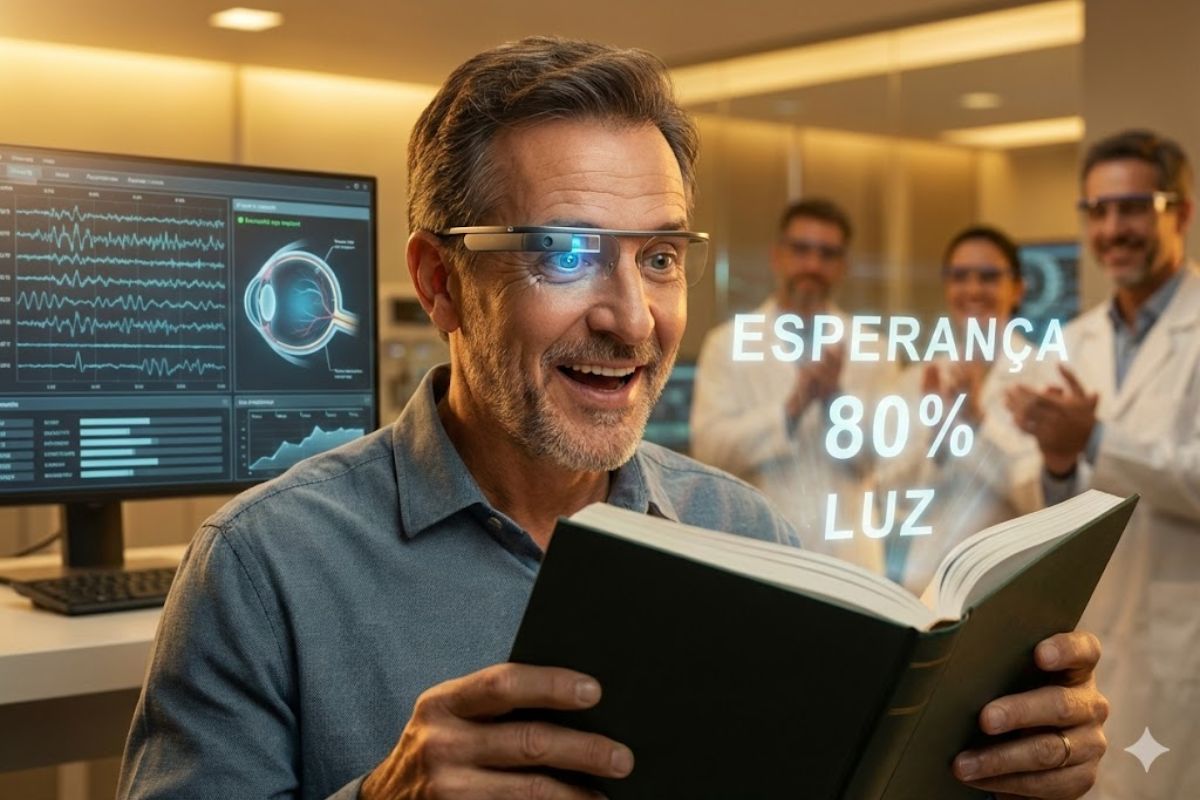


In International Study With 38 Blind Patients, A New Technology Combines Implantable Photovoltaic Microchip Under The Retina And Glasses With Camera To Restore Partial Vision, Allowing Recognition Of Letters And Numbers, While Progressing In Tests For Geographic Atrophy And Stargardt Disease, Under Regulatory Review In Europe, The United States And Brazil.
This week, the disclosure of the results of an international study rekindled hope for dozens of patients who have completely lost their vision due to degenerative diseases. The new technology, based on a photovoltaic microchip implanted under the retina and smart glasses with a camera, restored partial vision to 80% of the 38 volunteers monitored in 17 hospitals across five countries.
The data, published in the New England Journal of Medicine, shows that these patients, previously unable to perceive shapes, have begun to identify letters, numbers, and words in contrast, even still in black and white. In parallel, stories like those of Ronaldo, diagnosed in his youth with Stargardt disease, and Maria, who lost her vision after a retinal detachment nearly 20 years ago, illustrate the potential impact of this new technology in the daily lives of those living in darkness.
Target Diseases: Macular Degeneration And Stargardt Disease

The new technology was initially tested in people with geographic atrophy, an advanced form of age-related macular degeneration.
-
In a flooded well, archaeologists found a 1,700-year-old Roman egg that still contains clear and yolk intact inside the very thin shell.

-
Something is happening around the Earth: Inside the huge explosion of fireballs in 2026

-
A hot air bubble coming from Argentina expands over Brazil, causing thermometers to exceed 38 degrees with a thermal sensation of 40 degrees in late March, affecting 6 states at once.

-
The radish leaf that almost everyone throws away has more polyphenols, flavonoids, and fiber than the consumed root, and a 2025 study showed that the leaf contains compounds that protect the intestine, combat inflammation, and may inhibit the growth of cancer cells.


In this condition, retinal cells progressively degenerate, leading to loss of central vision and the inability to read, recognize faces, or perform fine tasks.
The study focused on patients who had already completely lost functional central vision, meaning they could no longer read, even with conventional optical aids.
Still, 80% of the 38 participants showed significant improvement in their ability to see shapes and simple characters after the system was activated.
The researchers are now directing efforts to adapt the same new technology to other hereditary retinal diseases, such as Stargardt disease, which affects younger individuals, like Ronaldo, who received the diagnosis around 18 to 19 years of age, after years of being treated merely as myopic.
For these patients, the possibility of seeing “even just a little,” as he himself describes, represents a profound change in life perspective.
Photovoltaic Microchip Under The Retina And Smart Glasses
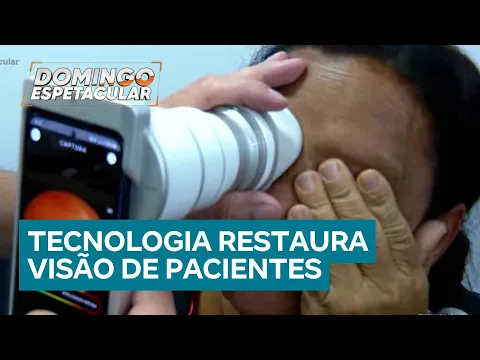

The heart of the new technology is a 2 mm photovoltaic microchip, with a thickness similar to that of a human hair, implanted under the retina.
The retina is the light-sensitive nerve tissue located at the back of the eye, responsible for transforming light stimuli into electrical signals that travel through the optic nerve to the brain.
After the chip is implanted, the patient begins to wear special glasses with an attached camera. This set forms an artificial visual circuit in several stages:
The camera captures real-time images of the environment
The images are converted into infrared light signals
These infrared signals are projected onto the photovoltaic microchip
The chip transforms infrared light into small electrical impulses
These impulses are directed to the still functional cells of the retina and optic nerve, which send the information to the brain
Between the camera and the implant, a pocket processor comes into play, connected to the system.
This device “processes” the image, enhances contrast, simplifies outlines, and sends optimized signals to the chip to maximize what the brain can reconstruct as visual perception.
In practice, the circuit replaces part of the lost function of the degenerated retina and recreates a new pathway for visual information to reach the brain, even in patients considered blind for reading before the intervention.
The Prima Implant As A Mini Solar Panel Inside The Eye
The implant used in the study is called Prima and was described by ophthalmologist Frank Brodie as a mini solar panel inside the eye.
Just as a traditional solar panel converts light into electrical energy, the photovoltaic microchip converts the infrared beam emitted by the glasses into electrical signals that stimulate the retina.
Currently, the Prima provides vision formed in black and white, with sufficient resolution for patients to distinguish letters, numbers, and simple high-contrast figures.
In demonstrations, it is possible to compare the image captured by the camera, in sharp definition, and the “translated” image to the pattern that the patient sees, which is more granular but functional for basic reading.
According to Brodie, the significant advancement is that it is the first time vision that has been completely lost due to degenerative diseases has been partially restored.
Previously, the focus of therapeutic efforts was only to try to delay visual loss, not reverse the situation.
Now, there is a pathway to recover some degree of vision in patients who had already crossed the line of functional blindness.
The upcoming developments for Prima target three main fronts:
to expand the field of vision covered by the implant
to improve resolution of details
to advance towards color vision, surpassing the current black and white standard
Each incremental gain in this system can mean, for the patient, moving from recognizing only large letters to being able to read entire sentences or identify objects in a home environment with greater autonomy.
Results Of The Clinical Study And Impact On Daily Life
The clinical study involved 38 patients treated in 17 hospitals across five countries, all with severe visual loss due to geographic atrophy.
After the implantation of the microchip and adaptation to the smart glasses, 80% of the volunteers showed relevant improvement in vision, especially in reading ability.
Patients who could not even recognize a hand passing in front of their face started to read isolated letters, numbers, and short words, following standardized testing protocols.
In some situations, they were able to identify lines of text in printed materials or on adapted screens with high contrast.
From an emotional standpoint, doctors report intense reactions during the first sessions when the new technology is turned on and adjusted.
Many describe the moment they begin to perceive outlines of faces, doors, windows, or large letters as a second chance at life.
For people like Ronaldo, who abandoned sports and leisure activities after losing central vision, the expectation is to navigate with more confidence, better recognize the environment, and reduce dependence on constant assistance.
He sums up his desire in a simple yet powerful goal: “to see people and what’s around, even if it’s not 100%”.
Maria, who lost her vision after a retinal detachment nearly two decades ago, relays the impact of spending so many years unable to see her son’s face, who was 8 years old when the problem occurred.
The possibility that a new technology might one day allow her to recognize family features, the aging of her parents, and changes in herself in front of the mirror deeply touches the emotional dimension of vision.
Regulatory Pathway, Current Limits And Future Challenges
Despite promising results, the new technology is still in the evaluation phase by regulatory agencies in Europe and the United States, a mandatory step before any incorporation into health systems.
Only after this international scrutiny will there be room for dossiers and formal approval requests in countries like Brazil.
The system also presents clear limitations at this stage:
restored vision is partial and black and white
reading still requires intensive training and controlled environments, with high contrast
there are currently no long-term data on durability of the implant and stability of function over many years
the procedure involves delicate intraocular surgery, requiring specialized centers and highly trained retina teams
Even with these limits, experts believe the study marks a paradigm shift in retinal ophthalmology.
Instead of only focusing on the prevention of visual loss, the prospect of a medicine capable of reconnecting the brain to visual signals in patients already considered blind is opened, at least in some cases of macular degeneration and, in the future, Stargardt disease.
As science advances, patients and families watch with anticipation each new published result.
For those who have not seen for years, seeing an outline, a letter or the face of a loved one can mean as much as a complete cure.
For you, reading this report: if you could choose, what would be the first thing you would like to see again if such technology became available tomorrow?







Olá bom dia, minha filha perdeu a visão nem com transplante de córnea ela quer reconhecer rostos das pessoas próximas.