





 English
  Francês
  Alemão
  Italiano
  Japonês
  Norueguês
  Portuguese
  Spanish
  5 min of reading
  0 comments


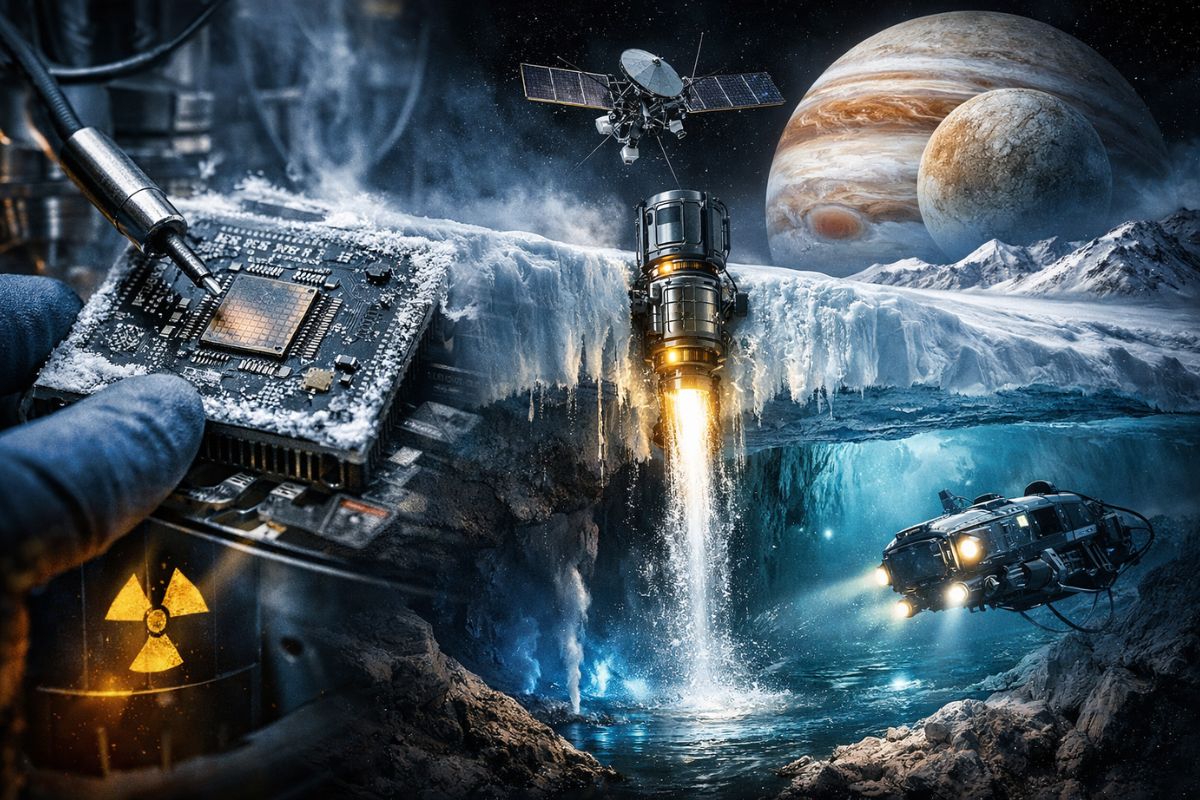
New NASA-Funded Technology Creates Chips Made of Silicon and Germanium Capable of Operating at −180 °C and Withstanding Radiation Up to 50 Times Lethal to Humans. The Advance Could Allow Robots to Bore Through the Ice of Europa, Moon of Jupiter, and Explore Potentially Habitable Alien Oceans.
Imagine sending a robot to dive into an ocean hidden beneath kilometers of ice on a distant moon. This was exactly the kind of challenge that led NASA-funded researchers to develop a new generation of chips capable of operating in extreme space environments.
The technology announced by NASA last Monday (10) represents an important breakthrough because it addresses one of the biggest obstacles to space exploration: the survival of electronic equipment in extreme conditions. In places like Europa, moon of Jupiter, temperatures can drop to around −180 °C while radiation reaches levels capable of quickly destroying conventional circuits.
The So-Called Ocean Worlds That Intrigue Scientists
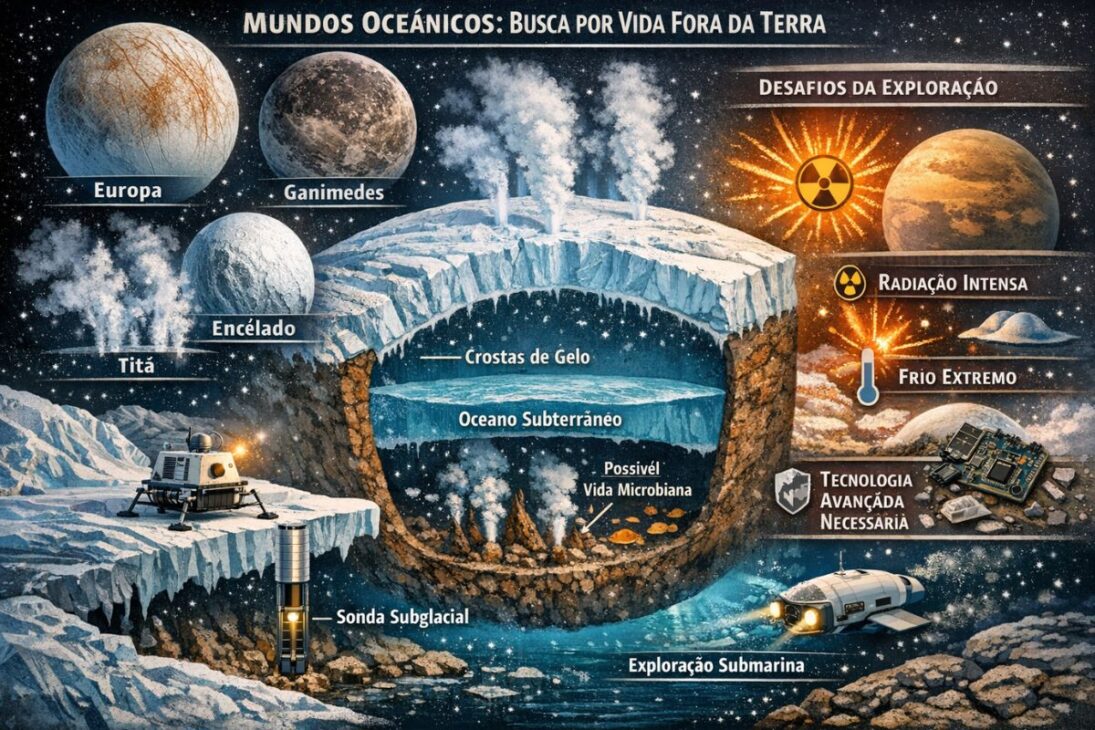
According to the portal G1, among the most promising destinations in the search for life beyond Earth are the so-called ocean worlds. Europa and Ganymede, moons of Jupiter, as well as Enceladus and Titan, which orbit Saturn, hide vast oceans of liquid water under thick ice crusts.
-
Archaeologists find in Mexico a sacrifice altar over 1,000 years old, surrounded by skulls, human bones, and signs of rituals from the Toltec Empire.

-
Goodbye to the traditional oven? IKEA draws attention with a 3-in-1 microwave that combines an air fryer, grill, and heating in the same compact, affordable appliance designed for small kitchens.

-
A forgotten stone in the barn hid a rare relic from the Bronze Age, and the discovery shocked archaeologists by revealing a millennia-old mold used to manufacture war spears over 3,000 years ago.

-
New technology with lights is being tested in the most dangerous stretch of Serra do Mar in Paraná to alert drivers, reduce delayed reactions, and try to curb the rise in deaths on the highway.


These environments spark scientific interest because they may have conditions similar to those of Earth’s primordial oceans, where life originated billions of years ago. If similar chemical processes occur in these deep waters, these locations could harbor microscopic life forms or ecosystems still unknown.
The problem is that exploring these places is extremely difficult. On Europa, for example, the combination of intense radiation and extreme cold quickly destroys traditional electronics, making direct exploration missions a huge technological challenge.
Why The Cold and Radiation Have Always Been An Obstacle

For decades, space missions have solved this problem in a relatively simple way: by protecting circuits inside heated compartments. These structures keep electronics at safe temperatures and help block some radiation.
However, this strategy has important limitations. These protective boxes increase the weight of the probes and consume energy to keep the systems heated, complicating missions destined for very distant environments.
When the destination is billions of kilometers from Earth, every additional kilogram translates to more fuel, more cost, and greater engineering complexity. In a scenario like Europa, where robots would need to bore through thick ice before reaching the subterranean ocean, efficiency and weight become critical factors.
The New NASA-Funded Chip Technology
The solution developed by NASA-funded scientists uses a semiconductor alloy made of silicon and germanium. This material has an unusual characteristic: the colder the environment, the better the electrons move within the circuit.
At extremely low temperatures, there is less interference with the electronic flow within the material. This means that the circuits can operate more quickly and stably precisely under conditions that would typically destroy common electronic equipment.
Moreover, the structure of these chips is also less vulnerable to the intense radiation present in regions close to Jupiter. This allows the components to function without the need for heavy layers of protection.
The result is an electronic device that not only survives the hostile environment but benefits from it to operate more efficiently.
Communication In Extreme Environments
One of the project’s milestones was demonstrating that a complete radio communication system can operate fully under these extreme conditions.
According to NASA, tests showed that a tiny transmitter smaller than a fingernail was able to send signals while operating at −180 °C under intense radiation.
This type of technology is essential for future missions. Sensors positioned in an alien ocean could transmit data to a lander on the surface, which in turn would send information to an orbiting satellite or directly to Earth.
Another application being studied involves called cryobots, machines designed to drill through thick layers of ice. These robots could traverse tens of kilometers of ice on Europa until they reach the subterranean ocean.
Applications Also For The Moon And Mars
Although the initial focus is on distant ocean worlds, the technology may also be useful closer to Earth. Extremely cold environments exist in lunar craters that never receive direct sunlight, where temperatures can reach around −200 °C.
These regions are considered strategic because they may contain deposits of water ice. This resource would be essential for future human bases, as it can be used to produce drinking water, oxygen, and fuel.
With chips capable of operating directly at these temperatures, rovers and sensors could explore these areas without the need for heating systems, saving energy and reducing the weight of the missions.
Next Steps For The Technology
So far, the components have been tested in the laboratory under conditions that simulate Europa’s environment very accurately. These experiments allowed validation of circuit operation under extreme cold and intense radiation.
The next step will be to turn this technology into products that can be manufactured at scale by space electronics companies. This will allow future missions to incorporate these chips into probes, robots, and scientific instruments.
Meanwhile, another mission is already on its way to Jupiter. The Europa Clipper spacecraft, launched in 2024, is expected to reach the Jovian system in 2030 to study Europa and assess whether its subterranean ocean can support life.
A New Phase In The Search For Life Beyond Earth
If plans come to fruition, the technology funded by NASA could pave the way for one of the most ambitious scientific missions in history: to land on Europa, bore through its ice, and directly explore the ocean hidden beneath the surface.
If robots can operate under these conditions and transmit data back to Earth, scientists could finally investigate environments that have remained inaccessible for billions of years.
And you, what do you think of this new NASA technology capable of surviving the extreme cold of space and possibly exploring alien oceans?
Do you believe humanity can really find life beyond Earth in the coming decades? Share your opinion in the comments.







Seja o primeiro a reagir!