





 Portuguese
  English
  Spanish
  5 min of reading
  2 comments


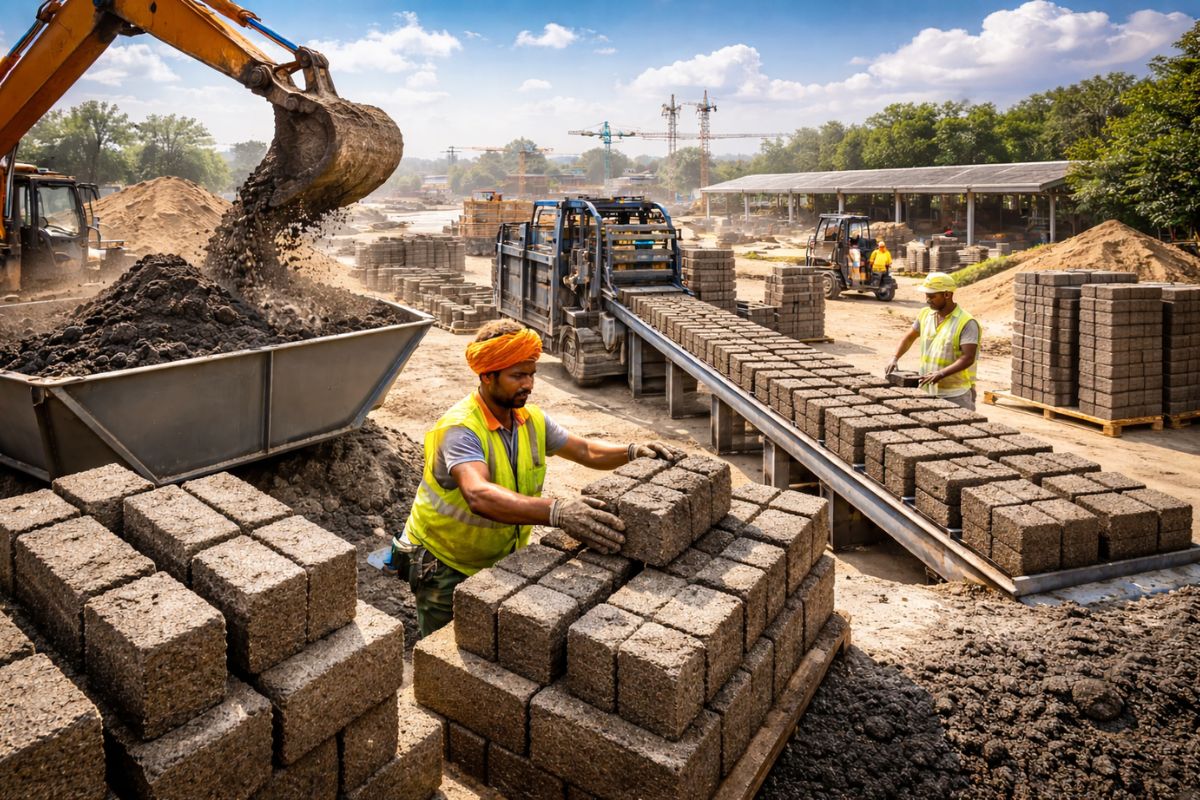


Eco Innovation Uses Foundry Waste to Produce Bricks with Foundry Sand, Reaching 5,000 Units per Day and Reducing Pressure on Natural Resources in Civil Construction
The idea of making bricks with foundry sand seems, at first glance, like a laboratory experiment far removed from daily construction site routines. But a new process developed by the Indian institute CSIR-NIIST is bringing this solution to life and scaling it up, with the potential to change how bricks, flooring, and paving elements are manufactured.
In partnership with a private company, the institute launched a unit capable of producing up to 5,000 bricks with foundry sand per day using, as the main raw material, a waste that was previously sent to landfills. What was once an environmental cost for foundries is now a resource for civil construction, aligning economics, materials engineering, and impact reduction.
What Are Bricks with Foundry Sand and Why Do They Matter?
The foundation of the technology is to utilize the sand used in molding metal parts, known as foundry sand.
-
The lack of welders, electricians, and operators becomes a structural threat in 2025, with the construction industry and manufacturing already suffering from delays, cost pressures, and labor shortages in Brazil.
-
Brazil and Paraguay are just 46 meters away from a historic union on the bioceanic bridge that promises to revolutionize trade between the Atlantic and the Pacific.

-
With 55 km over the sea, a cost of US$ 20 billion, and enough steel to build 60 Eiffel Towers, China’s largest project has connected Hong Kong, Zhuhai, and Macau in a colossal bridge that defies the logic of engineering.

-
A trick with joint compound transforms a Styrofoam ceiling into a plaster-like ceiling: leveled panels, wires and mesh at the joints, sand, paint, and change the environment while spending little today.

This material comes from the foundry processes exposed to high temperatures and chemical reactions with molten metal, making it unsuitable for new molds. Traditionally, the solution has been to discard this waste in landfills.
With the new technology, this sand ceases to be a problem and becomes part of the formulation of bricks with foundry sand, which can also lead to flooring, interlocking blocks, and other construction elements. The result is a portfolio of structural products that do not consume clay, natural sand, or gravel, easing the pressure on quarries and rivers.
How the Laboratory Transformed Waste into a Construction Product
To arrive at the current process, researchers studied in detail the reactivity of foundry sand in combination with cement, lime, gypsum, and polymer-modified binders. The goal was to find a formulation that ensured good workability in the factory and high performance after curing.
The next step was to take this recipe to industrial scale. CSIR-NIIST provided technical support in choosing machines, defining the layout, and designing the plant, ensuring that the bricks with foundry sand were manufactured with controlled compaction, curing, and mixing quality.
The process was designed from the outset to align with technical standards for strength and durability, which is decisive for the product to be accepted in real construction projects.
Production at Scale: 5,000 Bricks per Day and 30 Tons of Waste Utilized

In practice, the installed unit operates with about 30 tons per day of foundry sand from metal alloy foundries. Instead of going to landfills, this volume enters the production line as the main raw material for the bricks.
The production capacity of 5,000 units daily shows that it is not just an experimental prototype.
This is a scale that already interacts with low-income housing sites, urban paving, and public projects, paving the way for bricks with foundry sand to replace part of the traditional blocks in infrastructure programs.
Less Clay, Less Natural Sand, More Structural Performance
One of the most relevant points of the technology is that the final products practically do not depend on natural resources such as clay, industrial sand (M-sand), or gravel. The strength is achieved by combining cement with controlled compaction, in a compression molding process.
Tests conducted by the institute show that the bricks reach strength levels compatible with normative requirements, qualifying them for structural use and in wall structures.
Furthermore, the process allows for the development of pieces in different colors and shapes, with finishes suited for both facades and interiors, which enhances architectural appeal.
Environmental Impact: From Landfill to Circular Economy
Foundry sand is a waste continuously generated by metal foundries. Each ton discarded represents occupied space in landfills, contamination risks, and logistical costs. By transforming it into bricks with foundry sand, the project operates on two fronts simultaneously:
On one hand, it reduces the waste load sent to landfills and decreases the environmental liability of foundries. On the other, it replaces part of clay deposits and the extraction of natural aggregates that supply civil construction. This aligns with the concept of a circular economy, where waste from one sector becomes a resource for another.
The institute itself highlights that the technology was developed within a program aimed at transforming industrial waste into value-added products, with a specific focus on preserving natural resources used extensively by the construction sector.
Housing and Public Works: Where Bricks with Foundry Sand Can Fit In
As it is a material with good mechanical strength and produced in standardized formats, bricks with foundry sand have potential applications in various types of projects: social housing, retaining walls, sidewalk paving, public squares, and areas.
The developers expect the plant to help supply works supported by state and central governments in India, reducing raw material costs, optimizing logistics, and offering a product with a lower environmental footprint than conventional bricks.
The combination of scale, standardization, and use of industrial waste makes the model particularly attractive for public programs.
Research, Industry, and Public Policy Moving Together
Behind the solution lies a clear strategy to bring applied research, industry, and waste management policies closer together.
The institute positions this technology as part of an axis dedicated to industrial solid waste, under the umbrella of “waste to wealth” initiatives.
The central message is that each ton of foundry sand repurposed as brick represents less environmental cost and more economic value generated.
By creating a competitive product, the project also invites foundries, construction companies, and governments to adopt purchasing and bidding criteria that favor materials with a higher recycled content.
To close, a quick question for you: if you had the option in your city, would you choose to build using bricks with foundry sand instead of conventional bricks, as long as the price was the same or lower?








Me chamo Luis. Nós anos 80 trabalhei na fundição Tupy , naqueda época já tinha sugerido o uso do resíduo de areia para fabricação de tijolo para construção de casa popular. Disseram que era bobagem. A história é longa.
Escórias de fundição tem substâncias pesadas que envenenam lençóis freáticos…foi usada no meu bairro infelizmente na pavimentaçao asfáltico.