





 Portuguese
  English
  Spanish
  4 min of reading
  0 comments


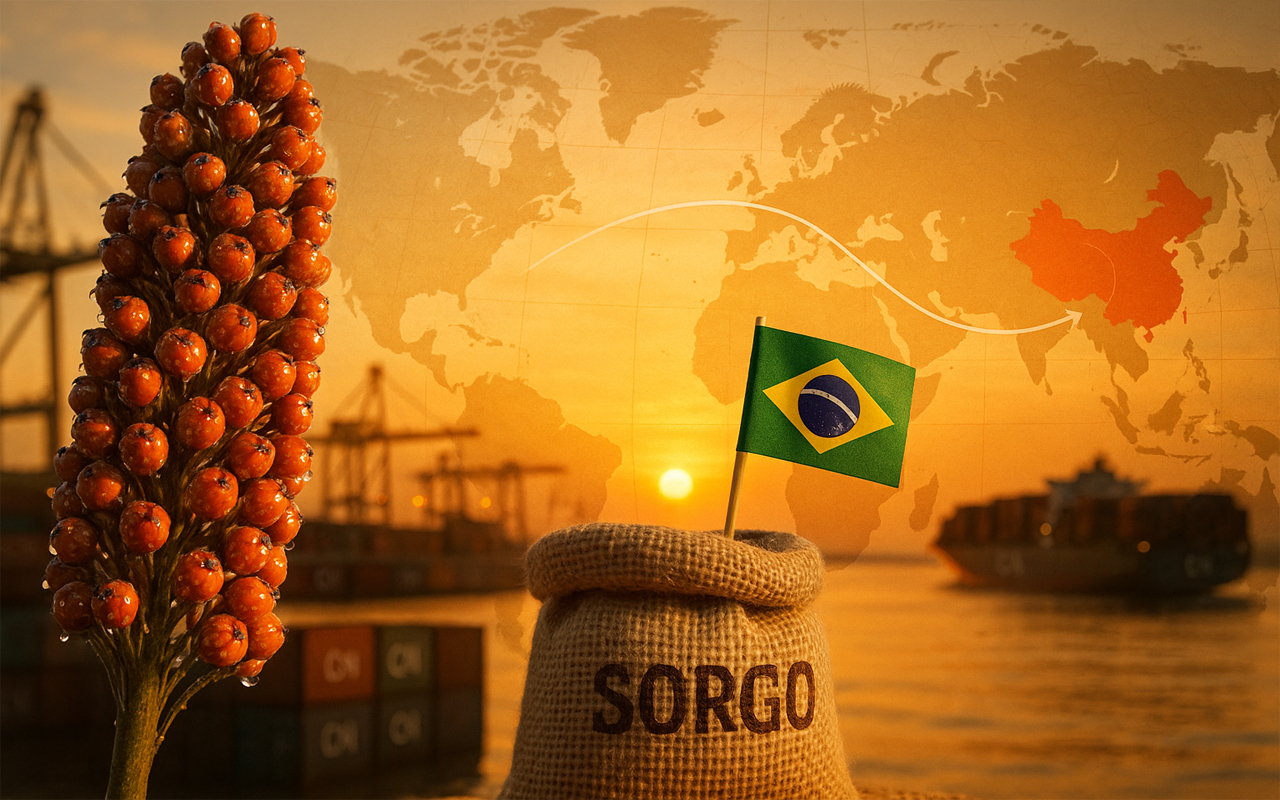
Brazil and China Signed a Protocol That Opens the Chinese Market to Brazilian Sorghum. The First Shipments Are Expected From 2026, Creating a New Front for National Agriculture.
Brazil took a strategic step to diversify its agricultural portfolio, as the Chinese government approved the protocol that allows the import of sorghum (Sorghum bicolor) produced here. It’s a major shift for a crop that, until now, had almost exclusively domestic destinations.
In practice, this means opening a gigantic and demanding market, with specific sanitary and phytosanitary rules, registration of processing plants, and validations with the authorities of both countries. The aim is to ensure standards and safety from the origin to the disembarkation at the Chinese port.
The operational schedule indicates shipments in 2026, a necessary period to finalize registrations, standardize quality controls, and adjust logistics. In August 2025, a mission from GACC (Chinese Customs) was in Brazil precisely to advance these proceedings, a clear sign that the process is progressing.
-
China alone accounts for 70% of trade within the BRICS, while Brazil establishes itself as an essential supplier of food and minerals: understand how the group, which already represents nearly 40% of the world’s GDP, is changing the game.

-
Starting in May, those who do not have registered biometrics will not be able to apply for Bolsa Família, sickness benefits, or unemployment insurance: understand the new rule that changes access to benefits for millions of Brazilians.

-
A new law being voted on in Brazil proposes a minimum fare of R$ 10 per trip and R$ 2.50 per kilometer for Uber and 99 drivers, and promises to ensure they earn as well as taxi drivers did during the golden age of taxis in the country.

-
Bauer Group collapses after failed judicial recovery: 25 years, 800 vehicles, and a network of gas stations leave a debt of R$ 50 million and 100 layoffs, exposing costs, tight margins, and expensive credit in Brazil.


Sorghum Export to China, Protocols, Deadlines, and What Changes
The Ministry of Agriculture and Livestock (MAPA) published the official rules of the “Protocol on Sanitary and Phytosanitary Requirements for Sorghum Export from Brazil to China,” including NCM 1007.90.00, instructions for registration in CGC/MAPA (SIPEAGRO), and stages for qualifying processing plants.
For some stages, MAPA itself indicates administrative deadlines — for example, up to 120 days to finalize registrations after Brazilian approval. Meeting the documentary checklist and standards of cleanliness, traceability, and pest control is a requirement for participation.
Moreover, MAPA’s technical page for China lists the specific protocol for sorghum and the integrated pest management required by Article 2 — guidelines that guide producers, warehouses, and exporters on what to do at the origin to avoid non-conformities at the destination. In other words: it’s an open market, but regulated.
To speed up the practical side, GACC sent a delegation to Brazil in early August, with meetings at MAPA and technical visits to processing units in Minas Gerais. The focus was to review procedures, quality standards, and cargo monitoring, a typical stage before the first export harvest.
Chinese Demand for Sorghum Has Potential of 7.9 Million Tons Annually
China is the largest global importer of sorghum, and according to the U.S. Department of Agriculture (USDA), it is expected to continue purchasing high volumes. The latest Grain & Feed Update from USDA projects 4.7 million tons imported in 2024/25 and 5.0 million tons in 2025/26 — a stable and relevant market for those seeking alternative suppliers.
A report from Agro Estadão reinforces the potential ceiling: China can import up to 7.9 million tons per year, which represents about 81% of global sorghum purchases — a figure also attributed to USDA. It is precisely this Chinese appetite that makes the agreement with Brazil so promising and explains the expectation of shipments starting in 2026.
On the global stage, the United States leads in exports, followed by Australia and Argentina. With the recent trade tensions and area adjustments in the U.S., analysts see room for new suppliers — and Brazil enters this equation with agronomic advantages in warm regions with lower water availability.
Sorghum Production in Brazil 2024/25, Second-Crop, Feed, and Biofuels
Sorghum is consolidating as a second-crop (safrinha) — an alternative to corn when the planting window tightens — and with major usage in animal feed, as well as increasing applications in ethanol. According to USDA/FAS (Post Brasília), Brazil is the 3rd largest global producer, with an estimated production of ~5 million tons and area of 1.5 million hectares in 2024/25, an increase of ~12% over the previous cycle. Resilience to water stress explains part of this leap.
Historically, almost everything stays in the domestic market. In 2024, the country exported about 180 thousand tons of sorghum, with 94% destined for South Africa and 5% to Spain — figures that highlight the starting point before China. Opening the Chinese market may change this geography, without hindering the grain’s competitiveness in animal nutrition and the biofuel matrix.
Conab reports a scenario of productivity above expectations in several states and area gain for the crop this harvest, with crops in good condition, especially where there was management and favorable weather. These are important signs of offering capacity for a future export agenda.
Competitiveness of Brazilian Sorghum and Logistics to China
On the cost side, USDA studies indicate that the price of sorghum tends to be 80%–85% of corn, while the production cost can be 20%–30% lower — a combination that helps to balance the numbers in the second-crop and maintain profitability. For external markets, cost is a competitive advantage.
In terms of logistics, every hour saved counts. In 2025, a direct maritime route was inaugurated between Brazilian and Chinese ports, reducing travel time by up to 30 days and potentially cutting logistics costs by over 30%. Although created with a focus on fruits, this same route opens an alternative corridor for Brazilian cargo heading to the Chinese market, with potential benefits for grains and feeds.
With the protocol in force and the more agile route, the next step is to standardize the classification, cleaning, and traceability of exported sorghum. Meeting specifications from harvest, through drying, processing, and storage, reduces the risk of non-compliance at GACC and avoids costly returns.










-

-

-

6 pessoas reagiram a isso.