





 Portuguese
  English
  Spanish
  4 min of reading
  0 comments


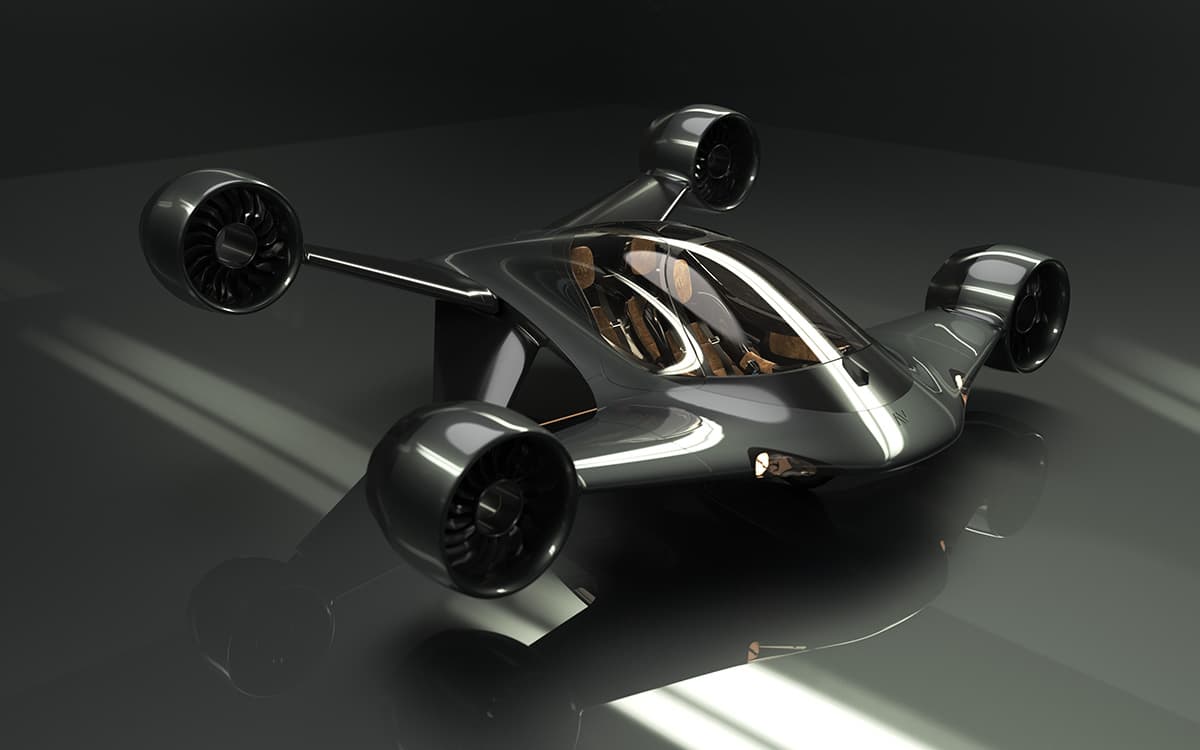
London Company Announces Its New Flying Car Capable of Delivering a Range of 827 km and Parking Almost Anywhere. Discover the Details of the Sigma.
The London startup AltoVolo revealed this May the first details of its innovative urban air vehicle: a hybrid electric eVTOL designed to transform the future of air mobility. AltoVolo’s new flying car will be able to transport up to three people, combining energy efficiency, advanced performance, and comfort for short to medium-haul flights.
With an impressive range of 827 km, the model promises to cater to everything from urban commutes to intercity routes, surpassing most current projects under development. Its cruising speed reaches 354 km/h, placing AltoVolo’s eVTOL among the fastest in its category, significantly reducing travel time compared to ground transportation.
Another highlight is the noise emission: the vehicle was developed to operate with up to 80% less noise than a conventional helicopter, representing a significant advancement for the integration of this type of aircraft in urban centers, where noise pollution is a growing concern.
-
Archaeologists find an intact tomb over 2,500 years old, with more than 100 preserved objects, weapons, jewelry, and human remains never touched.

-
Volcanic lava transforms into threads as fine as human hair that travel over 30 kilometers by wind and fall like cutting rain on roofs and backyards in Hawaii and Iceland.

-
NASA issues a warning for the feared Godzilla El Niño that could change the planet’s climate in 2026 with extreme warming of the Pacific capable of causing devastating droughts in some regions and historic floods in others simultaneously.

-
Archaeologists discover a 100-meter ship graveyard in a submerged Greek city, and what has appeared on the seabed of Libya could change what was known about this ancient port.


Company Completes Tests with Its New Vehicle
Called Sigma, for now, the new flying car is a promise in 3D rendering. The prototype flight tests have already been completed, and the startup is developing a full-scale demonstrator. The waiting list for pre-orders will open in July.
The focus of the product is to compete with private helicopters operating in residential areas, not air taxi services like the electric Midnight from Archer Aviation, or the hydrogen fuel cell demonstrator from Joby. The hover flight time of the new flying car is 15 minutes, with a payload capacity of 270 kg. Its cruising speed is 354 km/h, and its maximum speed reaches 475 km/h.
The hybrid range of the model can reach 827 km, while using only electric motors the range drops to 427 km. The estimated noise level during take-off is 65 to 70 decibels at 100 m, and the flight ceiling is 3,050 m.
In dimensions, the model measures 4050 mm in length, 4800 mm in width, 2280 mm in compact width, total height of 1,580 mm, and maximum take-off weight of 980 kg. In terms of safety, the new model will feature ballistic parachute deployment at 15 m, thrust vector stability, a triply redundant control system, among others.
New Flying Car Features a Unique Design
According to the startup, the Sigma does not resemble any current model on the market, and its design and engineering have been validated by Dr. Richard E Brown of Sophrodyne Aerospace, a leader in aerodynamics. The autonomous flight systems are provided by Embention, the Spanish company that supplies certified flight controllers for Amazon Prime Air.
According to the company behind the project, the new model does not resemble any eVTOL on the market and prioritizes an ultra-compact aircraft, with a clean silhouette that pushes the boundaries of vertical flight. The aerodynamic concepts explored in the vehicle aim to achieve high battery burst capacity for vertical take-off and landing and the energy density of liquid fuel for long-distance flights.
Moreover, the flying car will be small enough to land on sidewalks, yachts, or rooftops. The company claims that the goal is to make flying part of daily life, without requiring public infrastructure or waiting for urban planning policies to catch up.
Another key point is the noise reduction that could open new uses for vertical aircraft. Since, without the deafening roar of a turbine, landing pads could emerge in places where traditional helicopters are banned or discouraged. Therefore, there are no set hours or boarding gates. The idea is simple: fly whenever and wherever you want.
Main Challenges to Be Faced
However, it is worth noting that bold ideas often bring with them some uncertainties. Although the startup has released renderings and specifications, there are still doubts about certification, reliability, and long-term manufacturing; some observers have noted the lack of public information about the background of founder and CEO Will Wood in the aerospace industry. But with the right team, careful testing, and strategic partnerships, these obstacles can be overcome.
The advanced air mobility space is filled with players with diverse objectives. Some are developing air taxis for dense urban areas, while others aim to replace helicopters for medical or industrial use.
AltoVolo, however, is forging its own path, which is made for people who value privacy, speed, and freedom. With the Sigma, its goal is to sell a lifestyle. No lines, no delays, no crowds—just you, your destination, and the open sky.








-

Uma pessoa reagiu a isso.