





 Portuguese
  English
  Spanish
  3 min of reading
  0 comments


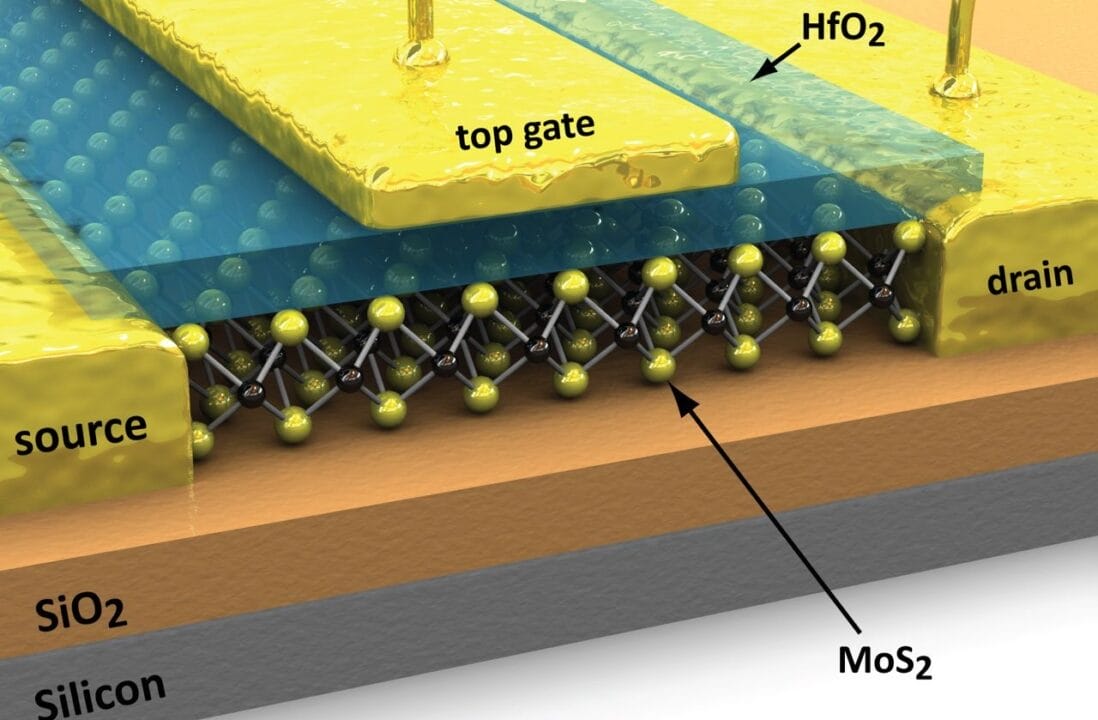
American Scientists Create Innovative Semiconductor With Potential To Make Silicon Obsolete In Modern Computing.
In today’s technology world, semiconductors are crucial elements, with silicon occupying a prominent position in this category. However, despite its prevalence, silicon is not necessarily the ideal semiconductor. One of silicon’s main limitations is its tendency to generate a lot of heat, resulting in significant energy loss. This thermal challenge imposes the need for higher-capacity batteries for mobile devices, directly affecting the energy efficiency of these devices, and it is with this in mind that scientists are working on what appears to be the world’s fastest new semiconductor.
Fastest Semiconductor In The World Is Discovered And Could Change The Computing Sector
The atomic structure of all materials vibrates, generating phonons – quantum particles responsible for conducting sound and heat. These vibrations cause the scattering of electrons or electron-hole pairs, known as excitons, which are crucial for transporting energy and information in electronic circuits.
Normally, this scattering results in energy loss in the form of heat and imposes a limit on the speed of data transfer. However, Jakhangirkhodja Tulyagankhodjaev and his team at Columbia University in the U.S. made a remarkable discovery by developing a new semiconductor that outperforms silicon and exhibits exceptional efficiency and speed, paving the way for significant advancements in computing.
-
With a cost per shot close to zero, the DragonFire laser could change naval warfare in 2027 and provide British ships with nearly unlimited defense against drones.

-
A British startup creates tires that generate electricity in electric vehicles when passing over potholes, speed bumps, and cracks.

-
Scientists have created robots made with living cells that have their own nervous system, swim on their own, explore the environment, and self-organize without any genetic engineering, and now they want to do the same with human cells.

-
Students create a solar-powered ambulance that operates without a plug, without fuel, and still keeps medical equipment running in remote areas.


The innovative material, called Re6Se8Cl2, is a superatom made of rhenium, selenium, and chlorine. Superatoms are clusters of atoms that behave like a single large atom but have distinct properties from the elements that compose them. A notable feature of this new semiconductor is how excitons interact with phonons.
Instead of scattering, they couple with phonons, forming quasiparticles known as acoustic exciton-polarons. These polarons, discovered in various materials since their first observation in 2016, have a special characteristic in the new material: the ability to perform ballistic or dispersion-free flows, representing a significant leap in efficiency and performance of semiconductors.
Data Obtained From Scientists’ Experiments With The New Semiconductor
The aforementioned ballistic behavior means that if the material supports the path to industrial-scale applications, it will be possible to produce electronic circuits that are much faster and energy-efficient than anything currently available in computing.
In experiments conducted by the team, acoustic exciton-polarons in the new semiconductor moved twice as fast as electrons in silicon and crossed several micrometers of the sample in less than one nanosecond.
Given that polarons can last about 11 nanoseconds, the team believes that exciton-polarons can cover more than 25 micrometers in just one pulse.
As these quasiparticles are controlled by light pulses and not by an electric current, theoretical processing speeds could potentially reach the realm of femtoseconds, which is six orders of magnitude faster than the nanoseconds achievable in current computing. All at room temperature.
Commercialization Process Is Not Viable
The new quasiparticles are fast; however, counterintuitively, they achieve this speed because they move very slowly on their own, somewhat like the story of the tortoise and the hare, where persistence wins over starting speed.
What makes silicon a desirable semiconductor is that electrons can move through it quickly, but they jump too much and actually don’t get very far or very fast in the end.
Excitons in the new semiconductor, on the other hand, may be slow, but they travel much farther. Nonetheless, it is unlikely that this will reach the computing sector, since rhenium, the first element of the molecule, is one of the rarest elements on Earth and, as a result, extremely expensive.
Source: Technological Innovation







Seja o primeiro a reagir!