





 Portuguese
  English
  Spanish
  3 min of reading
  1 comment


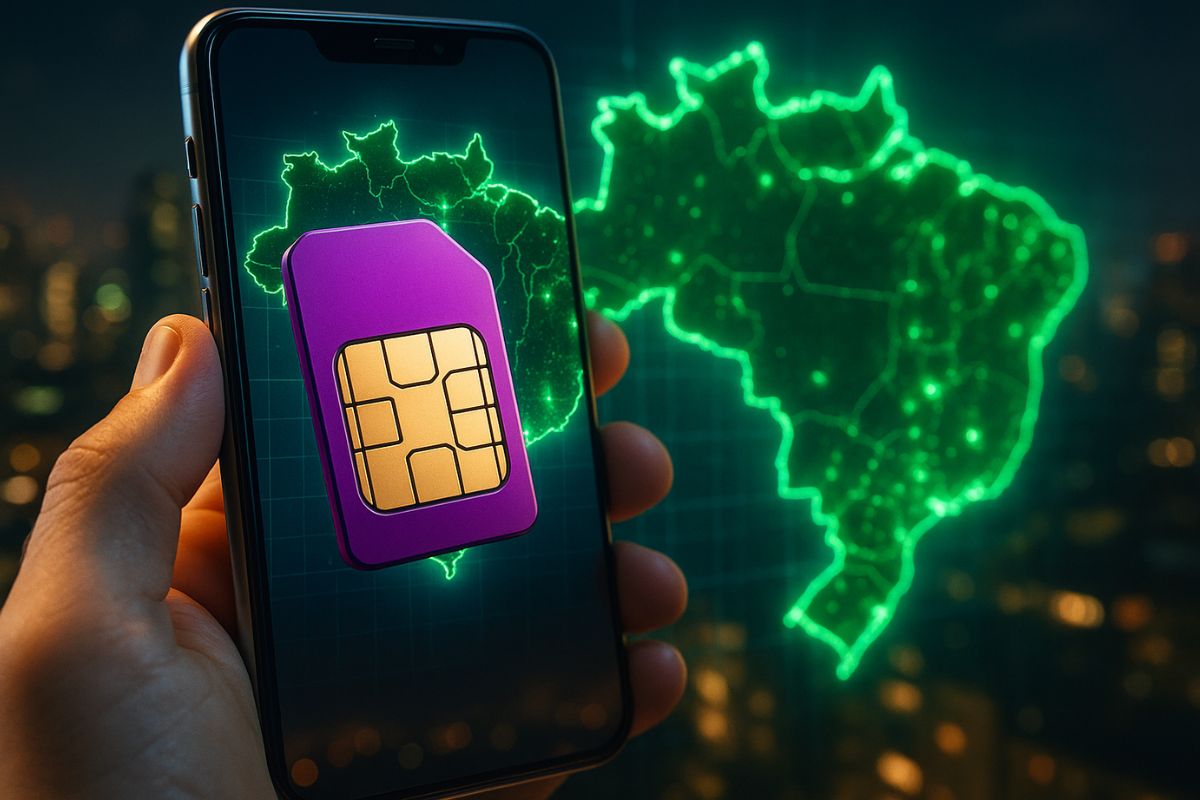


Nubank’s Mobile Service Now Has a Physical SIM, New Plans Starting at R$ 45 and Coverage Promising to Reach 93% of Brazil
Nubank announced this week the launch of the NuCel physical SIM, its mobile telephony service. Until now, the product operated exclusively with a virtual SIM (eSIM), which limited access for users with incompatible devices. With this news, the fintech expands its target audience and makes adjustments to the data plans, focusing on simplicity and higher internet volume.
The SIM can be requested by customers directly through the Nubank app, in the NuCel tab. Shipping is free, and there are no contractual obligations. The coverage continues to operate over Claro’s network, with 5G technology and a promise of coverage of 93% of the national territory.
What Changes with the NuCel Physical SIM
The launch of the physical SIM meets a demand from customers who do not use devices compatible with eSIM. Distribution will be done gradually, prioritizing users who have shown interest in the service. Nubank’s proposal is to maintain simplicity: no activation fees, no loyalty contract, and payment via Nubank card.
-
How the terraforming of Mars can transform the planet: artificial aerosols can increase the temperature by up to 35°C in 15 years, creating conditions for liquid water.

-
Scientists drilled nearly 8,000 meters into the ocean floor above the fault that caused the 2011 tsunami in Japan and discovered that a layer of clay 130 million years old was responsible for making the wave much worse than any model had predicted.

-
Thousands of years after causing the largest eruption of the Holocene, one of the world’s largest supervolcanoes is rebuilding itself beneath the sea south of Japan, receiving new magma and alarming scientists with its transformation.

-
China has activated a magnet 700,000 times more powerful than the Earth’s magnetic field that operates for over 200 consecutive hours while consuming little energy, and now the world wants to know what Beijing plans to do with this technology in 2026.


Until now, NuCel was exclusive to customers with recent smartphones that support a virtual SIM. Now, with the expansion, the service directly competes with traditional operators — especially among users who prioritize spending control and integration with financial services.
What Are the New NuCel Plans
Nubank has also revamped its data packages, which now offer more internet for fixed monthly prices:
- 20 GB for R$ 45
- 25 GB for R$ 55
- 30 GB for R$ 70
All plans include unlimited calls (local and long-distance), WhatsApp usage without deducting from the allowance, unlimited access to the Nubank app, and integration with the “Caixinha NuCel”, an automatic investment tool that yields 120% of the CDI on unused plan amounts.
Where NuCel Is Already Available
According to Nubank, NuCel coverage reaches 93% of the Brazilian population, utilizing the infrastructure of Claro as a partner operator. The service already offers access to 5G in areas where the network is available, maintaining signal stability in urban and rural areas where the partner is present.
The physical SIM can be activated after receipt, directly through the app. Customers with old plans have already been automatically migrated to the new packages.
Why Nubank Is Banking on NuCel
With more than 85 million customers, Nubank seeks to transform NuCel into a gateway to its ecosystem of services, unifying communication, payments, and investments. The idea is to offer connectivity as a banking service, generating loyalty through convenience and savings.
The integration with the “Caixinha NuCel,” which automatically invests the plan amount when unused, represents a unique approach among operators, blending telephony with digital fixed income.
Is It Worth Switching to NuCel?
For those who are already Nubank clients, NuCel can represent savings and convenience, with unified payments and good data packages. The absence of loyalty and widespread coverage are also positive points. However, the experience may vary by region, as service quality depends on Claro’s network.
Another advantage is the integration with the app and yields linked to the CDI, something that traditional operators do not offer. On the other hand, NuCel still does not provide features such as virtual numbers, family plans, or direct portability between eSIM and physical SIM.
Would you use NuCel as your main operator? Do you think Nubank’s proposal could change the telecommunications market? Leave your opinion in the comments — we want to hear from those who have tested it or are considering testing the service.










Sim, maravilhoso já vou contratar hoje para o meu tablet, sou, fã na nubank
Inovador e permite oportunidades para, quem quer recomeçar e ser um empreendedor