





 Portuguese
  English
  Spanish
  6 min of reading
  0 comments


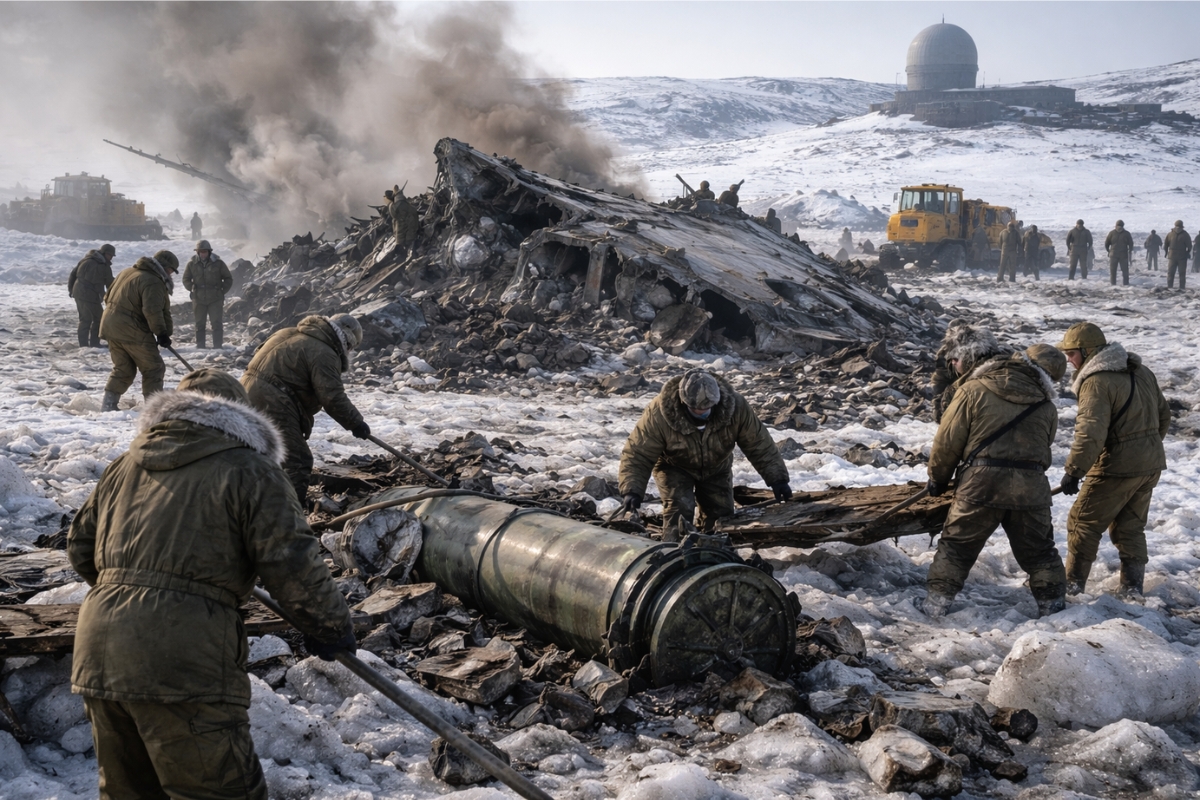
In Greenland, the United States Air Force Conducted a Patrol Flight with 4 Thermonuclear Weapons to Monitor Missile Alert, Causing Radioactive Contamination on the Ice and Drawing Attention from Denmark and Cold War Authorities.
What seemed like a routine mission in the Arctic turned into one of the most impressive episodes of the Cold War. A B 52G Stratofortress took off from Plattsburgh, New York, and headed to the Thule region in Greenland with a clear objective: to monitor the Ballistic Missile Early Warning System.
The plan was to keep the aircraft at about 35,000 feet above Thule Air Base, observing signals that could indicate communication failures or the beginning of a nuclear attack.
However, in the middle of the flight, a fire destroyed the electrical systems. The cockpit was filled with dark smoke, and the crew had to abandon the aircraft hastily, leaving the B 52 to fall alone onto the ice.
-
Friends have been building a small “town” for 30 years to grow old together, with compact houses, a common area, nature surrounding it, and a collective life project designed for friendship, coexistence, and simplicity.

-
This small town in Germany created its own currency 24 years ago, today it circulates millions per year, is accepted in over 300 stores, and the German government allowed all of this to happen under one condition.

-
Curitiba is shrinking and is expected to lose 97,000 residents by 2050, while inland cities in Paraná such as Sarandi, Araucária, and Toledo are experiencing accelerated growth that is changing the entire state’s map.

-
Tourists were poisoned on Everest in a million-dollar fraud scheme involving helicopters that diverted over $19 million and shocked international authorities.


The detail that caught the most attention was that the impact triggered conventional explosions in four thermonuclear weapons and spread radioactive material over kilometers, even without a complete nuclear detonation.
What Happened in Thule, Greenland, and Why the Case Made Headlines Decades Later
At 3:39 PM local time on January 21, 1968, the bomber hit the ice near Thule Air Base. The crash caused conventional explosions from four thermonuclear weapons, but the safety systems prevented a total nuclear detonation.
Even so, debris and radioactive residues were scattered kilometers away over the ice. One crew member died in the accident.
Jeffrey Carswell, a shipping employee from a Danish contractor, was in Thule and described the shock of the impact, saying that the building shook as if it were an earthquake.
The contrast that turned into a crisis is direct: Denmark had maintained a nuclear-free territory policy since 1957, prohibiting such weaponry on its soil and territories. The accident exposed that flights with nuclear weapons were occurring over Greenland, despite this prohibition.

The Hard Head Mission and Operation Chrome Dome, the Secret Plan That Kept Bombers in the Air
Captain John Haug took off from Plattsburgh with a crew of seven men in a top-secret Strategic Air Command program called Hard Head.
This scheme was part of Operation Chrome Dome, which aimed to keep bombers with nuclear capability in the air continuously. In practice, the mission was to circle over Thule to confirm that any Soviet missiles heading toward North America would pass through that region.
The Hard Head aircraft also monitored signs of sudden blackout in communications, something that could indicate system failure or the onset of a nuclear attack. The surprising result is that a protocol created for constant surveillance ended in an accident with diplomatic impact.
The Fire Inside the B 52G, the Sequence of Decisions and the Jump in the Arctic
The flight lasted about six hours in very cold conditions. Before takeoff, Major Alfred D’Amario placed foam pads near a heating outlet and opened an engine purge valve to bring warm air into the cockpit.
The problem was that the system failed to cool the overheated air, and the pads caught fire. The smell of burnt rubber spread, and navigator Curtis Criss went to investigate the source.
Criss opened the lower compartment and found flames coming from behind a metal box. He used two fire extinguishers, but the fire continued to spread.
At 3:22 PM, about 90 miles south of Thule, Haug sent an emergency message and requested authorization for immediate landing. About five minutes later, he ordered evacuation.
D’Amario later reported that the plane was directly over the runway lights when the men prepared to jump into the Arctic night. Six managed to eject, but co-pilot Leonard Svitenko did not have an ejection seat. He tried to exit through a lower hatch, hit his head, and did not survive the fall. His body was found later north of the base.

Four B28FI Bombs, 12 Feet, 2,300 Pounds and What These Numbers Reveal About the Scale
In the front compartment of bombs were four thermonuclear weapons B28FI. Each was approximately 12 feet long and about 2,300 pounds, with enough power to devastate a large city, according to Military.com.
In the crash, the explosions were conventional, not complete nuclear detonations. Still, the impact burned the ice and spread plutonium, uranium, americium, and tritium over the area.
In some areas, contamination reached extreme levels. There were fears that radioactive fuel could resurface when the ice melted and moved along the coast of Greenland, expanding the reach of the problem.

Cleanup in 1968, 90 Percent of Plutonium Removed, More Than Half a Million Gallons and Cost of 9.4 Million
The Air Force activated a disaster control team within hours after Denmark demanded that the United States remove all material from the accident.
Initially, U.S. authorities refused to clean up the debris. Only after a Danish scientist warned that the future of Thule was at risk did the country accept the demands.
Teams opened pathways in the ice of the frozen bay, set up makeshift structures and decontamination stations. Aviators walked shoulder to shoulder collecting everything they found, from large twisted pieces to small fragments.
Workers removed inches of contaminated ice, and ships took back more than half a million gallons of radioactive waste to the United States, with reports of handling without adequate protective equipment.
The operation ended on September 13, 1968. The cited balance points to a removal of 90 percent of the plutonium and a cost of 9.4 million dollars, about 90 million in current values.
The Controversy of the Four Bombs and the Component That Never Appeared, the Point That Kept the Mystery Alive
Soon after the accident, U.S. authorities declared that the four bombs had detonated. Three weeks later, investigators concluded that this was not true, as only components from three weapons were identified.
A classified report from July 1968 indicated that most components were recovered, including almost all uranium from three weapons. However, the fusion stage of a fourth weapon, the part linked to the massive explosion of a hydrogen bomb, was never found.
This brings up another point of interest: the accident also revealed that bombers with nuclear weapons had been routinely sent over the island for years. Danish authorities treated the flight as an isolated emergency, but declassified records later indicated discreet approval of these missions, despite public denials.
The truth remained hidden for decades and only returned to the center of debate when a 1995 investigation generated the scandal known as Thulegate, revealing secret government authorization and public outrage.
The episode continues to be remembered because it brought together, on the same day and at the same location, a technical failure inside the plane, four thermonuclear weapons on the ice, and a political crisis among allies, with consequences that spanned decades.
The information was disclosed by Daily Mail, UK news and entertainment website










-

2 pessoas reagiram a isso.