





 Portuguese
  English
  Spanish
  7 min of reading
  0 comments


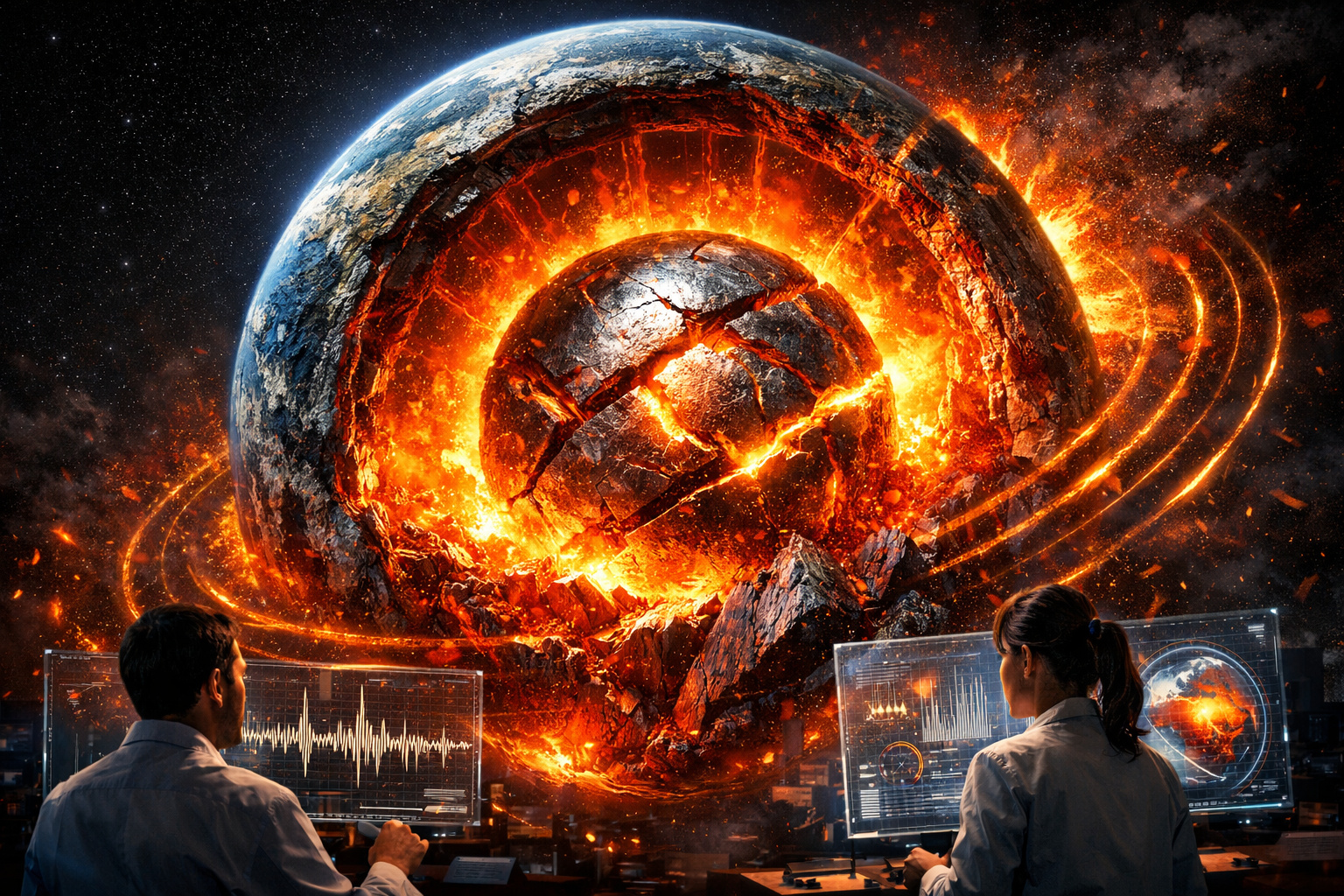
Internal Core of the Earth: Iron Sphere the Size of the Moon Rotates Slower than the Planet and May Be Deforming at 5,000 km Depth
There is a sphere of iron and nickel at the exact center of the Earth. It has a radius of 1,221 kilometers — approximately the size of the Moon. It is subjected to a pressure of more than 3.3 million atmospheres and heated to about 5,400 °C, a temperature comparable to that of the Sun’s surface. Despite these extreme conditions, it remains solid — too compressed to melt, no matter how hot it gets. No instrument has ever touched it. No probe has ever come close. Everything science knows about the internal core of the Earth was deduced from seismic waves from earthquakes that travel through the planet and arrive on the other side with shapes and speeds slightly different from expected.
For decades, the accepted model among geophysicists was simple: the internal core would be a stable solid sphere, rotating slightly faster than the planet’s surface. This model dominated geology textbooks for decades. Since 2024, however, this model began to change.
Study Published in Nature Ends 20-Year Debate on Earth’s Core Rotation
The idea that the internal core could rotate independently of the crust and mantle is not new. In 1996, geophysicists from Columbia University suggested, based on the analysis of seismic waves, that the internal core rotated about 1° per year faster than the Earth’s surface. The hypothesis became known as super-rotation of the internal core.
-
China has launched the world’s first floating artificial island, a scientific structure designed to face open seas, test equipment weighing hundreds of tons, and reach depths of 10,000 meters.
-
China accelerates global science and may surpass the United States in 2 years with increased public investment, continuous growth, and direct impact on the global technological competition.

-
Scientific studies indicate that drought may be strengthening a much greater silent threat: more resistant superbugs.

-
Man builds functional 5-meter submarine in his garage using gas cylinders, PVC pipes, and a refrigerator motor, and navigates with the vessel on a lake in Colombia.

During the following two decades, the topic generated intense debate in the scientific community. Some groups found results consistent with this differential rotation. Others suggested that the internal core did not rotate continuously but instead oscillated over time. There were also researchers arguing that there was no independent rotation at all.
The impasse began to be resolved in July 2024, when geophysicist John Vidale, a professor at the University of Southern California, and researcher Wei Wang, from the Chinese Academy of Sciences, published in the journal Nature one of the most comprehensive studies ever conducted on the Earth’s deep interior.
The team compiled 143 pairs of repeated earthquakes recorded in the South Sandwich Islands in the South Atlantic between 1991 and 2023.
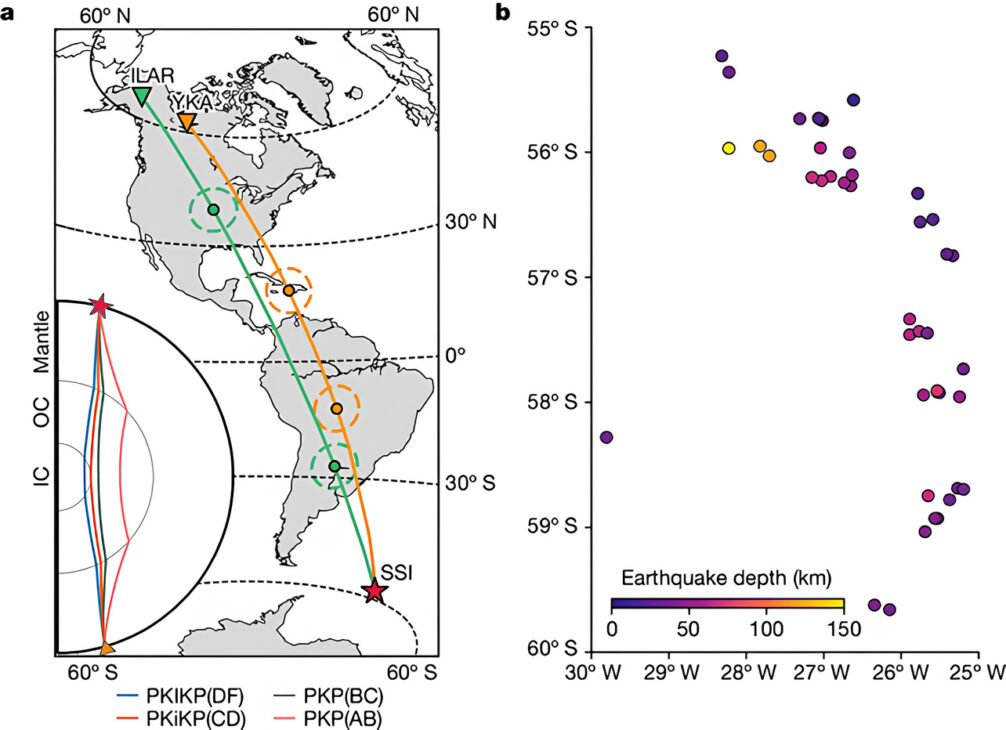
These events are particularly useful for science because they occur in the same location and produce virtually identical seismic signals. Thus, any observed difference in the waves recorded at another point on the planet reveals changes in the Earth’s interior where those waves passed through.
Seismic Data Show the Internal Core Began to Rotate Slower than the Planet
The analysis revealed something unexpected. Between 2003 and 2008, the internal core indeed rotated slightly faster than the rest of the Earth — a phenomenon referred to by researchers as supersuperrotation, with a speed between 0.05° and 0.15° per year. However, around 2010, the behavior changed.
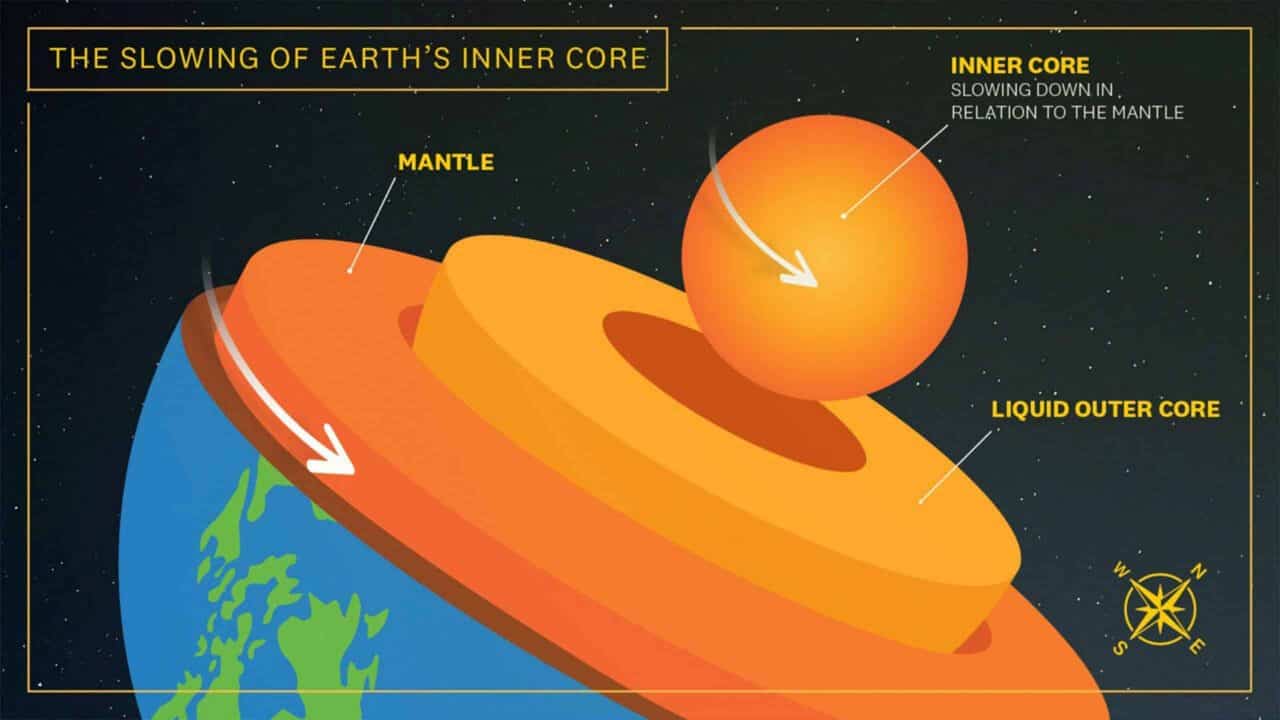
Between 2008 and 2023, the data indicate that the internal core began to rotate slightly slower than the Earth’s mantle, a phenomenon described as subrotation. In practical terms, this means that the internal core began to move in the opposite direction compared to the rest of the planet, something that had not been observed for about 40 years.
When the study was published, Vidale commented, “We have been discussing this for 20 years. I think this ends the debate.”
Rotation Cycle of the Earth’s Internal Core May Last About 70 Years
The researchers also identified that the change in rotation is not random. The data point to a cycle of approximately 70 years, with similar reversals occurring around the 1970s.
According to this model, the internal core should start to accelerate again between 2028 and 2033. This behavior results from the competition between two massive forces acting within the planet.
On one side is the magnetic field generated by the liquid outer core, formed by molten iron circulating in convection currents around the solid central sphere. This movement exerts a force that tends to accelerate the internal core. On the other side is the gravity of the Earth’s mantle, composed of enormous masses of highly dense rock that also exert gravitational influence on the metallic sphere.
The result is a kind of extremely slow geophysical pendulum, where the internal core alternates between acceleration and deceleration over decades.
On the surface, the effects are minimal. The variations in the length of the Earth’s day caused by this movement are on the order of milliseconds. For humans, this is imperceptible. However, for systems like GPS and navigation satellites, these variations need to be taken into account.
Scientists Detect Signs of Physical Deformation in the Internal Core of the Earth
In February 2025, the same team published a second study, this time in the journal Nature Geoscience, presenting an even more surprising result. By analyzing about 200 pairs of earthquakes recorded between 1991 and 2024, the researchers identified subtle differences in the seismic waves detected in Yellowknife, Canada, that did not appear in seismic stations in Fairbanks, Alaska. If the only change in the core was rotational, both stations should have recorded similar patterns. They did not.

The most consistent interpretation of the data was that the surface of the Earth’s internal core may be physically deforming. According to Vidale, visualizing this process is extremely difficult.
“It’s almost science fiction to imagine what is happening at the surface of the internal core,” explained the researcher. “Maybe the topography is rising and falling. Maybe it’s sliding like landslides.”
One hypothesis is that the liquid outer core is pushing against the inner sphere, causing small deformations on the metallic surface. These deformations could occur as bulges, depressions, or local displacements, slightly altering the topography of the solid sphere.
Earth’s Core May Be in a Superionic State, a Rare Phase of Matter
As studies on rotation and deformation progressed, another line of research investigated a different question: why does the internal core behave differently from a common solid metal.
For decades, seismic data have indicated that the internal core is solid enough to transmit shear waves, yet at the same time too soft to be pure solid iron. Seismic waves travel through this region more slowly than traditional models predicted.
In December 2025, a team led by professor Youjun Zhang from Sichuan University published in the journal National Science Review experimental evidence that the internal core may be in a superionic state of matter. This state is considered a distinct phase from solid, liquid, and gas.
In this state, some atoms remain organized in a solid crystalline lattice — in the case of the Earth’s core, iron — while lighter elements move freely through this structure, as if they were a fluid.
In the Earth’s interior, under pressures of about 140 gigapascals and temperatures nearing 2,600 Kelvin, carbon atoms can behave exactly this way. According to researchers, they move through the iron structure like “children dancing in a square dance”, while the metallic lattice remains rigid.
To test the hypothesis, scientists accelerated samples of iron and carbon alloys to over 7 kilometers per second using two-stage gas guns, reproducing pressures similar to those in the planet’s interior. The measurements confirmed a significant drop in seismic wave speed, exactly as geophysical data indicated.
Movement of the Internal Core May Influence the Earth’s Magnetic Field
The discovery has important implications for understanding the Earth’s geodynamo, the mechanism responsible for generating the Earth’s magnetic field. This magnetic field is produced by the circulation of liquid iron in the outer core.
The internal core influences how these currents are organized. Changes in the rotation or structure of this metallic sphere can gradually alter the configuration of the magnetic field over decades or centuries.
Without this magnetic field, the Earth’s atmosphere would be exposed to the solar wind, a constant flow of particles emitted by the Sun. Over billions of years, this process could gradually strip away the planet’s atmosphere, something that likely occurred on Mars.
The Internal Core Continues to Grow Slowly at the Center of the Earth
The internal core of the Earth is not a static structure. Over billions of years, it has been slowly growing as the liquid iron from the outer core solidifies on the surface of the inner sphere. This process occurs at an extremely slow scale — millimeters per year.
In a very distant future, when all the liquid outer core eventually solidifies, the Earth’s magnetic field will cease to exist. However, this scenario is billion of years away. Before that happens, the Sun itself will evolve into a red giant phase, expanding to engulf the inner planets of the Solar System.
For now, the metallic sphere the size of the Moon that exists about 5,000 kilometers below the Earth’s surface continues to rotate, oscillate, and possibly deform — while scientists attempt to understand it using only the echoes it leaves in the seismic waves that traverse the planet.






-

Uma pessoa reagiu a isso.