





 Portuguese
  English
  Spanish
  4 min of reading
  0 comments


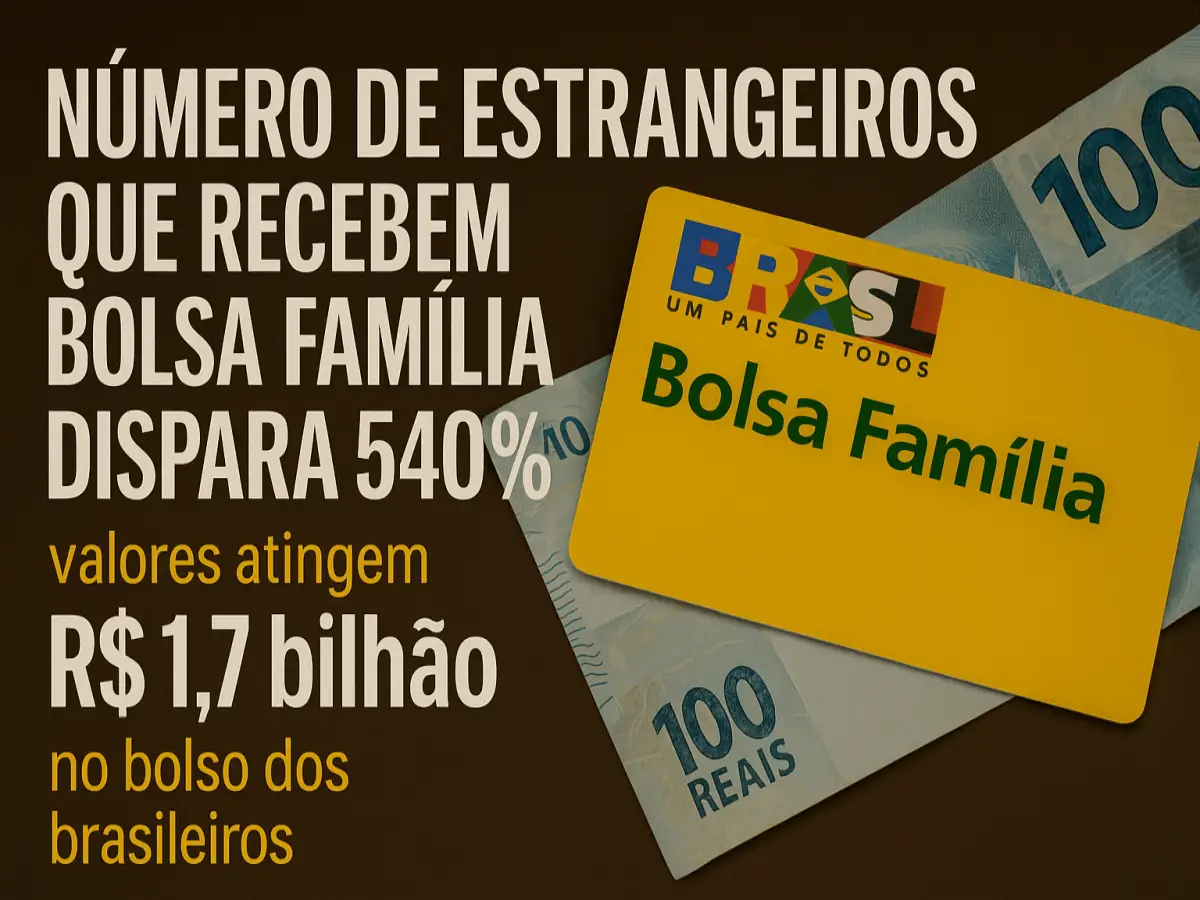
Explosion In The Number Of Foreigners On Bolsa Família Raises Debate About The Use Of Public Resources
Brazil has seen a significant change in the profile of beneficiaries of the Bolsa Família. One noteworthy fact: the number of foreigners receiving the benefit has increased by more than 540% since 2019. Most of this growth occurred under the current administration of President Lula, with Venezuelans at the center of this transformation.
From 26 Thousand To 172 Thousand: A Leap No One Can Ignore
According to information obtained by journalist Carlo Cauti from Revista Oeste through the Access to Information Law, in 2019 there were 26,500 foreign families registered in the program. By 2024, this number reached an impressive 172,500.
-
A new Brazilian shopping center worth R$ 400 million will be built in an area equivalent to more than 4 football fields, featuring 90 stores, 5 cinemas, a supermarket, a college, and parking for 1,700 cars, potentially generating 3,000 jobs.

-
Larger than entire cities in Brazil: BYD is building a 4.6 km² complex in Bahia with a capacity for 600,000 vehicles per year, but the discovery of 163 workers in conditions analogous to slavery has shaken the entire project.

-
With an investment of R$ 612 million, a capacity to process 1.2 million liters of milk per day, Piracanjuba inaugurates a mega cheese factory that increases national production, reduces dependence on imports, and repositions Brazil on the global dairy map.

-
Brazilian city gains industrial hub for 85 companies that is equivalent to 55 football fields.

This increase represents a new reality in the use of the Cadastro Único, a fundamental tool for those seeking access to the country’s social programs. Estimates indicate that, considering an average value of R$ 780 per person, this group of foreigners generates an annual cost of approximately R$ 1.7 billion for public coffers.
Venezuelans Lead Among Foreign Beneficiaries Of Bolsa Família
Who is leading this growth? The Venezuelans. They alone went from 6,600 assisted families in 2019 to 84,900 in 2024. This advance coincides with the intensification of forced migration due to the economic and political crisis in the neighboring country.
The evolution of the number of immigrants registered in the Cadastro Único reinforces this trend. The total number of registered foreigners rose from 6,000 in December 2019 to 34,800 in March 2025, with more than 14,000 Venezuelans, according to official data from the Ministry of Development and Social Assistance, Family and Combatting Hunger.
Strategy Or Abuse? Reports Indicate Immigrants Cross The Border Just To Register
Sources from the Federal Police in Pacaraima (RR), on the border with Venezuela, reported to Revista Oeste a controversial practice: many immigrants are reportedly crossing the border just to register for the program, later returning to their home country to spend the money.
This movement raises an important discussion about the control and scrutiny of social benefits. Even though the Brazilian Constitution guarantees humanitarian aid, including for foreigners in vulnerable situations, the management of these resources requires constant oversight.
Federal Police Take Action Against Fraud In The Bolsa Família Social System
Frauds in assistance programs are not new. In early 2025, the Federal Police launched two operations against groups that were defrauding the Continued Benefit (BPC-Loas). Fourteen search and seizure warrants were executed in different regions of the country.
According to delegate André Viana, who participated in the investigation, “the frauds involved the use of fake documents, duplicate registrations, and even the registration of non-existent people.” These practices not only drain resources but also hinder access for those who truly need it.
More details about these operations can be found on the official Federal Police website.
What Is Behind The Increase? Experts Evaluate
Public policy experts point out that the growth of the immigrant population in Brazil and the restructuring of the Bolsa Família with an expanded focus on social protection explain part of this advance. Professor Rosana Baeninger, from the Center for Population Studies at Unicamp, stated to UOL that “it is not just about numbers, but about a growing demand for humanitarian support and social integration.”
However, the debate intensifies when budget priorities, oversight capacity and the risk of misuse of social benefits come into play.
Social Inclusion Or Lack Of Control?
The expansion of the Bolsa Família to include foreigners reflects a more inclusive stance of the current government. But at the same time, it raises alarms about potential loopholes in the system that favor fraud or misuse. Striking a balance between humanitarian support and control over public resources is at the center of this discussion.
With Brazil facing fiscal challenges, transparency and efficiency in managing social programs become even more urgent. The question that remains is: how to ensure that the benefit actually reaches those in need without opening the door to abuse?
And you, what do you think about this? Should the growing number of immigrants on the Bolsa Família be seen as progress in social inclusion or a cause for concern regarding public spending? Leave your comment below and share this content with others interested in the topic. Your opinion is very important!









-

Uma pessoa reagiu a isso.