





 Portuguese
  English
  Spanish
  4 min of reading
  0 comments



In Brazil, The Difference Between Salaries In Security Forces Goes Far Beyond Rank. Colonels Earn More Than Four Times The Amount Paid To Soldiers, While Military Personnel From The Armed Forces Earn Less Than State Military Police. Experts Discuss The Impact Of These Differences And The Future Of A Possible Single Career.
The salaries in Brazilian security forces intrigue experts and divide opinions. In a context of growing professional appreciation, many question how salary differences and career progression directly impact the performance and motivation of military police and Armed Forces personnel.
The Disparity Between Base And High-Ranking Salaries In Security Forces Is Surprising, and even more so, the difference between the salaries of state and federal military personnel raises heated debates about the real appreciation of public security service in the country.
The recent report from the Brazilian Forum on Public Security provides a detailed picture of the salary structure of security forces in Brazil.
-
From sertanejo star to international investor: Ana Castela invests millions in a mansion in the USA, creates a themed accommodation in Orlando, and shows that the “boiadeira” also wants to grow away from the stage.

-
The 10 most stunning motorhomes in the world: a $3 million trailer with a rooftop nightclub and garage for a Ferrari, “palaces on wheels” with Italian marble, private cinema, and five-star hotel luxury for billionaires.

-
Trump wanted to spend $400 million on the White House, but the courts prohibited the million-dollar construction.

-
How the Egyptians erected giant structures like pyramids, temples, and obelisks without modern technology, cranes, or engines still amazes the world and reveals the power of engineering based on ramps, levers, ropes, and colossal organization.


According to the study, the average gross salary of soldiers and officers in the Military Police is around R$ 8,628.87, while the average net salary reaches R$ 6,139.07.
However, the salary can vary significantly between ranks and in each Brazilian state.
The Difference In Ranks And Salaries
The relationship between ranks and remuneration in the Military Police of Brazil is noteworthy.
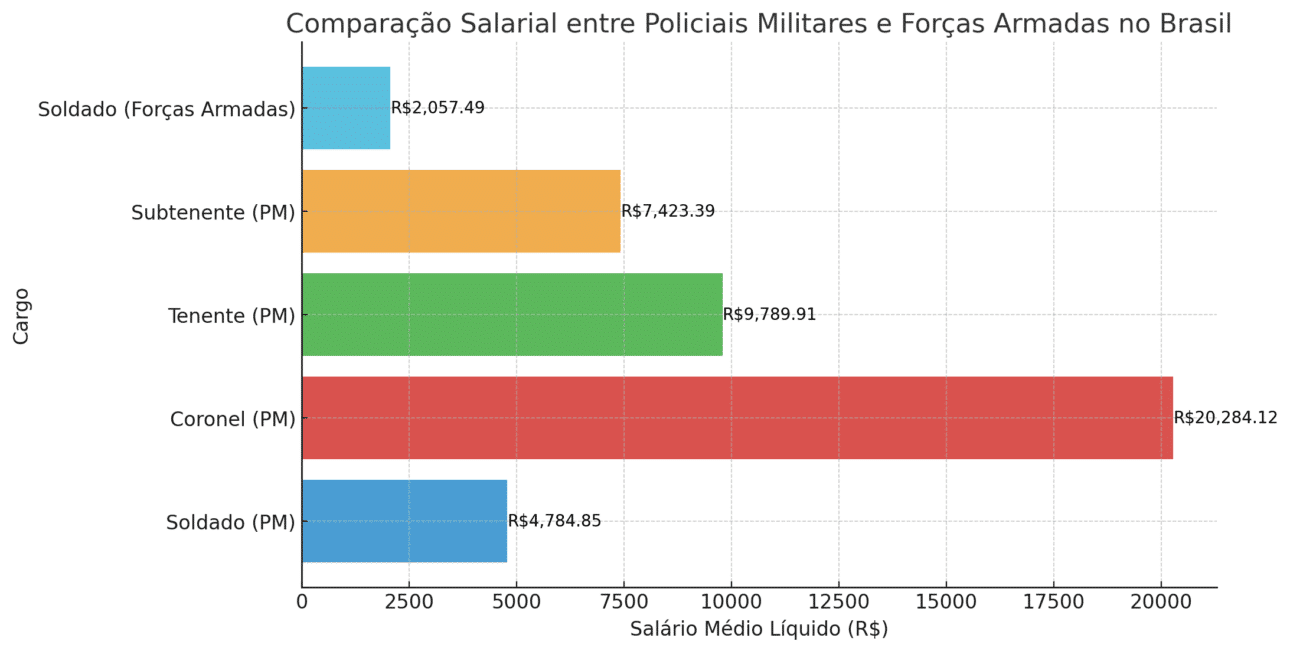
A soldier, at the base of the hierarchy, receives an average net salary of R$ 4,784.85, while a colonel, at the top of the hierarchical scale, can earn up to R$ 20,284.12 net—a difference of more than four times. These figures highlight the disparity in values paid between the lower and higher ranks within the corporation itself.
In the career of officers, the numbers are also striking. Lieutenants, who represent the first rank of the category, have an average net salary of R$ 9,789.91.
In contrast, a sergeant, who holds the highest rank among soldiers, receives an average of R$ 7,423.39.
This reveals a curious dynamic: even at the top of their career, a soldier still earns less than a newly appointed officer.
This disparity sparks discussions about the progression model adopted, and the debate about a single career, which advocates for the unification of functions and a more continuous progression among different ranks, has gained ground.
According to the study, this restructuring could motivate police officers, creating a more equitable progression system that better values time served.
Comparison With The Armed Forces
Another controversial point in the survey is the comparison between the salaries of the Armed Forces (Army, Navy, and Air Force) and those of the Military Police.
The disparities between federal military personnel and state military police are evident, even though both constitutionally belong to the country’s defense and security forces.
The data indicates that a soldier in the Armed Forces earns, on average, 231% less than their equivalent in the Military Police.
This percentage highlights a valuation gap that is reflected in cases where sergeants of the Armed Forces leave their positions to join as soldiers in the Military Police in search of better salary conditions.
Hierarchical Progression And Impact On Motivation
In the structure of the Armed Forces, progression to the top is extremely limited. General officers, such as generals, admirals, and brigade commanders, represent less than 1% of the total personnel, and only 0.002% of lieutenants achieve the rank of brigade commander.
According to the Military Society, these high-ranking positions inflate the average salaries and create a distorted view of what the majority of military personnel actually earn.
Moreover, according to experts’ analysis, the average earnings of military personnel in the Armed Forces correspond to approximately 43% of the average remuneration of military police of the same rank.
This contrast raises questions about how federal military service is valued and why, in practice, a member of the Armed Forces earns less than a military police officer, even though the Military Police is constitutionally subordinate to the Army.
The Consequences And The Future Of Military Careers
These salary disparities and difficulties in hierarchical progression directly impact the work and satisfaction of professionals, with significant reflections on public safety.
The Brazilian Forum on Public Security argues that the debate about appreciation should not be limited to salary adjustments but should consider ways of restructuring, qualifying, and simplifying careers, allowing for fairer mobility between positions and hierarchies.
The Need To Rethink The Structure Of Security Careers In Brazil Is An Increasingly Urgent Topic, Especially In A Context Of Rising Social Demands For Security.
For experts, the creation of a single career that simplifies hierarchical steps and values time served would be an alternative to keep professionals more motivated and engaged.
What Changes Could Really Bring A Balance Between Salary Appreciation And Professional Progression Within The Security Forces?







-

Uma pessoa reagiu a isso.