





 Portuguese
  English
  Spanish
  4 min of reading
  0 comments


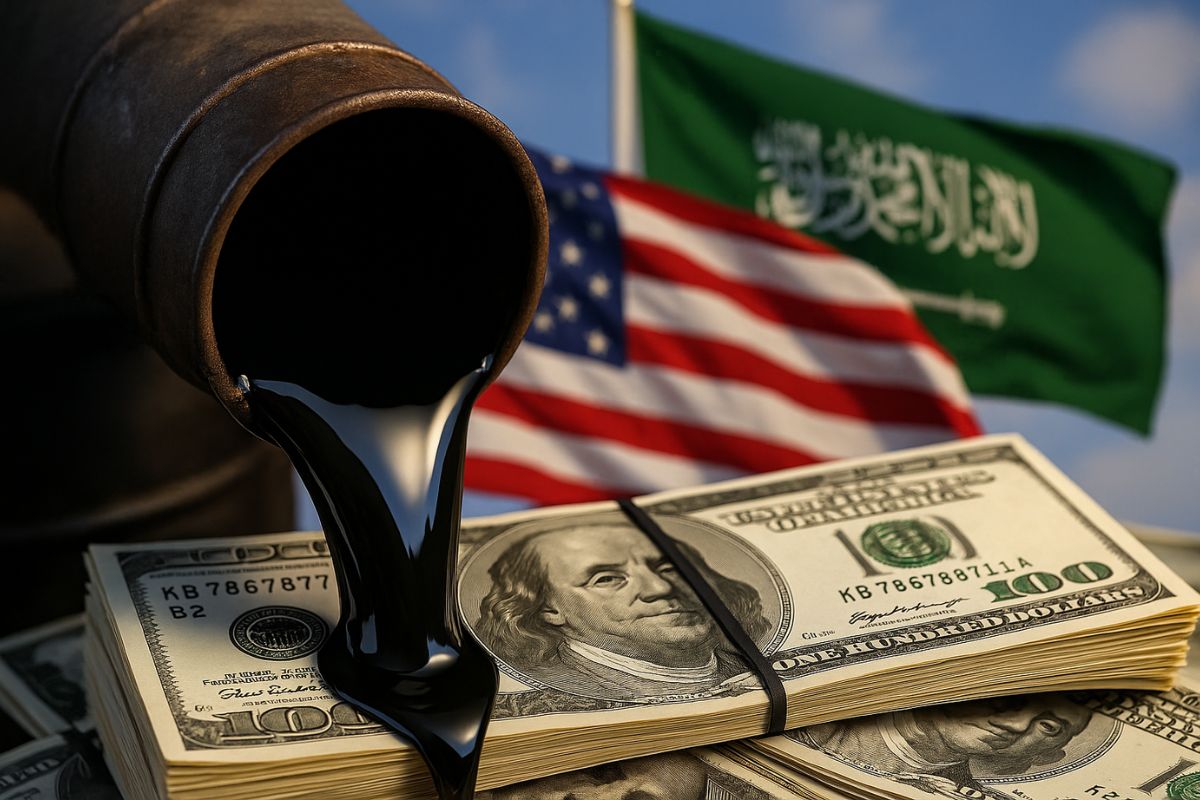
For 50 Years, An Alliance Between The United States and Saudi Arabia Ensured That The US Dollar Functioned As The Official Oil Currency
For five decades, a strategic agreement between the United States and Saudi Arabia defined the rules of the global economy, establishing the US dollar as the official oil currency. This system, known as the “petrodollar”, not only secured American financial supremacy but also emerged from a crisis that redefined global power in the early 1970s.
Today, in 2025, this 50-year order faces its biggest threat. The rise of China as an economic power, the unification of countries in the BRICS+ bloc, and the development of new financial technologies are, for the first time, seriously challenging the dominance of the dollar. The big question is whether we are witnessing the dismantling of the system that sustained the modern economy or merely its adaptation to a new multipolar reality.
The Origin Of It All, The End Of The Gold Standard In 1971 And The 1973 Oil Crisis
The history of the petrodollar begins on August 15, 1971. On that day, American President Richard Nixon shocked the world by suspending the convertibility of the dollar into gold. This decision, known as the “Nixon Shock”, ended the Bretton Woods system and transformed the dollar into a fiat currency, with no physical backing. The US urgently needed a new way to ensure global demand for its currency.
-
The Argentine government celebrates the lowest poverty rate in 7 years, but experts warn that the methodology has changed, real wages have fallen, unemployment has risen, and the number of people on the streets of Buenos Aires has increased by 57% since Milei took office.

-
7.8 magnitude earthquake in Indonesia frightens the population, triggers tsunami alert, and hits an island with over 200,000 inhabitants this Thursday.
-
Google will finally let you change that embarrassing Gmail address you created in your teenage years without losing any accounts, logins, or old emails: the feature is already available in the United States.

-
The institute that trained the greatest aerospace engineers in Brazil has just opened its first campus outside São Paulo after 75 years: ITA Ceará will have R$ 445 million, new courses in energy and systems, and classes are expected to start in 2027.

The opportunity arose from a crisis. On October 6, 1973, the Yom Kippur War broke out. In retaliation for American support of Israel, the Arab oil-producing nations imposed an embargo. The price of oil quadrupled, skyrocketing from US$ 3 to nearly US$ 12 by January 1974. This caused an energy crisis in the West and a flood of dollars — the “petrodollars” — into the coffers of OPEC countries.
Unraveling The US-Saudi Arabia Pact Of 1974
Contrary to popular myth, there was never a secret treaty that obliged Saudi Arabia to sell its oil exclusively in dollars. That was already the market practice. The real agreement was more subtle and strategic.
On June 8, 1974, the US and Saudi Arabia established the “Joint Commission for Economic Cooperation”. Officially, the pact was to provide technical and military assistance to the Saudi kingdom. Behind the scenes, the agreement established the mechanism for “petrodollar recycling”. In exchange for military security, Saudi Arabia agreed to invest its vast oil revenues in US government debt securities. This created a perfect cycle for the US.
The Consequences Of The Official Oil Currency, 50 Years Of American Hegemony
The recycling of petrodollars gave the United States what has been called the “exorbitant privilege”. The constant demand for Treasury securities allowed the country to maintain huge budget and trade deficits year after year, without suffering the consequences that would bankrupt other economies. Essentially, the rest of the world financed the American lifestyle and military spending.
With the global financial system dependent on the dollar, the US also gained a powerful weapon. The ability to impose sanctions, cutting countries off from the system, became an unparalleled foreign policy tool. However, the system also had global side effects, such as an arms race in the Middle East and the debt crisis of the 1980s in Latin America, caused by recycled petrodollar loans.
The Rise Of China And The “Petroyuan”
The first major challenge to this system comes from China. As the world’s largest oil importer, Beijing sees it as a strategic vulnerability to have to use the currency of its main rival to purchase its most vital resource. Therefore, the country seeks to establish the “petroyuan”.
In March 2018, China launched the Shanghai International Energy Exchange, a market that allows the trading of oil futures contracts in its own currency. Additionally, the country has been closing bilateral agreements with nations like Russia for trade in local currencies. Despite these efforts, the yuan still faces significant obstacles, such as the stringent capital controls of the Chinese government, which diminish international investor confidence.
A Multipolar World And The Gradual Decline Of The Dollar
Today, the challenge to the dollar as the official oil currency is broader. The expansion of the BRICS+ bloc in 2024, which included major producers like Saudi Arabia and the United Arab Emirates, created a powerful forum to accelerate de-dollarization.
The most concrete threat, however, is technological. The mBridge Project, a platform for central bank digital currencies of which Saudi Arabia became a member in June 2024, allows for instant international payments that completely circumvent the dollar system.
Numbers already show this trend. IMF data reveals that the dollar’s share of global foreign exchange reserves fell from 72% in 2000 to around 58% by the end of 2024. The collapse of the dollar does not seem imminent, as no rival has the strength of its financial ecosystem. The most likely scenario is a slow transition to a more fragmented and multipolar monetary world.









-

-

-

5 pessoas reagiram a isso.