





 Portuguese
  English
  Spanish
  6 min of reading
  0 comments


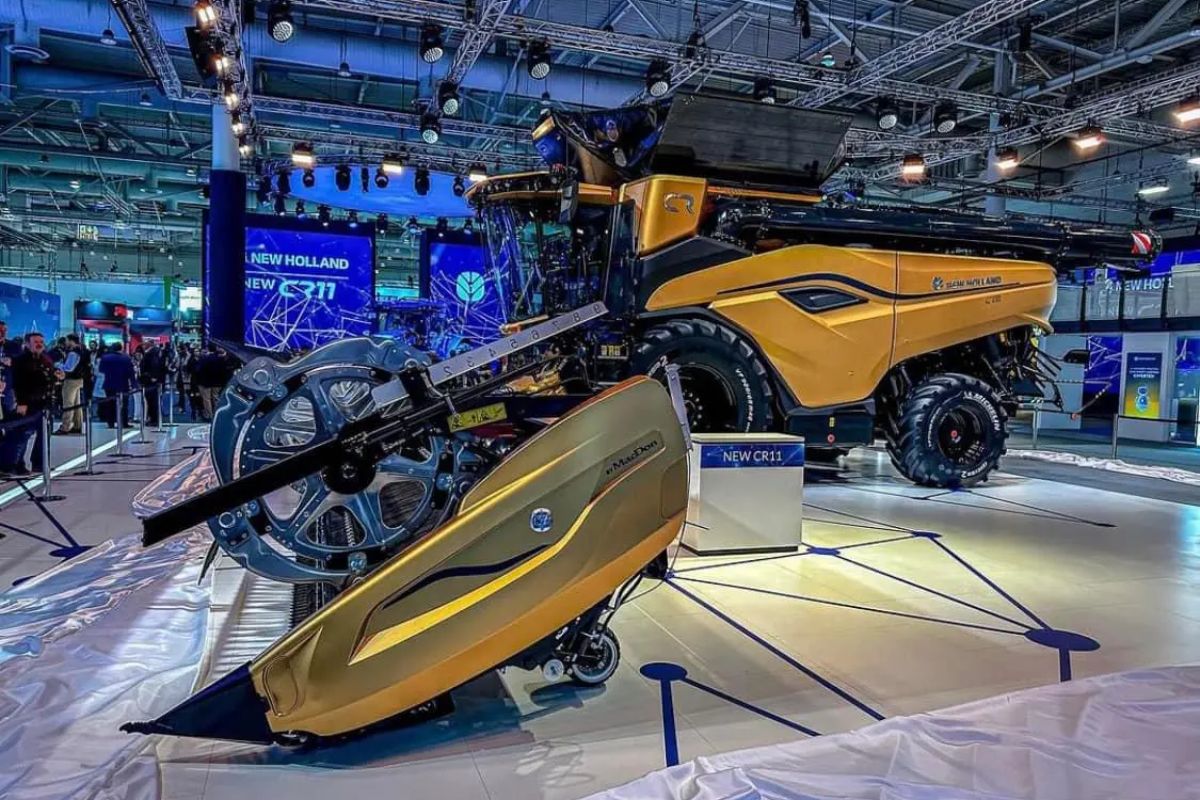
With Bigger Machines, Agriculture Accelerates the Transition of Farms to Industrial-Scale Operations, with Extreme-Width Planters, High-Coverage Sprayers, Modular Systems, and a CR11 Harvester That Combines Power, Quick Discharge, and Automation to Increase Daily Productivity on Properties That Operate Against Short Windows.
The machines have ceased to be merely support tools in the field and have become the centerpiece of the production strategy in large-scale farms. What appears as gigantism, in practice, responds to an objective operational account: to plant, spray, and harvest more area in less time, with fewer stops and less loss.
This movement doesn’t happen by chance or in just one country. It appears in environments where the planting and harvesting window is short, the cultivated area is extensive, and each hour of operation interferes with the final result of the harvest. Therefore, the advancement of machines combines width, power, automation, tank capacity, and discharge speed in one technical package.
When Agriculture Starts to Operate as an Open-Air Industry

The starting point of this transformation is the size of the properties and the pressure for productivity. In regions with farms spanning tens or hundreds of thousands of hectares, conventional machines start to create bottlenecks because they require more passes, more refueling, and more time to complete the same task.
-
While Russia dominates the global wheat market, Brazil emerges as an unexpected competitor in the Cerrado, offering grain available in July and August when stocks in the Northern Hemisphere are at their lowest point of the year.

-
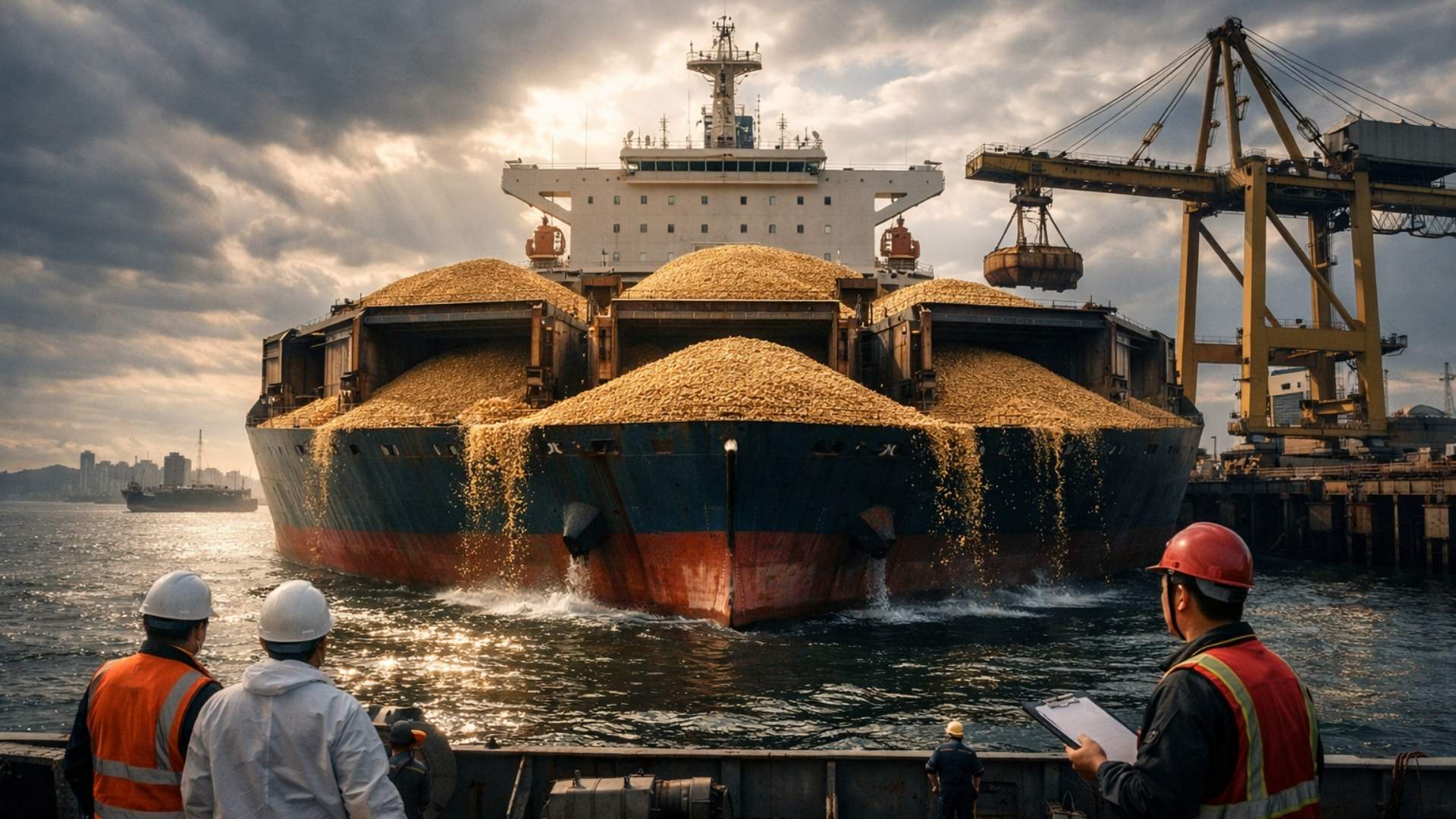
China returned almost 20 Brazilian ships with soybeans, but now everything could change: the country that buys 80% of the grain is considering relaxing regulations after impurities held up shipments of thousands of tons and caused million-dollar losses.
-
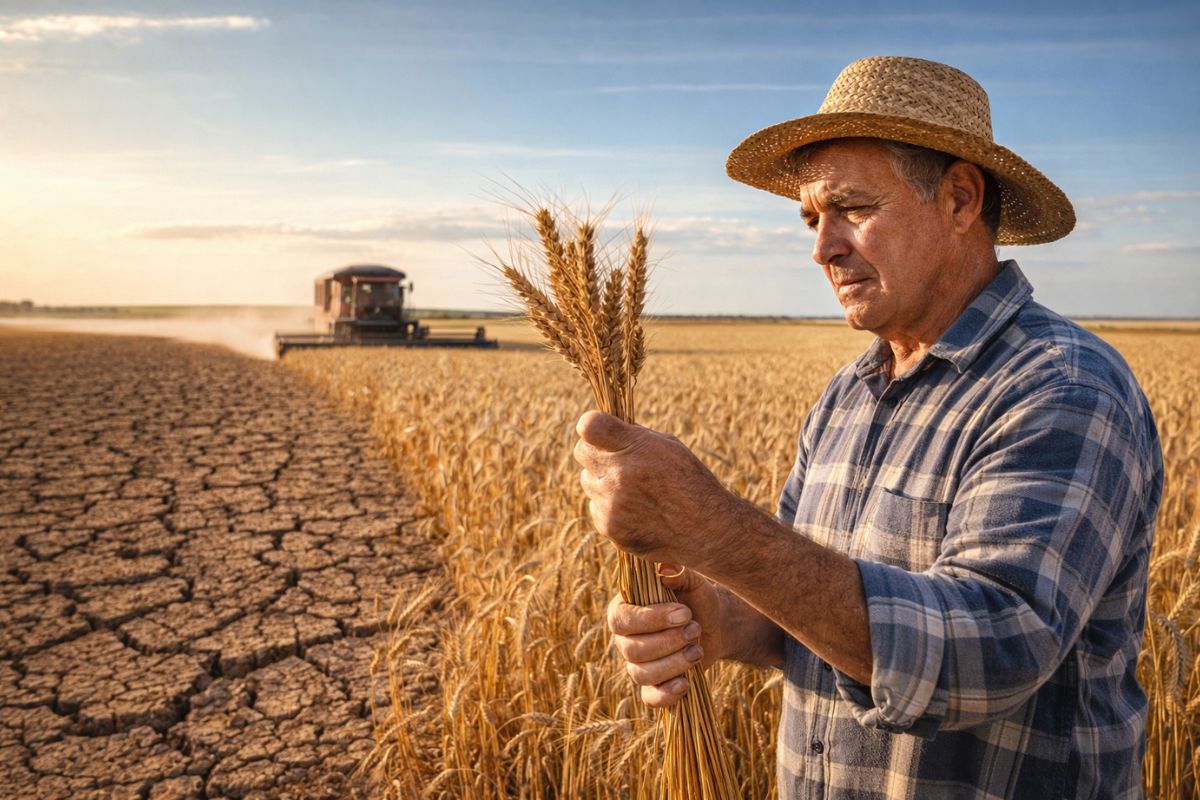
The drought of the cerrado was considered an enemy of wheat, but Brazilian scientists turned the lack of rain into a competitive advantage by creating a grain with quality that is already attracting the attention of international mills around the world.
-
THE OWNER of Brazil: a farmer who came from laundries, created an ’empire’ and today runs a company valued at R$ 42 billion after tripling its value in less than a year and receiving a billion-dollar investment from the USA.

The scale changes the logic of the farm, which begins to organize itself as an industrial operation distributed across the territory.
In this scenario, the central question shifts from merely which equipment is bigger to which set delivers more yield per day with stability.
That’s why records of width, discharge, and capacity have gained technical importance. They reduce idle time, expand coverage per pass, and help the producer navigate tight climatic windows without compromising the pace of agriculture.
Multiplanter and the Width Leap That Redefines Planting

Among the machines that symbolize this turnaround, the Multiplanter holds a special place because it brings planters to an uncommon scale outside of large areas in Australia.
Developed by Multifarming Systems, it was designed for properties where planting needs to progress swiftly without losing precision. Here, width is not a visual spectacle; it is a calendar strategy.
The maximum version announced reaches 92 meters in width and 273 planting rows, surpassing the previous record of 48 meters mentioned for the prior generation. The system is modular, allowing for rows to be added or removed according to the operational needs and growth of the farms.
Operating between 8 and 12 km/h, the Multiplanter demonstrates how giant machines can maintain planting accuracy even at high speeds when the demand is to cover vast areas in a short time.
Fendt Ideal 9T and the Factory Harvester with a 50-Foot Platform
The Fendt Ideal 9T stands out as a clear example of how harvesting machines have evolved to sustain intense operations without relying on frequent discharges.
The initial highlight is the 50-foot platform, about 15 meters wide, cited as a factory differentiator. This figure changes productivity per pass and helps to understand why the harvester has gained prominence in large harvests.
The two rotor track assembly virtually spans the entire machine, enhancing separation and threshing while reducing losses in heavy conditions.
The grain tank, with about 16,100 liters, equivalent to over 200 bags of soybeans, allows for longer periods of continuous work. Additionally, there is an autopilot, high-precision GPS, loss monitoring, and automatic adjustment control, forming a harvester designed for high daily output in large-scale farms.
Uniport 4530 and the Size That Only Works with Spraying Precision
In the case of the Uniport 4530, developed by the Brazilian company Jacto, the size of the machines is directly linked to operational control. The 4,500-liter tank and the booms of up to 42 meters enhance the area covered per pass and reduce stops for refueling.
But the real gain comes not only from size, but from the ability to maintain stability and precision in different terrain conditions.
The intelligent 4×4 hydrostatic traction automatically adjusts the force on each wheel, improving grip, reducing bogging, and helping to contain soil compaction.
The Unitrack system, as described technically, reduces the turning radius by up to 35% and can increase the daily treated area by up to 10%. In ideal conditions, the Uniport 4530 exceeds 100 hectares per day, placing it among the most productive spraying machines for large-scale farms.
Nexat and the Conceptual Shift That Goes Beyond the Large Tractor
The Nexat enters the list as a conceptual breakthrough, not just as one more of the giant machines in agriculture. Developed in Germany, it functions as a self-propelled platform for direct coupling of modules, instead of operating like a conventional tractor that tows implements.
The change addresses a structural problem of modern mechanization: soil compaction caused by the repeated traffic of heavy sets.
This architecture allows the same equipment to transform into a planter, sprayer, or harvester in just a few minutes, with module changes done by one person in less than 10 minutes, according to the system description.
In a configuration of 14 meters wide, about 95% of the cultivated area is not compacted by wheels or tracks, and the total weight can be up to 40% lighter than a traditional set.
When equipped with a harvesting module, the Nexat demonstrated over 24 tons of grain discharge in under 1 minute during tests in Brazil.
Its transverse axial rotor, nearly 6 meters long, sustains estimated yields between 130 and 200 tons per hour, depending on the crop, and helps explain why the system has been regarded as one of the most disruptive machines in modern agriculture.
CR11 at the Center of the Agricultural Revolution and the New Capacity Ceiling
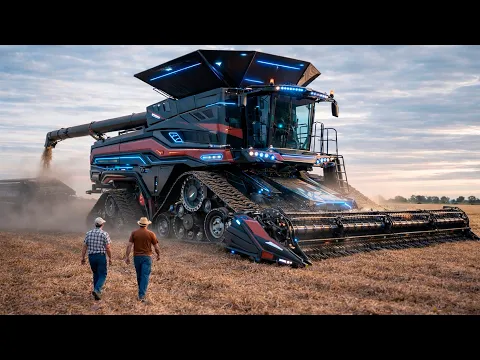

The New Holland CR11 is presented as the largest harvester in the world and visibly embodies the logic that has been driving agriculture towards industrial-standard machines.
Resulting from about 10 years of development, the CR11 emerges as an evolution of the CR10.90, a model that had already made history by harvesting nearly 800 tons of wheat in 8 hours. The new stage is not limited to growing in size; it enhances material flow, discharge, and automation.
On the CR11, the trail capacity is estimated to be 20% to 40% higher in relation to the previous generation, with larger and longer rotors. The diameter increases from 56 to 61 cm, the length reaches 3.5 meters, the discharge hits 210 liters per second, and the grain tank holds 20,000 liters.
The engine delivers up to 775 horsepower, sensors distribute material across the sieves even on sloped terrain, and artificial intelligence systems automatically adjust settings for better performance.
There is also an estimate of harvesting over 1,000 hectares per day and highlighting the gold medal for innovation at Agritechnica. These numbers help explain why the CR11 has become a benchmark in the debate about high-yield machines and why the harvester occupies the symbolic center of this new phase of agriculture.
What These Records Say About Farms, Cost, and Operational Decision
When observing machines like Multiplanter, Fendt Ideal 9T, Uniport 4530, Nexat, and CR11 together, a clear technical pattern emerges.
The gain is not in a single isolated number but in the combination of working width, reduction of stops, automation, less compaction, and greater yield per hour. This alters the way to plan teams, support logistics, and fuel usage within the farms.
It also becomes evident that not every property needs machines of this size. These equipment make more sense in operations with extensive area, short windows, and a need for high daily volume. In other scenarios, the cost and complexity can outweigh the benefits.
Still, they serve as a showcase of what the industry considers a priority for the future of agriculture: operational efficiency, system integration, and continuous performance at scale.
The advancement of these machines shows that agricultural mechanization has entered a phase where size, technology, and yield go hand in hand. The largest harvester in the world, the CR11, has become a symbol because it combines power, quick discharge, and automation in a package that encapsulates the direction of agriculture in large areas, operating more as an industrial system and less as a sum of isolated steps.
In your experience or observation of the field, what factor weighs most when discussing giant machines: width to save time, discharge to avoid stops, automation to reduce losses, or less soil compaction, and in what type of farms does this truly change the harvest outcome?









-

-

-

3 pessoas reagiram a isso.