





 Portuguese
  English
  Spanish
 5 min of reading
  0 comments


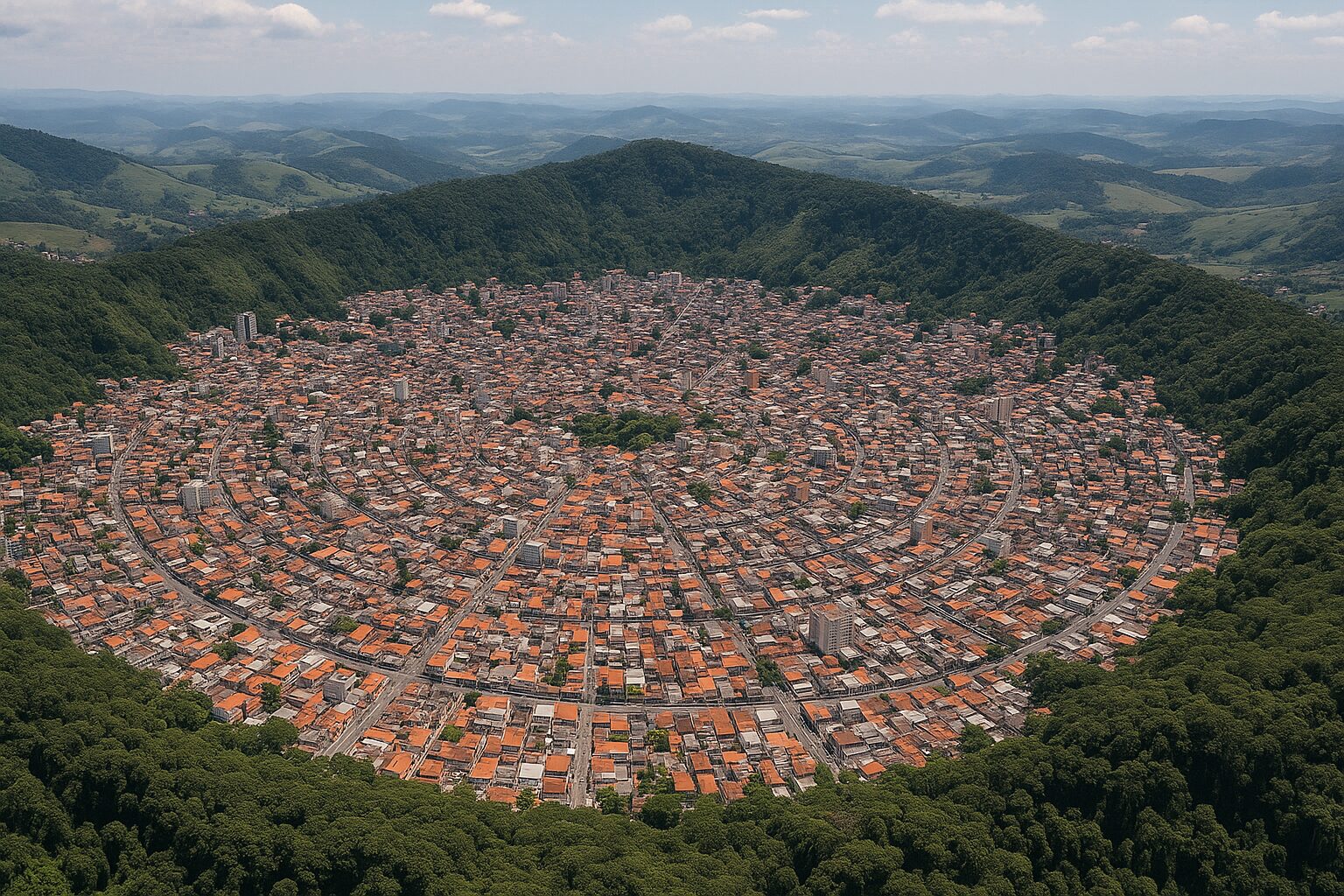
In the Far South of Brazil’s Largest Metropolis, a Quiet Neighborhood Hides a Cosmic Secret Beneath the Feet of Its Residents. The Vargem Grande Neighborhood, in Parelheiros, is Located Within a True Meteor Crater — the Colonia Crater — One of the Only Habited Formations of Its Kind on the Planet.
Imagine going about your routine in a common neighborhood and suddenly discovering that you are living inside a meteor impact crater formed between 5 and 36 million years ago. This is the reality for the residents of the Vargem Grande neighborhood, in the Parelheiros district, south zone of São Paulo, approximately 40 km from Praça da Sé, the zero mark of the capital. The geological formation where the neighborhood was built is known as the Colonia Crater and was only identified in the 1960s after the analysis of aerial photographs and satellite images.
Since then, it has been the subject of over 60 years of scientific studies, and is now internationally recognized as one of the few inhabited craters in the world. See also: The City in Brazil Where the Ground Gave Way, Neighborhoods Disappeared from the Map, and Over 60 Thousand Residents Were Forced to Flee Their Homes
The Discovery of the Neighborhood Built in a Crater


The existence of the neighborhood built in a crater remained a mystery until the 1960s when scientists began to suspect its origin while analyzing aerial images that showed an unusual circular pattern in the region’s relief. Subsequently, with the arrival of satellite images, the structure was investigated further.
-
Spain surprises the world by erecting 62 artificial dunes, mixing sand with natural remains of posidonia, and causing the structure to lose only 1.4% of its volume in 1 year.

-
With 16 Bulava missiles, improvements in acoustic stealth, and a design focused on silent patrols, Russia’s nuclear submarine was born to ensure Moscow’s invisible retaliation and has become one of the pillars of its maritime strength.

-
‘Populous’ city in Rio among the worst in Brazil in national ranking and exposes silent development crisis.
-
Couple buys house in the South Zone of São Paulo, opens a hidden door in the garage, and finds a secret wine cellar with dozens of old wines forgotten since the 1970s.

With a diameter of 3.6 kilometers, a depth of 400 meters, and edges reaching 120 meters high, the formation soon drew the attention of the geological community. Initially, it was thought to be a natural depression or one caused by volcanic processes, but new evidence pointed in another direction: the impact of a meteor or comet coming from space.
A Piece of the Solar System in the Heart of São Paulo – Neighborhood Built in a Crater
Recent research led by geologist Victor Velázquez from USP, with support from Fapesp, confirmed that the formation is indeed a impact crater, resulting from the collision of a celestial body with the Earth’s surface.
According to Velázquez, the impact occurred at high speed, releasing an enormous amount of energy, enough to create a depression several kilometers in length. The site has been officially recognized and included in the Earth Impact Database, maintained by the University of New Brunswick in Canada — the main database of impact craters on Earth.
To date, the database lists only 190 confirmed impact craters worldwide, and only two of them are inhabited by humans: the Colonia Crater in Brazil and the Ries Crater in southern Germany.
Vargem Grande: A Neighborhood Inside the Crater
The Vargem Grande neighborhood, located in the center of the crater, is home to hundreds of families and a landscape that contrasts with the rest of the metropolis. Surrounded by native Atlantic Forest vegetation, mild climate, and little traffic, the area gives the sensation of being far from São Paulo, even though it is part of it.
Despite the grandeur of the geological formation, many residents only learned of the crater’s existence in the 1990s, when research was made public in the media.
“Everyone was shocked by the news. But then they got used to it, and nowadays they even take a certain pride. People proudly say they live in a meteor crater,” says Ozéias, a resident of the neighborhood since the 1980s.
Geological and Environmental Heritage
Due to its scientific and environmental importance, the Colonia Crater was declared a protected area in 2003 by the Condephaat (Council for the Defense of Historical, Archaeological, Artistic, and Tourist Heritage of São Paulo) and, in 2009, it received the title of State Geological Monument.
The area is also considered an environmental heritage of the city, protected by laws that prohibit irregular occupations and encourage preservation actions. Part of the region is being transformed into the Colonia Crater National Park, still in the implementation phase.
Curiosities About the Colonia Crater
Here are some curiosities that make this neighborhood even more surprising:
- The Colonia Crater was formed between 5 and 36 million years ago, according to geological studies.
- The structure has an almost perfectly circular shape, with a 3.6 km diameter, visible on satellite maps.
- It is one of the only two inhabited craters in the world.
- The area features unique characteristics, such as preserved vegetation, clean water springs, and geologically distinct soil.
- For many years, the origin of the terrain was attributed to natural subsidence or an ancient lake, before the celestial impact was proven.
The Crater and Science: What Researchers Say
The confirmation that the Colonia Crater is of meteoric origin only came with more detailed analyses of rocks from the region. These samples showed evidence of shock metamorphism — a structural transformation that occurs only with the release of energy during cosmic impacts.
Other data, such as the presence of deformed minerals and the symmetrical circular topography, reinforced the theory. According to scientists, the celestial body that caused the impact was several meters in diameter and reached Earth at speeds of up to 20 km per second.
This collision released energy equivalent to thousands of atomic bombs, creating the terrain that today serves as a home to residents, schools, businesses, and public roads — all within the scar left by an astronomical event.
Tourism and Awareness
The neighborhood and the Colonia Crater have been attracting the attention of curious people, students, researchers, and even tourists interested in geology and astronomy. Various informational signs and viewpoints have been installed, and guided tours are offered through local educational projects.
The proposal for the Colonia Crater National Park includes the creation of visitor centers, ecological trails, observation points, and environmental education programs, making the region a hub for scientific and sustainable tourism.
For the residents, the existence of the crater is a cause for curiosity and, for many, pride. According to reports, the news about the meteoric origin initially caused surprise, but it has now become part of the local identity.
The main concern now is with the preservation of the area, in the face of urban expansion and real estate speculation. Civil organizations and environmental NGOs work in partnership with the state government to protect the crater against irregular occupations and constructions.
Other Impact Craters in Brazil
Brazil has eight cataloged impact craters in the Earth Impact Database. Here are a few:
| Crater Name | Location | Diameter (km) | Habitation |
|---|---|---|---|
| Colonia | São Paulo (SP) | 3.6 | Yes |
| Araguainha | MT/GO | 40 | No |
| Serra da Cangalha | Tocantins | 13 | No |
| Vista Alegre | Paraná | 9.5 | No |
| Riachão | Maranhão | 4 | No |
| Cerro do Jarau | Rio Grande do Sul | 13 | No |
| São Miguel do Tapuio | Piauí | 20 | No |
| Vargeão | Santa Catarina | 12 | No |








-

-

-

5 pessoas reagiram a isso.