





 Portuguese
  English
  Spanish
  8 min of reading
  0 comments


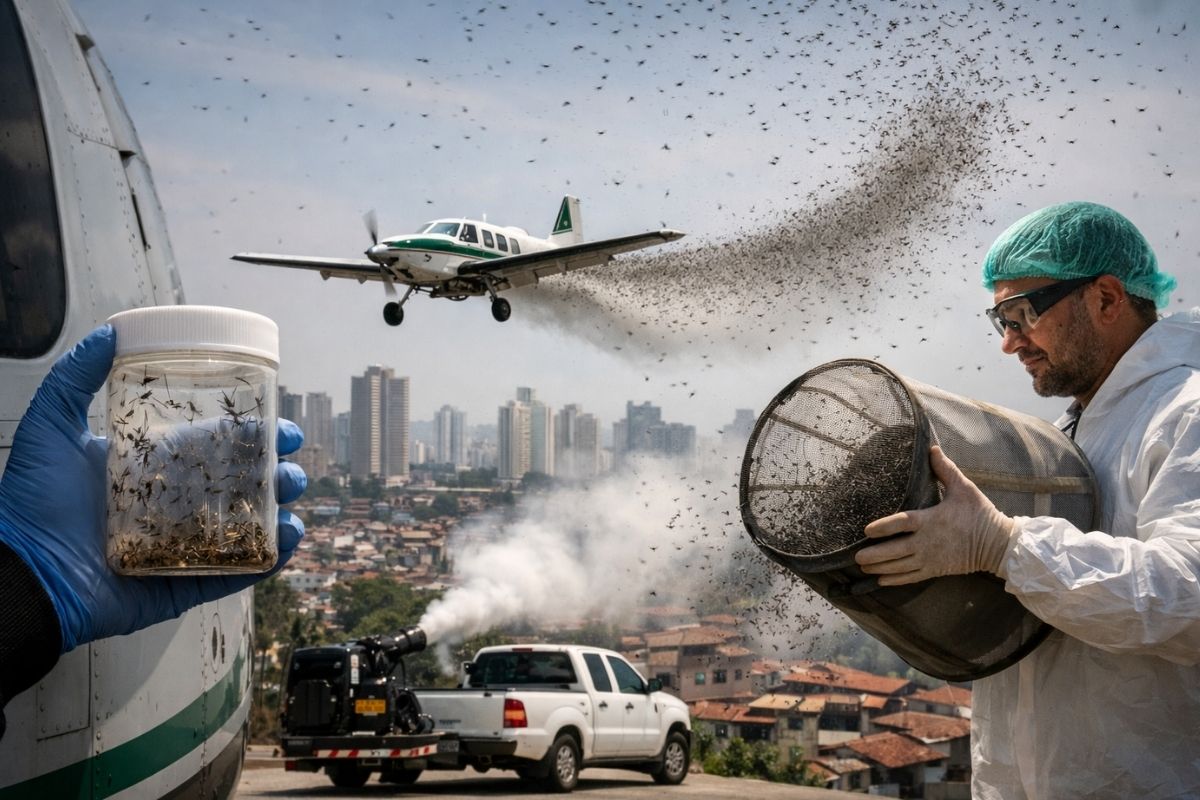
In Cities Like Joinville And Niterói, The Strategy Against Dengue Releases Aedes Aegypti With Wolbachia To Block Virus And Make The Mosquito Population Less Dangerous. The Wolbito Biofactory Of Brazil In Curitiba Will Produce Up To 100 Million Eggs Per Week To Attend The Ministry Of Health This Year.
In Brazil, the fight against dengue has entered a phase that seems counterintuitive at first glance: instead of trying to eliminate all mosquitoes, trucks and teams now release new Aedes aegypti in the streets to weaken the transmission of the disease.
The logic behind the measure is to transform the mosquito itself, historically seen as the enemy, into an ally of public health. The strategy frightens residents, divides opinions, and requires intense communication, because living with clouds of insects is part of the process of reducing dengue and other arboviruses in urban areas.
Why Dengue Led Brazil To Adopt Such An Unusual Strategy

Dengue remains one of the greatest pressures on public health in Brazil because the country has ideal conditions for Aedes aegypti: heat, humidity, and an abundance of food and shelter, even in densely populated areas.
-
The coldest seawater ever recorded in Earth’s history was hidden under extreme ice 717 million years ago and reached an impressive -15°C.

-
China has launched the world’s first floating artificial island, a scientific structure designed to face open seas, test equipment weighing hundreds of tons, and reach depths of 10,000 meters.

-
China accelerates global science and may surpass the United States in 2 years with increased public investment, continuous growth, and direct impact on the global technological competition.

-
Scientific studies indicate that drought may be strengthening a much greater silent threat: more resistant superbugs.


In this scenario, more than 90% of the population lives in a risk zone, which increases the potential for outbreaks and overload of services.
The impact is not limited to the discomfort of fever and pain.
In severe cases of dengue, there is a risk of severe complications and death, which worsens the social situation when epidemics spread and hit harder those with fewer resources to protect themselves, such as families without screens on windows or without constant access to repellents.
This background helps explain why Brazil has started to seek alternatives beyond the traditional package of control, which includes eliminating standing water, applying chemical products, and awareness campaigns.

Even with a focus on vaccination starting in 2024, initially targeting children and adolescents, adherence has not progressed as expected, with only about 17% of doses recorded in the initial stage, while the need for more effective responses continued to grow.
What Changes When The Mosquito Carries Wolbachia

The core of the strategy is the bacterium Wolbachia. It is natural, widely present in the insect world, and does not depend on genetically modified mosquitoes.
The method uses Aedes aegypti with Wolbachia to hinder the development of arbovirus in the mosquito’s body, reducing its ability to transmit.
The biological logic is straightforward: when Wolbachia is established in the mosquito, the dengue virus has difficulty replicating.
Without efficient replication, the Aedes aegypti becomes much less competent at transmitting dengue through new bites.
As the bacterium can be transmitted to the next generations, the strategy seeks something greater than a one-time action: to make protection self-sustaining over time, with the mosquito’s own reproductive cycle working in favor of dengue control.
How Releases Happen In Cities And Why There Seem To Be “More Mosquitoes”
In practice, the operation is visible and, for many residents, puzzling. In urban actions, teams circulate early, before peak hours, with containers holding mosquitoes ready for flight.
Along the way, they open lids and release the insects in sequence, repeating the procedure in small sections of the target area, because mosquitoes do not usually travel long distances.
There are also releases from containers with infected eggs: the eggs hatch in the environment, and the process follows the natural course of development until they become adult mosquitoes.
The operation is not a unique event, but a series of repeated releases over months, neighborhood by neighborhood, to increase the chance of Wolbachia establishing and spreading within the local population.
This is the point that confuses public perception. In the short term, the feeling may be of an increase in mosquitoes.
In some reports, releases even occur in common areas of condominiums, with male mosquitoes in hallways.
Technically, males do not bite, but that does not eliminate the discomfort of buzzing, landing on skin, and the constant presence, which fuels resistance and criticism, including in areas already suffering from dengue.
Consent, Communication And Monitoring To Avoid Panic
To function in an urban environment, the method relies on social acceptance. Therefore, the dengue strategy with Wolbachia is accompanied by stages of communication and engagement, with coordination with local authorities, health professionals, and community organizations.
Information circulates through radio, TV, social media, newspapers, local events, and, in some areas, through door-to-door visits to explain what will happen and why.
In addition, there are opinion polls and acceptance checks before releases.
The operation is described as dependent on the community’s “yes”, and areas with resistance may be excluded from the route, with the team seeking other points for deployment.
After the release, monitoring occurs: traps capture mosquitoes, and tests confirm whether Wolbachia is present, if it has been transmitted, and if the proportion of Aedes aegypti with Wolbachia is increasing.
This follow-up is essential to adjust the plan and sustain the promise of dengue reduction without relying on continuous reapplications.
What Has Already Been Observed In Niterói, Rio de Janeiro, And Other Brazilian Cities
Niterói, in the state of Rio de Janeiro, has become a national reference for being pointed out as the first city fully covered by the method.
The implementation started in a pilot format and was gradually expanded to dozens of neighborhoods, with coverage described as encompassing 33 neighborhoods and expanding in stages.
In the results associated with Niterói, there are two numbers that appear in different records: 69% reduction in dengue cases in studies and descriptions of a near 90% decline in local monitoring and communications.
In parallel, the comparison with nearby areas of Rio de Janeiro, during a time when there was not the same coverage of releases, reinforced the debate over why some municipalities advance more rapidly than others in adopting the method.
The method is also connected to a broader network of Brazilian cities with implementation underway or already established.
Among the locations cited as receiving Wolbachia actions are Niterói, Rio de Janeiro, Londrina, Foz do Iguaçu, Campo Grande, Joinville, Belo Horizonte, and Petrolina.
There is also implementation in progress in Presidente Prudente, Uberlândia, and Natal.
The ambition is to bring the protective effect against dengue to areas where Aedes aegypti is a daily and persistent problem.
The Biofactory In Curitiba And The Billion Scale Of The Strategy Against Dengue
The scaling of the project relies on the industrial structure installed in Curitiba, Paraná: the Wolbito do Brasil, presented as the largest biofactory in the world dedicated to breeding Aedes aegypti with Wolbachia.
The unit has more than 3,500 m² of built area, automation, and breeding equipment, in addition to a specialized entomology team of around 70 professionals.
The projected capacity is 100 million eggs per week, with the potential to reach approximately five billion eggs per year, in a production designed to meet national demand.
The operation was announced to initially work exclusively for the Ministry of Health, ensuring distribution to regions with high dengue rates.
In the estimate presented for the functioning phase, the biofactory expects to protect at least 14 million people per year, expanding access to the method and reducing dependence on smaller breeding and release structures.
Who Is Behind It And Why The Project Became A Symbol Of National Innovation
Wolbito do Brasil is described as the result of a joint venture involving the Molecular Biology Institute of Paraná, linked to Fiocruz, and the World Mosquito Program.
The implementation highlights more than ten years of accumulated experience, international cooperation, and the use of the method by a global network already present in various countries.
In Brazil, the implementation of the method is associated with coordination arrangements between municipalities, states, and the Union, as well as integration with other pillars of dengue control, such as surveillance, diagnosis, and vaccination.
The central argument is that Brazil’s territorial scale demands capillarity and logistical capacity, something that the combination of SUS, science, and national production seeks to address.
Where The Expansion Begins: Cities Listed To Receive The “Wolbitos”
With the biofactory strengthening the supply, municipalities have been listed to enter the communication and engagement phase before releases: Balneário Camboriú and Blumenau, as well as new areas in Joinville, in Santa Catarina; Valparaíso de Goiás and Luziânia, in Goiás; and Brasília, in the Federal District.
The reported forecast for these fronts is to start releases between August and September, after the dialogue stage with the population and local preparation.
The selection of municipalities was described as selective and linked to the national strategy to reduce dengue and other arboviruses.
Fear, Misinformation, And The Debate Over “Releasing Mosquitoes” In Mass
Dengue has created an environment where out-of-the-box solutions arouse both hope and mistrust.
For part of the population, releasing mosquitoes in neighborhoods seems contradictory, especially in places where the bite is already a daily nuisance.
Even when the method relies on a natural bacterium and tests for Wolbachia presence, the topic can be crossed by noise, theories, and fear of experiments.
The discussion gains momentum because there have been historical precedents of mosquito releases in completely different contexts, such as old tests linked to the ability to spread diseases, which raises concerns when it comes to laboratories, large-scale production, and controlling what is released into the environment.
Therefore, communication and operational transparency have become as important as the technique itself to sustain trust and avoid panic.
What The Wolbachia Method Does Not Replace In The Fight Against Dengue
Even with industrial expansion and the promise of a significant drop in dengue, the method is presented as complementary.
It does not eliminate the need for basic measures to control breeding sites, nor does it replace actions for surveillance, diagnosis, and rapid response to outbreaks.
It also coexists with the advancement of initiatives related to vaccination and other forms of risk reduction.
The practical goal is to reduce dengue transmission with a tool that, once established, tends to maintain a continuous effect, reducing the pressure on health systems and costs associated with hospitalizations and treatments, especially in urban areas where Aedes aegypti finds favorable conditions year-round.
Would you support the release of mosquitoes with Wolbachia in your city as a strategy to reduce dengue, even if it increases the presence of insects in the short term?








-

-

-

8 pessoas reagiram a isso.