





 English
  Francês
  Alemão
  Italiano
  Japonês
  Norueguês
  Portuguese
  Spanish
  8 min of reading


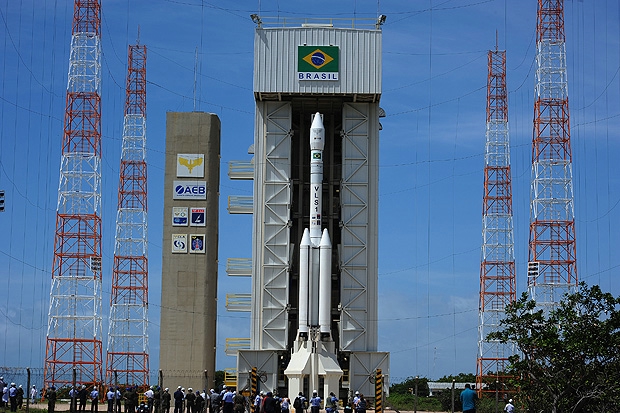
On Tuesday, the Trump administration signed a preliminary agreement with Brazil that could one day lead to U.S. rocket launches from the South American country’s coastal spaceport. President Trump praised the idea of using the base, arguing that “due to its location, enormous amounts of money would be saved.” However, while the launch site offers several important benefits for U.S. launch providers, it’s possible that these advantages may not be enough to attract all the major rocket companies to the area.
The biggest asset of Brazil’s spaceport is its proximity to the equator. The site, known as the Alcântara Space Center, is located at a latitude of just 2.3 degrees south. For anyone launching a rocket, this is an appealing point. There aren’t many options on Earth for launching them close to the equator, and this base would make it much easier for satellite operators to send payloads into an equatorial orbit. Furthermore, rockets at the equator receive an extra boost in speed thanks to the Earth’s rotation, which helps rockets save fuel.
However, the logistics of establishing a new launch base in Brazil may pose challenges for some. Major U.S. rocket companies like SpaceX, United Launch Alliance, and Blue Origin already have several launch options outside the U.S. that are relatively close to the equator. A new base would require substantial initial investment to create the ground infrastructure in Brazil to support each company’s unique rocket design. That’s a lot of money and work for a small amount of benefits in flights. Additionally, shipping to Brazil could add an extra layer of time and money that wouldn’t be an issue when launching in the U.S.
-
Government unlocks R$ 554 million for a highway that has been requested for decades and accelerates the duplication of BR.
-
Without bricks, without cement, and without endless construction: the cardboard house that is assembled in modules and can be moved.

-
Billions of barrels on the equatorial margin could lead Amapá to double its oil production in Brazil — the state aims to enter the route of companies in the Campos Basin, attract investments, and boost jobs and businesses in the oil and gas sector.

-
Without bricks, without cement, and without endless construction: the cardboard house that is assembled in modules and can be moved.

There are some launch providers on the smaller end of the rocket scale that see big opportunities in Brazil. Companies like the startup Vector, which is dedicated solely to launching small satellites, have openly advocated for the possibility of launching from Alcântara. This would allow them to conduct missions that they simply can’t do in the United States due to their smaller size. Since the company’s hardware isn’t as large as a Falcon 9 or Atlas V rocket, very little investment is necessary to make the launch pad infrastructure. “I think it will really be the domain of future small rockets that go there,” says Jim Cantrell, CEO and co-founder of Vector, to The Verge.
Why Brazil?
Rockets launching again from Alcântara would revitalize what was once a great national resource for Brazil. Numerous rockets sounded off in the area during the 1990s. But in 2003, a rocket designed for orbit exploded on the launch pad during some ground tests, killing 21 people nearby and leveling the launch tower. The accident halted Brazil’s efforts to launch two planned satellites, and the country’s space endeavors struggled to recover.
:format(webp):no_upscale()/cdn.vox-cdn.com/uploads/chorus_asset/file/15977553/GettyImages_2425254.jpg)
Debris at the Alcântara Launch Center, following the 2003 explosion
Since then, Brazil has been seeking international partnerships to bring vehicles from other countries to Alcântara. The country even courted the Bush administration in 2000 to bring commercial launches to the site, but those efforts faced opposition from Brazilian lawmakers. Now, Brazil is trying again. In 2018, the government invited two major players from the U.S. aerospace industry, Boeing and Lockheed Martin, to visit Alcântara, according to a Reuters report. The goal is to offer a cheaper site than the neighboring Guiana Space Center in French Guiana, South America, where all of Europe’s rockets fly.
Alcântara has some impressive geographic benefits that are essential for a spaceport. It is on Brazil’s coast, with the Atlantic Ocean to the east. This is critical for a launch site, as many rockets launch eastward to align with the Earth’s orbital direction. Launching over a large body of water is important for safety, as it reduces the risk of any part of the rocket falling on someone or damaging someone’s property. This is why U.S. launches occur in coastal areas, such as Cape Canaveral in Florida or Vandenberg Air Force Base in California.
Brazil has a slight advantage over Cape Canaveral, located about 28.5 degrees north. Being close to the equator is great for sending satellites into a type of orbit known as geostationary orbit. This is a path 22,000 miles above the Earth’s equator, where satellites are traveling at the same speed as the Earth’s rotation. The result is that satellites effectively hover over the same stretch of the Earth at all times. It’s a perfect spot to deploy a communications satellite or a surveillance probe that needs to look at the same region of the planet all the time.
:format(webp):no_upscale()/cdn.vox-cdn.com/uploads/chorus_asset/file/15977527/531752488.jpg.jpg)
A SpaceX Falcon 9 launches from Cape Canaveral, Florida
Reaching geostationary orbit from Florida requires a little extra work. Rockets must place a satellite in a slightly inclined path from the equator (with an inclination of 28.5 degrees), and satellites need to change their direction in orbit by burning an onboard engine. This requires fuel, which takes up space on a satellite and affects the design of the vehicle. At a place like Alcântara or the Guiana Space Center, such a plane change would be minimal, requiring less fuel.
Moreover, the Earth is actually moving faster at the equator than at other points on the planet, which is good news for rockets. The Earth’s equator is its widest section, so it has a long way to travel every time the planet completes a full 24-hour rotation. A point on the equator has to cover a much greater distance than a point near the poles, for example. Thus, a rocket launch at the equator receives an extra speed boost, making it easier for the vehicle to reach the high speeds necessary to achieve orbit. The rocket doesn’t need as much fuel, making launches more efficient and potentially allowing companies to carry more payload on a flight.
“You can use a less powerful rocket to launch the same satellite, or you can launch a bigger satellite using the same launch vehicle,” says Lakshmi Kantha, aerospace engineering professor at the University of Colorado Boulder.
WHO REALLY WANTS TO LAUNCH IN BRAZIL?
Are all these benefits enough to attract major U.S. companies to Brazil? It’s not a huge inconvenience to send rockets over water. In fact, Arianespace sends its rockets by boat from Europe and Russia to French Guiana. ULA also ships parts of its Delta IV Heavy by boat, and NASA used to send the external tank of the Space Shuttle from New Orleans to Florida. “Large ships are used to accommodate oversized equipment,” says Dennis Jenkins, aerospace engineer at the California Science Center, who used to work on the Space Shuttle, to The Verge. “Most large rockets throughout history have been shipped at least partially by sea.”
However, moving by boat is time-consuming and somewhat expensive, especially when traveling to Brazil via the Panama Canal. “This, of course, is one of the issues with ships – they are very slow,” says Jenkins. Having a launch site closer to where a rocket is built makes things more efficient. Recently, SpaceX CEO Elon Musk noted that the company’s next-generation rocket, Starship, would be built in Texas and Florida, next to two of SpaceX’s launch sites. Additionally, locations like Texas and Florida are still quite far from the south, meaning the performance benefit of moving even further south won’t be as significant for U.S. companies as it would be for Russia or European countries.
Then there’s the cost of equipping Alcântara to meet a launch provider’s needs. For larger rockets, companies will need to add concrete blocks, towers, and fuel storage tanks to the surrounding area to support flights of their vehicles. Building all this in the Brazilian jungle, where there is already minimal infrastructure, will require a lot of work and investment. Moreover, all this would be in service to securing more missions to geostationary orbit, which is a type of flight that has seen a recent slowdown in the market.
:format(webp):no_upscale()/cdn.vox-cdn.com/uploads/chorus_asset/file/15977555/DSC01302.jpg)
A Vector rocket, standing around 40 meters tall
SpaceX has already told Reuters that it is not interested in building at Alcântara and declined to comment to The Verge. Boeing and Lockheed Martin, which oversee United Launch Alliance, confirmed that they have looked at the site but have yet to make significant investment plans there. “While we have not made concrete plans at this time, the potential for a new launch site is an encouraging development, given the global interest in fast and efficient launch opportunities,” said a Lockheed Martin representative in a statement to The Verge. Boeing declined to comment.
Ultimately, Alcântara may be a better investment for rocket companies that don’t resemble SpaceX or ULA, which are pursuing an entirely different market. Companies like Vector are only capable of launching smaller satellites to low Earth orbit, and these types of probes are unable to significantly alter their directions in space. So, if a small satellite operator wants to get into a lower orbit over the equator, they’ll basically have to launch at the equator. “Virtually no one is launching rockets to equatorial orbits from low Earth orbit,” says Cantrell. “Practically no one.” Vector hopes to be one of the first companies to offer that option, claiming that about 10 customers have requested it.
An extra speed boost from a small launcher like Vector means a lot more than it would for SpaceX or ULA. It could be the difference between launching 200 pounds and 300 pounds, opening the company up to different types of missions. Additionally, the costs of infrastructure and transportation for Vector’s smaller rockets are less burdensome. “All we really need is a concrete pad like the one we’ve already built in Alaska, and we need permission to launch,” says Cantrell, adding that the company’s rocket can fit inside a plane.
Alcântara is far from being open for U.S. rocket business yet. The U.S. signed what is known as a technology safeguards agreement with the company, which is the same type of agreement signed by Bush in 2000. The agreement needs to be approved by the Brazilian Congress, and if that happens, there are still many regulatory hurdles to clear. But if it were to someday be allowed, the base seems much more suited for smaller rockets than for the larger ones.









-

Uma pessoa reagiu a isso.