





 Portuguese
  English
  Spanish
  4 min of reading
  0 comments


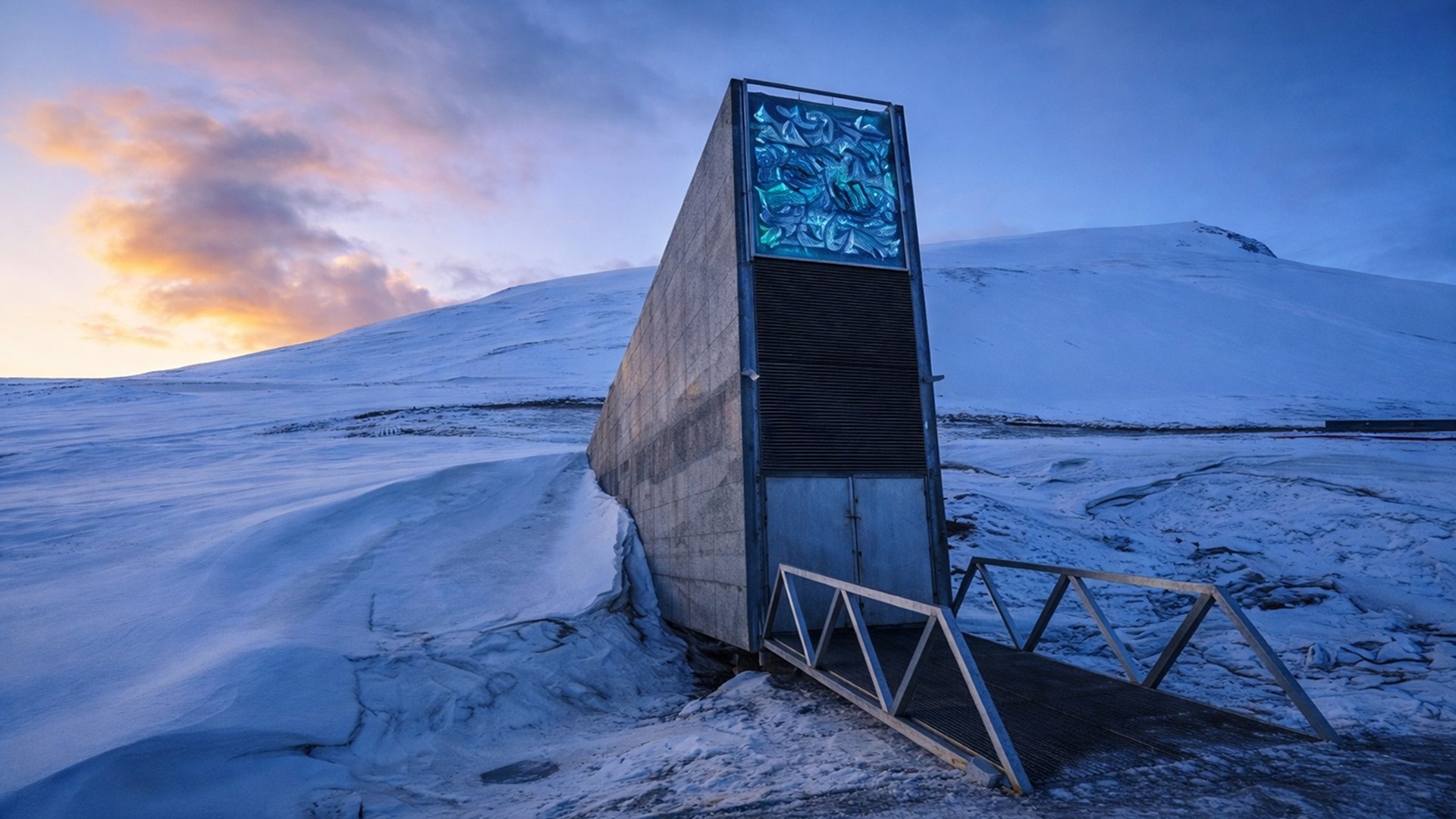
Apocalypse Vault Update Adds 7,800 New Samples to Svalbard Global Seed Bank, Raising the Total Stored to 1,386,102 Varieties Preserved in Subterranean Environment at -18°C, Strengthening the International Food Security Strategy in the Face of Wars, Structural Failures, and Global Climatic Disasters
The apocalypse vault has been updated with the addition of 7,800 new varieties to the Svalbard Global Seed Bank, located beneath a mountain in Spitsbergen, in the Norwegian archipelago of Svalbard, expanding the global agricultural preservation system maintained under controlled subterranean conditions.
Apocalypse Vault Expands Global Reserve of Seeds Stored in the Arctic
The Apocalypse Vault serves as an international facility designed to store backup copies of seeds from different regions of the planet. The site houses agricultural materials deemed essential for the continuity of global food production.
With the new update, the total number of unique seeds preserved has reached 1,386,102 samples stored underground. The new contributions include staple grains from Africa, traditional crops from Guatemala, and olive varieties originating from Spain.
-
Motorola launched the Signature with a gold seal from DxOMark, tying with the iPhone 17 Pro in camera performance, Snapdragon 8 Gen 5 that surpassed 3 million in benchmarks, and a zoom that impresses even at night.

-
Satellites reveal beneath the Sahara a giant river buried for thousands of kilometers: study shows that the largest hot desert on the planet was once traversed by a river system comparable to the largest on Earth.

-
Scientists have captured something never seen in space: newly born stars are creating gigantic rings of light a thousand times larger than the distance between the Earth and the Sun, and this changes everything we knew about stellar birth.

-
Geologists find traces of a continent that disappeared 155 million years ago after separating from Australia and reveal that it did not sink, but broke into fragments scattered across Southeast Asia.

According to Crop Trust Executive Director Dr. Stefan Schmitz, storage in Svalbard represents one of the simplest and most effective ways to protect the foundation of global agriculture in the face of potential future crises.
Subterranean Structure Keeps Seeds Frozen Even Without Energy
The seeds in the Apocalypse Vault remain stored in freezers set to a constant temperature of -18°C. The deep location beneath the mountain enhances the thermal stability of the environment.
The permafrost and the thick layer of rock keep the interior frozen even in scenarios of energy failure. This condition allows agricultural material to remain preserved for long periods without relying solely on artificial systems.
The seeds are sealed in custom packaging composed of three layers of aluminum. After sealing, they are placed in boxes and positioned on internal shelves designed for long-term storage.
Apocalypse Vault Serves as Final Safety Net for National Seed Banks
Millions of agricultural varieties are already distributed in germplasm banks around the world. However, many of these centers face risks associated with wars, natural disasters, lack of funding, or operational failures.
According to Crop Trust, even simple problems, such as freezer malfunctions, can jeopardize entire collections. The Apocalypse Vault was specifically designed to serve as the final global safety net for these national reserves.
The system operates under conditions classified as a black box. Depositors remain the owners of the seeds and are the only ones authorized to request their withdrawal, should it be necessary to restore lost collections.
The main goal is not to support scientific research, but to ensure that genetic banks can reconstruct their collections after natural disasters, conflicts, or extreme climate events.
Strategic Location Ensures Long-Term Physical and Climatic Security
The Apocalypse Vault was inaugurated in 2008 and is managed by the Norwegian Ministry of Agriculture and Food. The facility was positioned in an area considered geologically stable and with low humidity levels.
Svalbard is described by Crop Trust as the northernmost point accessible by regular commercial flights, combining geographic isolation and controlled logistical access. While the entrance is visible on the surface, the main vault is located more than 100 meters deep.
The bank was built above sea level and remains protected against ocean flooding, even in extreme scenarios of sea-level rise. These features enhance the physical security of the stored seeds.
New Countries and Crops Expand Diversity Preserved in the Vault
The recent update included contributions from 10 depositors. Among them are seeds from Guatemala and Niger, countries that have now joined the repository for the first time.
Guatemala sent two varieties of teosinte, the wild ancestor of maize still cultivated by indigenous farmers. Niger deposited 204 agricultural varieties, including sorghum, black-eyed peas, peanuts, and millet.
Another unprecedented contribution came from the Olive Germplasm Bank at the University of Córdoba. The donation included seeds of wild Spanish olives and the 50 most important cultivated varieties in the world.
According to researcher Dr. Concepción Muñoz Díez, local varieties of olives face threats related to aging trees, low profitability of traditional olive groves, and the expansion of more mechanized crops.
Total Capacity Could Reach 2.5 Billion Stored Seeds
The Apocalypse Vault has a designed capacity to store up to 500 seeds of 4.5 million different agricultural varieties. This represents a total potential of approximately 2.5 billion preserved seeds.
The internal conditions of low temperature and humidity cause the seeds to use energy extremely slowly, maintaining their viability for prolonged periods.
The structure was designed to ensure that, in scenarios of war, climate disaster, or severe natural events, surviving populations can still rebuild global agriculture from the reserves preserved in the Arctic.








-

-

3 pessoas reagiram a isso.