





 Portuguese
  English
  Spanish
  6 min of reading
  0 comments


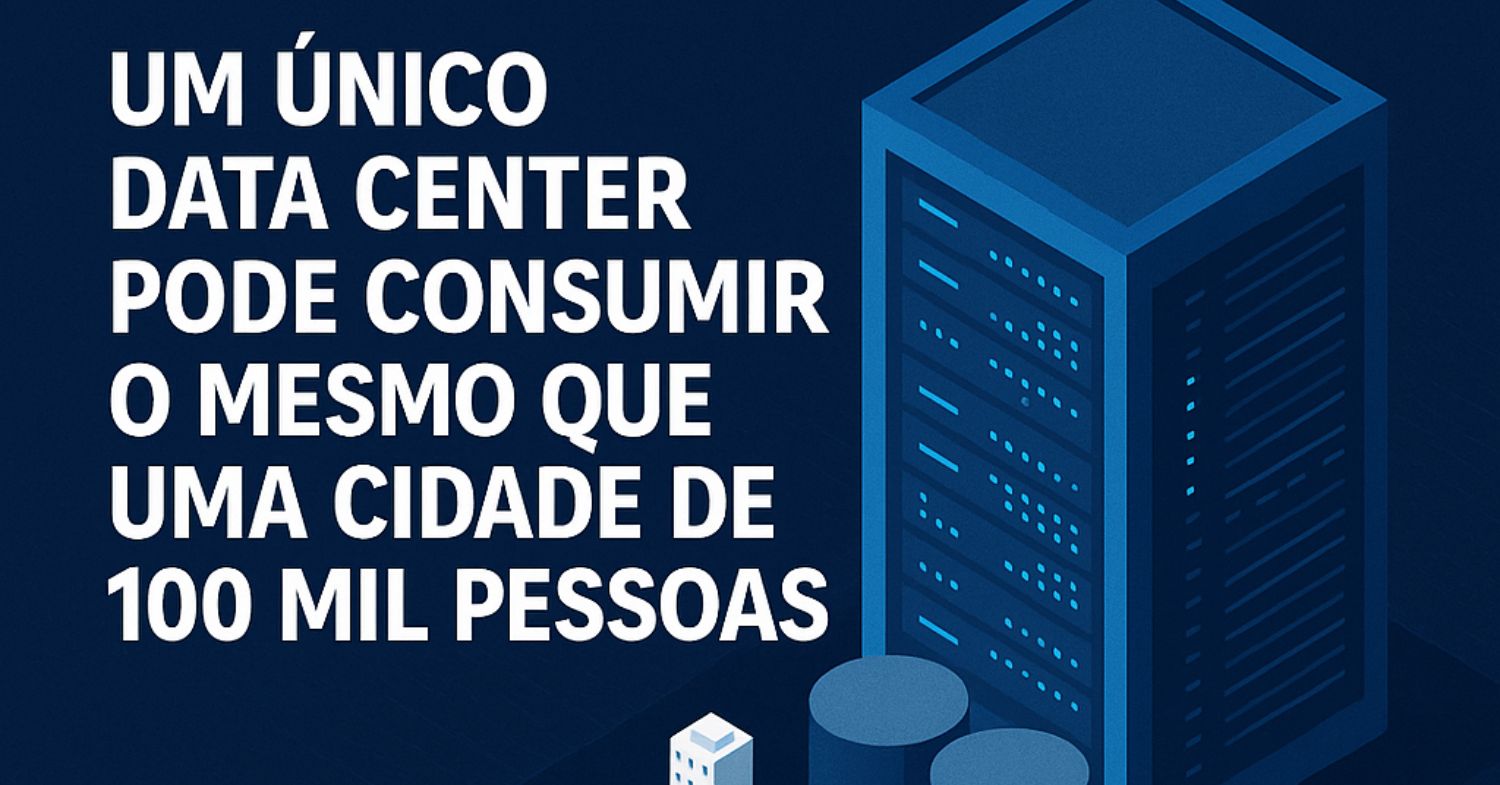
While You Watch A Video, Send Messages, Or Access An App, There Is An Invisible Giant Working Nonstop Behind The Scenes Of The Internet. And It Is Consuming As Much Energy As An Entire City.
Today, a single 10 megawatt (MW) data center — a common power in large centers — is already capable of consuming the same amount of electricity as a city of 100,000 inhabitants. This is confirmed by Roberto Beauclair, director of Cepel (Electric Energy Research Center of Eletrobras). This comparison helps to gauge the growing impact of data centers, essential structures for the digital age, which require increasingly more infrastructure, energy, and regulation.
In Brazil, the scenario is already starting to raise concerns. According to the Ten-Year Energy Expansion Plan (PDE 2034), national energy consumption by data centers will reach 2.5 gigawatts (GW) by 2037. This is equivalent to the energy expenditure of 25 million people, surpassing even the current population of Greater São Paulo. With this projection, the pressing question is: Are we prepared to deal with the explosive growth and the consumption of data centers?
What Is A Data Center And What Does It Store?


Although invisible to the general public, data centers are behind practically everything we do online. Simply put, a data center is a highly controlled and secure environment where thousands of servers, routers, storage systems, and databases are installed. They function as a gigantic nerve center that keeps all our digital services alive and accessible.
-
Motorola launched the Signature with a gold seal from DxOMark, tying with the iPhone 17 Pro in camera performance, Snapdragon 8 Gen 5 that surpassed 3 million in benchmarks, and a zoom that impresses even at night.

-
Satellites reveal beneath the Sahara a giant river buried for thousands of kilometers: study shows that the largest hot desert on the planet was once traversed by a river system comparable to the largest on Earth.

-
Scientists have captured something never seen in space: newly born stars are creating gigantic rings of light a thousand times larger than the distance between the Earth and the Sun, and this changes everything we knew about stellar birth.

-
Geologists find traces of a continent that disappeared 155 million years ago after separating from Australia and reveal that it did not sink, but broke into fragments scattered across Southeast Asia.

It is in these centers that sensitive information from companies, governments, and individuals is stored: from private messages and cloud files to financial systems, e-commerce, artificial intelligence, digital health, logistics, and defense. Large companies like Google, Amazon Web Services (AWS), and Microsoft Azure operate hyperscalers — that is, facilities with hundreds of thousands of servers that process data for billions of users in real-time, nonstop.
How Cooling And Energy Redundancy Work
The massive volume of data processed generates a tremendous amount of heat. Servers operating 24 hours a day require highly sophisticated cooling systems to maintain the ideal operating temperature. The average thermal range of the equipment is around 18 to 27 °C, and any variation can cause failures or million-dollar losses. This is why data centers use solutions like precision air conditioning, chilled water cooling, free cooling in cold climates, and even direct liquid cooling systems.
Another essential point is energy. The operation of a data center must be constant, with extremely high reliability. Therefore, in addition to the conventional electrical grid, the facilities have multiple redundancy systems, such as uninterruptible power supplies (UPS), diesel generators, solar panels, and high-capacity batteries. In Tier 4 standard structures, the fault tolerance is minimal: availability must be 99.995%.
All this setup results in a brutal energy expenditure. From cooling to redundancy, each step is designed to ensure that nothing stops — even if it costs as much as powering an entire city.
Real Examples: The Global Impact Of Companies Like Google, AWS, And Microsoft
Leading technology companies operate the largest data centers on the planet — true digital industrial complexes. Amazon Web Services (AWS), for example, has a presence in over 30 regions worldwide, with hundreds of data centers. Google maintains advanced facilities in the U.S., such as the one in The Dalles, Oregon, which uses water from the Columbia River for cooling and operates with climate neutrality goals.
Meanwhile, Microsoft, through Azure, is developing submerged data centers and is betting on renewable energy for all its operations by 2030.
These centers are not merely technical installations: they are strategic pieces for global power. Controlling data infrastructure today is as important as controlling oil reserves or logistic chains. Each of these giants invests billions annually in energy efficiency, cybersecurity, and artificial intelligence to keep operations running while minimizing environmental impact at the same time.
Brazil On The Data Center Route: Potential And Challenges
Brazil currently has 181 data centers in operation, according to data from EPE. By 2034, this number could jump to 500 units, driven by the increase in the use of artificial intelligence, cloud storage, and the digitization of the public sector. In 2024, the Ministry of Mines and Energy (MME) was analyzing 42 new data center installation requests — a significant leap from the 12 projects in 2023.
The preferred locations for new enterprises are the Southeast and South regions, where the consumer market is concentrated, in addition to the Northeast, which stands out for its proximity to submarine cables connecting to Europe and the U.S. and the availability of renewable energy. States like São Paulo, Rio de Janeiro, Bahia, Ceará, and Piauí lead this race.
Piauí, for instance, is investing in the ZPE (Export Processing Zone) of Parnaíba, where companies can import equipment without paying taxes like ICMS. The proposal is to create a national hub for digital infrastructure, with fiscal incentives and access to clean energy. Governor Rafael Fonteles has argued that Brazil should firmly enter the geopolitics of data, stating that “the competition should not be between states, but between countries.”
The Environmental Impacts Of Data Center Consumption
Despite technological advancements, data centers are significant sources of environmental impact. According to estimates from the International Energy Agency (IEA), they are already responsible for about 1% of global electricity consumption — a number that could increase with the popularization of generative AI, metaverse, blockchain, and 5G.
In Brazil, although the energy matrix is cleaner than in many countries, the high consumption of resources — especially for cooling and energy backup — is still concerning. The intensive use of water, the indirect emissions associated with diesel generators, and the disposal of equipment (electronic waste) put data centers at the heart of the debate on ecological transition.
Moreover, the concentration of these centers in metropolitan regions can lead to disputes over energy and pressure on electrical infrastructure, necessitating coordinated planning with distributors and the National Operator of the System (ONS).
Why Data Centers Are Essential For Modern Life
Even with their challenges, data centers are indispensable structures for modern life. They sustain the functioning of digital platforms, banking networks, health systems, urban transport, and even schools and public services. Without them, practically everything would stop: there would be no emails, social networks, cloud storage, video calls, or electronic payments.
In the current context, where artificial intelligence and automation are gaining more space, data centers become even more strategic. They are the ones processing AI models, running language algorithms, storing billions of parameters, and distributing content globally in milliseconds.
Additionally, they are at the center of the digital economy. Every food order, every ride-hailing request, every bank transfer ultimately depends on the smooth operation of one or more data centers. Therefore, thinking about their efficiency, regulation, and impact is thinking about the future of digital civilization.
The growth of data centers in Brazil and around the world is irreversible. They are the backbone of digital transformation, artificial intelligence, real-time communication, and networked life. However, this progress brings with it an increasingly significant energy consumption, comparable to that of entire cities, which calls for a similarly robust response in terms of planning, sustainability, and innovation.
Discussing the data center that consumes the same energy as a city of 100,000 inhabitants is more than a technical curiosity. It is a warning about the challenges that the digital age imposes on energy and environmental infrastructure. And the time to act is now — before the future catches us offline.








Seja o primeiro a reagir!