





 Portuguese
  English
  Spanish
  3 min of reading
  0 comments


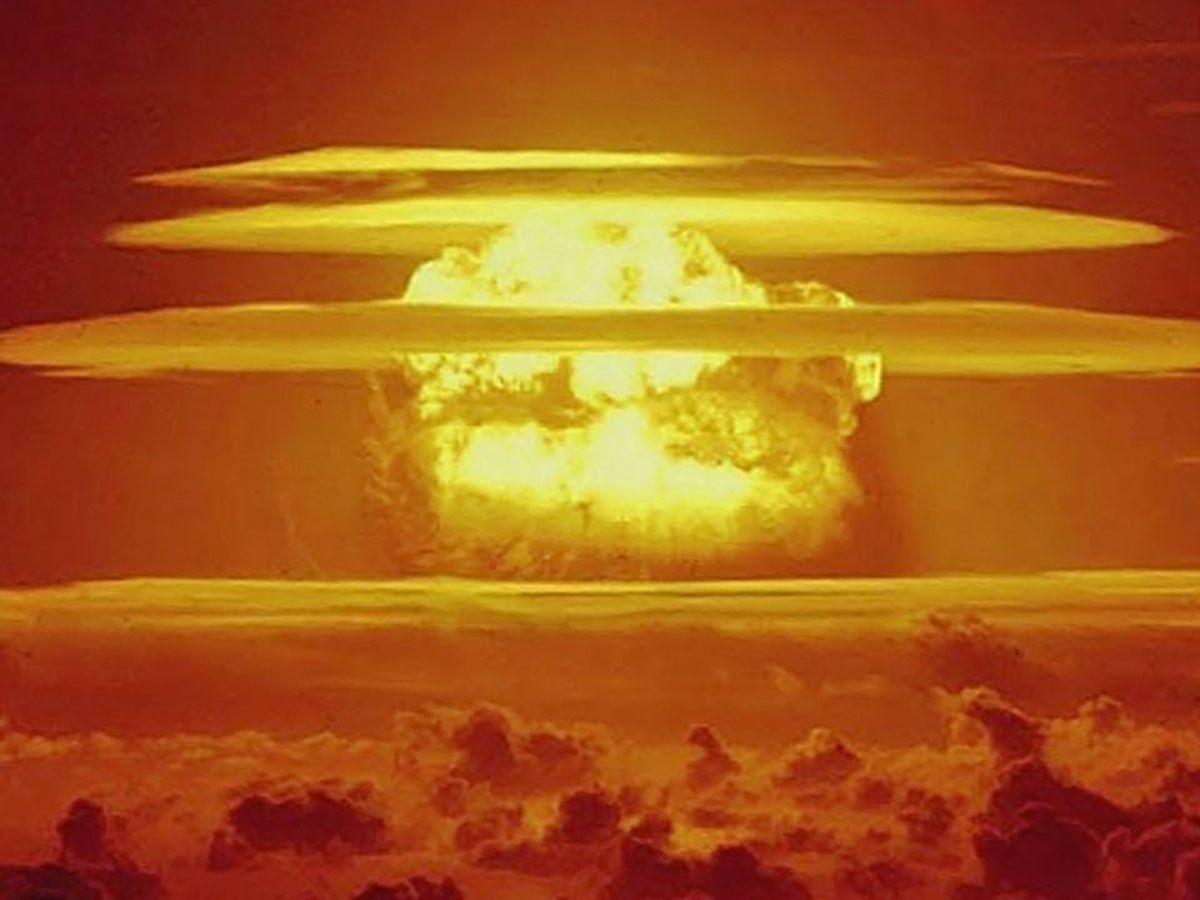
In 1961, the Largest Nuclear Explosion in History Shook the Planet. Meet the Soviet Thermonuclear Device That Changed the Course of the Cold War, and Its Effects Still Felt Today
It was 11:32 AM on October 30, 1961 when the world witnessed an unprecedented event: the test of the largest nuclear artifact ever built, conducted over the archipelago of Novaya Zemlya, north of what was then the Soviet Union. With a destructive power equivalent to 50 megatons of TNT, the explosion surpassed by 1,570 times the sum of the devices used in Hiroshima and Nagasaki. The prototype, known as “Tsar,” was so devastating that it was nicknamed “the second Sun” by those who witnessed its flash.
Launched from a bomber at 10,500 meters altitude, the device generated a mushroom cloud that reached an impressive 64 km high, exceeding the stratosphere. The impact was felt in unimaginable ways: people 270 km away reported feeling the heat of the explosion on their skin, and windows were shattered more than 900 km from the epicenter — a distance equivalent to that from São Paulo to Brasília.
How Did We Get Here?
To understand how humanity came to conceive such a destructive device, we must go back to the end of the 19th century when scientists discovered the process of nuclear fission — the splitting of heavy atoms like uranium, which releases enormous amounts of energy. The energy released by a single gram of uranium can power 45 homes for an entire month.
-
Motorola launched the Signature with a gold seal from DxOMark, tying with the iPhone 17 Pro in camera performance, Snapdragon 8 Gen 5 that surpassed 3 million in benchmarks, and a zoom that impresses even at night.

-
Satellites reveal beneath the Sahara a giant river buried for thousands of kilometers: study shows that the largest hot desert on the planet was once traversed by a river system comparable to the largest on Earth.

-
Scientists have captured something never seen in space: newly born stars are creating gigantic rings of light a thousand times larger than the distance between the Earth and the Sun, and this changes everything we knew about stellar birth.

-
Geologists find traces of a continent that disappeared 155 million years ago after separating from Australia and reveal that it did not sink, but broke into fragments scattered across Southeast Asia.

The first successful fission experiment was conducted in 1938 by Otto Hahn, in Berlin. Then came World War II and, with it, the fear that Nazi Germany would develop a weapon of mass destruction. This threat led Albert Einstein to sign a letter to President Franklin D. Roosevelt, warning of the risk. The warning resulted in the creation of the Manhattan Project, which culminated in the explosions at Hiroshima and Nagasaki in 1945 — marking the beginning of the nuclear era.
From Fission to Fusion: A New Era of Destruction
The nuclear weapons used in Hiroshima and Nagasaki were based on fission. The device tested in 1961 used nuclear fusion — in other words, it was a thermonuclear device. In this type of armament, two light atoms (usually hydrogen) are fused under absurdly high temperatures, similar to those in the core of the Sun (about 15 million °C), generating an even more intense release of energy.
To reach these temperatures on Earth, an initial fission stage is used (like in the first artifacts), whose explosion heats the second stage, initiating the fusion. In the case of the Soviet device, the explosion temperature reached 100 million °C, six times hotter than the solar core.
A Test with Global Consequences

The mushroom cloud exceeds 60 km in height, visible from hundreds of kilometers from ground zero
The bomber that carried the artifact had to be painted with reflective paint to withstand the extreme heat. Even so, the crew was given only a 50% chance of survival. The detonation was so intense that it generated a seismic shockwave that circled the planet three times and launched atmospheric debris that remains in our bodies to this day, in the form of radioactive isotopes.
Despite its power, the artifact was never created for direct military use. It was a symbolic message: a reminder to the world of what technology can do if used without limits.
Between Horror and Hope: The Nuclear Legacy
The nuclear era has left deep scars, but also lessons. Today, the same science used to destroy is applied to create. Nuclear energy, despite being controversial, is one of the most promising sources of clean and efficient electricity, especially with advances in controlled nuclear fusion — which could one day free us from dependence on fossil fuels.
Mastering this technology safely could be the definitive step for humanity to become an advanced energy civilization, according to the Kardashev Scale. But for that, we need to learn from the mistakes of the past.








Seja o primeiro a reagir!