





 Portuguese
  English
  Spanish
  4 min of reading
  0 comments


A New Vision of the Deep Universe: Understand How Einstein’s Theory Allowed Astronomers to Observe an Extremely Remote Galaxy
A Discovery That Crosses Space and Time
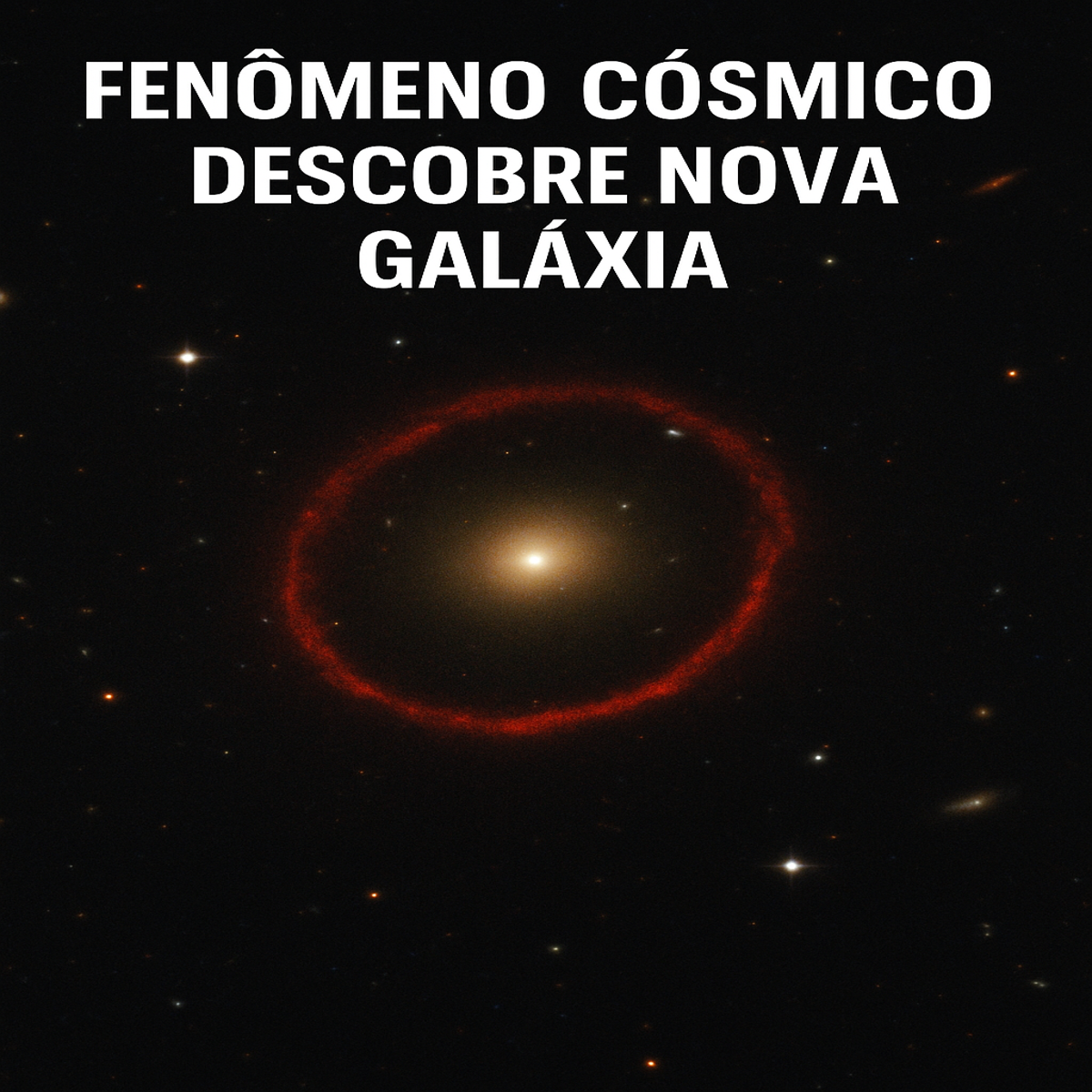
The Hubble Space Telescope, in operation since 1990, revealed a new feat of modern astrophysics by capturing one of the most intriguing phenomena in the cosmos. In one of its observations, focused on a relatively nearby elliptical galaxy, Hubble captured something surprising in the same field of view: a bright, reddish arc, precisely shaped and curved, surrounding the central galaxy.
This arc is not a reading error or optical flaw, but rather the result of a rare and powerful natural effect: gravitational lensing. This phenomenon allowed the visualization of an extremely distant galaxy, identified as HERS 020941.1+001557, whose light took approximately 11 billion years to reach us.
The Theory That Changed Astronomy: Gravitational Lens and Einstein’s Ring
The gravitational lens is an effect predicted by Albert Einstein’s General Theory of Relativity, presented in 1915. According to this theory, the presence of large masses in space — such as galaxies or clusters — deforms the fabric of space-time around them. This distortion causes the light from more distant objects to bend, creating visual phenomena that may include arcs, rings, and multiple images of the same object.
-
China has created a mass-produced hypersonic missile that costs the same as a Tesla, and this is changing everything in modern warfare because the United States cannot defend itself without spending millions.

-
100% Brazilian technology transforms agricultural waste into a meat-scented ingredient using fungi from the Amazon rainforest. The process does not use excessive water or chemicals, and it also increases the nutritional value of the final product.

-
Psychology reveals that adults who avoid conflicts at all costs are not balanced individuals, but rather children who learned in the worst way that expressing emotions brought punishment and now live paralyzed by the fear of expressing themselves.

-
Goodbye pet hair on clothes: a washer with an internal filter promises to remove up to 5 times more hair than regular machines and uses an XL trap dryer system to capture what remains.


In this specific case, the elliptical galaxy SDSS J020941.27+001558.4, located about 2.7 billion light-years from Earth, acts as a lens for the much more remote galaxy, which is approximately 19.5 billion light-years away in spatial distance. The precise alignment between these galaxies and the observer resulted in an Einstein’s ring, a circular or partial formation produced by the symmetric deflection of light.
Instrument, Technique, and Context of the Observation
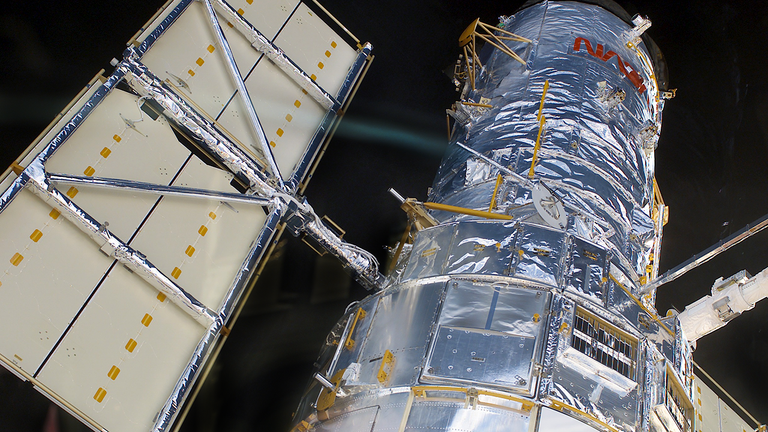
The Hubble Space Telescope recorded the images while operating in low Earth orbit in a partnership between NASA and ESA.
Hubble captures images in the visible and ultraviolet light spectrum with high precision and regularity.
Scientists have utilized Hubble to provide thousands of essential data points for cosmology and astrophysics.
In the observation that revealed the ring, astronomers also identified a third galaxy, SDSS J020941.23+001600.7, apparently crossing visually with part of the bright arc. These overlaps reinforce the complexity of the cosmic field of view and the importance of gravitational lenses as tools for natural magnification.
Scientific Applications of Gravitational Lenses
Gravitational lenses have become indispensable instruments for studying the primitive universe. They enable telescopes to detect very faint or distant galaxies, enhancing the observational capacity of current instruments. Additionally, this phenomenon can replicate or distort images, functioning as a natural cosmic magnifying glass.
Through these effects, it is possible to observe objects as they were billions of years ago, offering a window into remote periods of the universe. In this case, the light from galaxy HERS 020941.1+001557 reveals an era before the formation of the Solar System, becoming a valuable record of the early structure of the cosmos.
The Role of Citizen Science in the Discovery
A participant in the Spatial Distortion project identified Einstein’s ring in an astronomical image. The citizen science initiative uses crowdsourcing to detect gravitational lenses.
Volunteers analyze data collected by telescopes and assist professional scientists in locating patterns that indicate the presence of rare optical phenomena.
Public participation in science reinforces the importance of this type of collaboration.
Thousands of citizens help explore vast volumes of data efficiently with their contributions.
History of Gravitational Lenses in Astrophysics
Although widely known today, gravitational lenses caused confusion in the past. In 1987, astronomers observed a huge blue arc near the galaxy cluster Abell 370.
Initially, they considered it one of the largest objects in the universe.
Later, scientists correctly identified the structure as an illusion caused by the distortion of space-time.
In the same year, another significant advance in understanding these phenomena occurred, largely due to studies conducted by teams from Stanford University and, in addition, the United States National Optical Astronomy Observatory. For this reason, the episode received coverage in the international press, being cited, for example, by The New York Times as a hallmark case of the “bizarre” implications of Einstein’s theory.
A Tool for the Next Generation of Discoveries
The observation of galaxy HERS 020941.1+001557 through the gravitational lens SDSS J020941.27+001558.4 represents not only a visual milestone but a technical achievement that validates physical models over a century old. This image serves as a time capsule, revealing a universe that existed before neither the Sun nor the Earth had formed.
As science continues to evolve, thanks to instruments like Hubble and James Webb, in addition to collaborations between professional and amateur scientists, increasingly new images expand the horizons of human knowledge. In this way, they bring astronomy closer to a deeper understanding of the origins of the cosmos.










Seja o primeiro a reagir!