





 Portuguese
  English
  Spanish
  6 min of reading
  0 comments


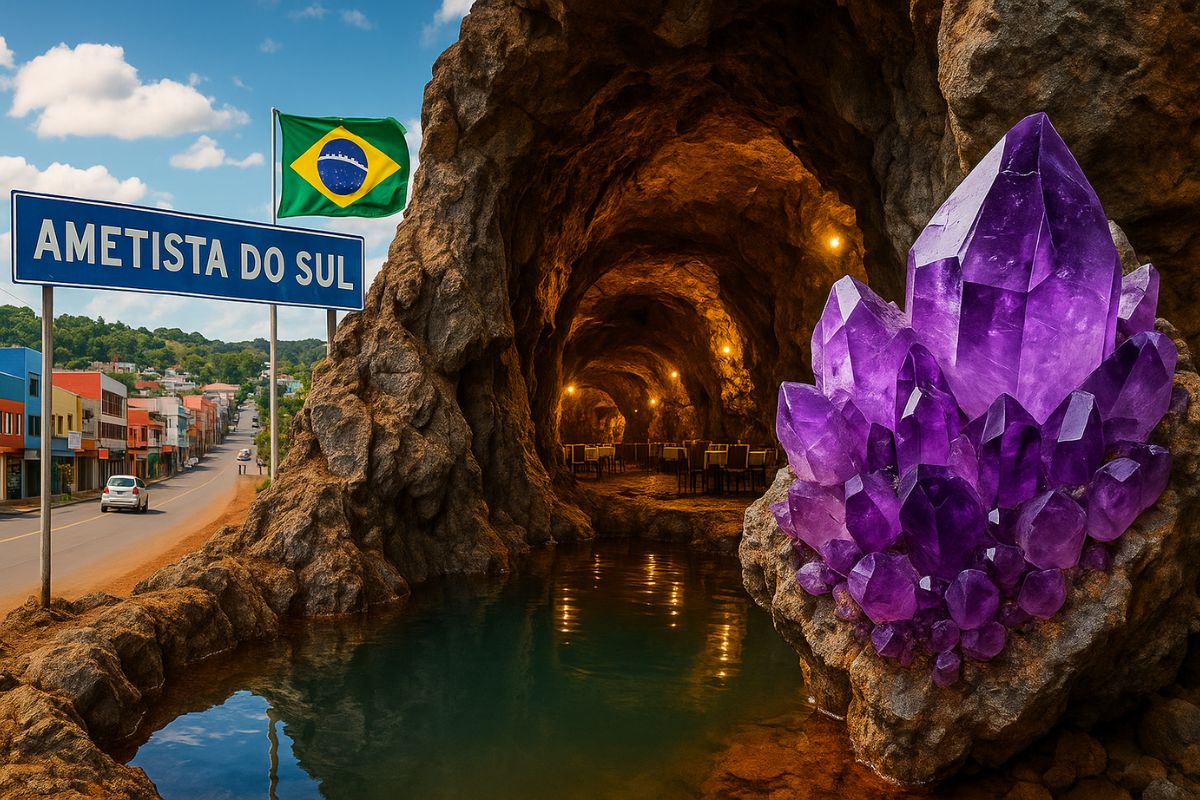
Beneath Apparently Common Valleys, Brazil’s Underground Ant Colony Reveals Mines Transformed into Restaurants, Pools, Breweries, and Museums: A Unique Ecosystem That Grows Beneath the City.
The underground ant colony in Brazil has a specific address: Ametista do Sul, in the north of Rio Grande do Sul. At first glance, the rural setting hides a universe of tunnels, geodes, and galleries that has supported the local economy for about a century and now gives rise to improbable tourist experiences, from gastronomy in old mining fronts to meditation in silent chambers carved into the basalt.
The story, told by the miners and residents themselves, shows how rudimentary mining evolved into a safe and organized underground environment, paving the way for a value chain that goes from extraction to experience tourism. Between Tradition and Reinvention, the underground ant colony in Brazil has become a showcase of geology, culture, and entrepreneurship.
How the “Underground Ant Colony in Brazil” Was Born
In the mid-1920s and 1930s, farmers began finding fragments of amethyst while plowing the land. What started as a curiosity became barter currency in the old warehouses until the first open-pit mines gave rise to pits of 15 to 20 meters.
-
A forgotten cord on the floor of a basement in Vienna leads a plumber to a box containing 30 kilograms of gold with Mozart’s face, hidden before World War II. The treasure, worth 2.3 million euros, was just centimeters away from a worker who ignored the sign a day earlier.
-
A couple buys an old chalet, breaks the kitchen floor for renovation, and finds over a thousand coins of gold and silver hidden since the English Civil War over 4 centuries ago.
-
Rigid bags with their days numbered: new trend prioritizes comfort in 2026.

-
YouTuber creates an excavator equipped with a giant 4.5-meter sword to challenge his brother to a rematch, and the invention quickly goes viral on social media.

The discovery of “bubbles” of geodes led to deeper excavations, consolidating the municipality’s vocation.
The work was hard and risky. Without technique and protection, many miners worked kneeling in narrow galleries, using hammers and chisels. The silica-rich basalt, combined with the dust from the pneumatic hammer, exposed workers to silicosis.
The turning point came in the 1990s, when water jet drilling started to retain dust and organized production underground.
Technology, Safety, and Method: From Improvisation to Professional Routine
The evolution of the method reduced risks and increased productivity. Where two holes per day were once done by hand, today machines open fronts in minutes.
Controlled explosives began to be used with clear protocols: alarm, evacuation, and safe detonation—the famous shout of “Fire!” that echoes in the mining fronts.
The design of the mines also changed. Taller and better-ventilated galleries replaced narrow passages, and the identification of geodes became more precise, based on the texture of the skin and difference from the basalt. Still, the craft retains its duality: it is a rough yet delicate task, as breaking a geode can significantly reduce its commercial value.
Geology That Explains the Abundance: Layers, Veins, and Geodes
The region contains one of the largest amethyst deposits, distributed across four mineralized flows: high, medium, low, and a fourth level.
The crack between basalts indicates different pulses of eruption, a factor that helped create cavities where purple crystals grew over time.
Although amethyst exists in other areas of the South, the concentration and quality stand out around Ametista do Sul. This geological framework supports Brazil’s underground ant colony and explains why active mines exceed 150 and the deactivated ones are lost in tunnels that connect for hundreds of meters.
Price, Color, and Value Chain: From Geode to Market
In commerce, color and size determine price. The more purple and homogeneous, the more valuable the stone. The presence of calcite can reduce value, but thermal processes transform light amethysts into commercially interesting citrines.
The local productive arrangement involves partnerships between mine owners and miners, sharing costs and risks.
International demand, especially from Asia, reinforces the export-oriented vocation. At the same time, stores, lapidaries, and attractions form a circuit that multiplies the value of what comes out of the ground.
From Extraction to Showcase, Brazil’s underground ant colony functions as an integrated organism, where each stage feeds the next.
Underground Tourism: Restaurants, Pools, and Beer Beneath the Basalt
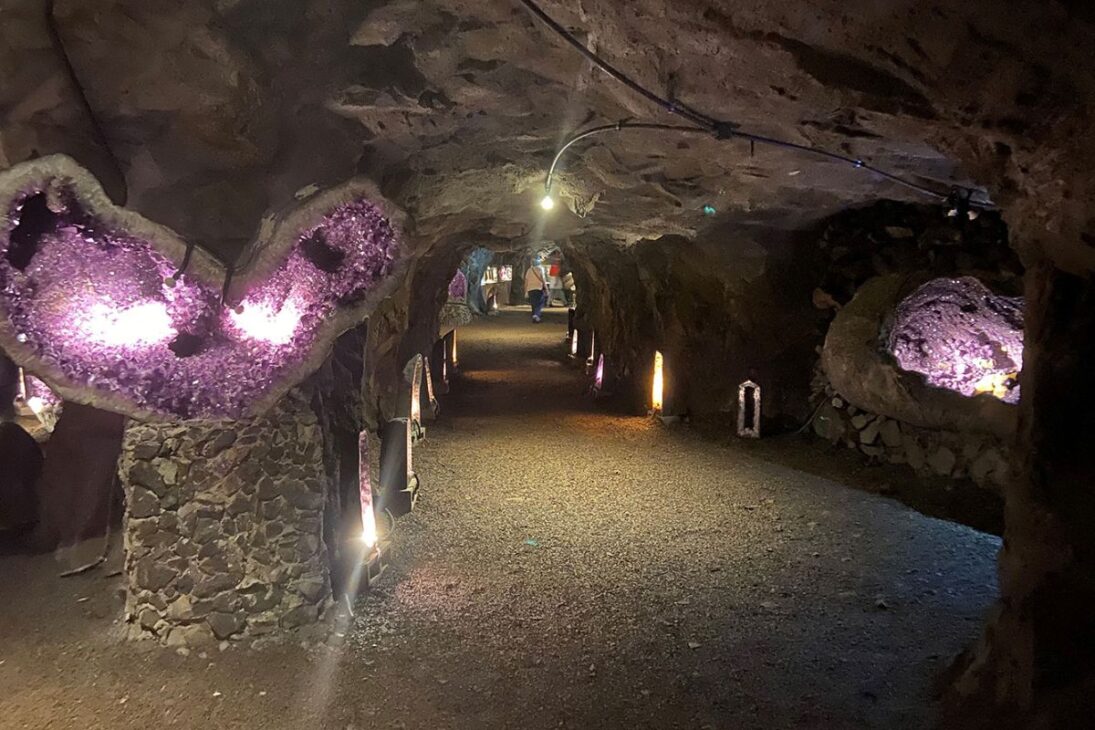
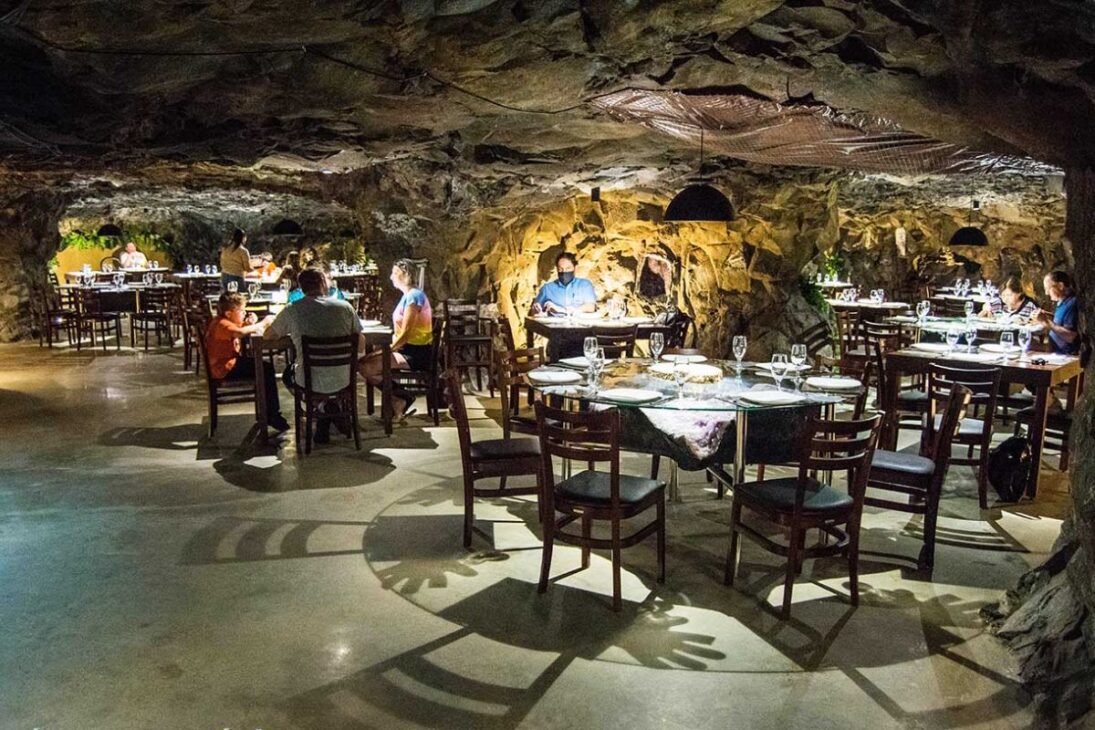
Deactivated mines have been recycled into attractions, creating an unmatched underground tourist route in the country. Restaurants in galleries, with tables adorned by geodes, coexist with pools dozens of meters deep and with the only operating brewery beneath the earth—experiences that transform the visitor into an explorer.
The stable temperature around 17ºC makes the tour ideal on rainy days and for those avoiding the sun. The logistics are designed for safety and comfort, with accessible circulation and preservation of geodes in situ, allowing visitors to see how nature organizes the cavities. This is experiential tourism with a practical geology lesson.
Energy, Silence, and Sensory Experiences
Beyond science, the symbolic dimension of stones attracts people seeking silence, sensory deprivation, and meditation in dark chambers.
The belief in the “resonances” of amethyst is part of local daily life and attracts an audience that associates the stone with mental clarity and balance—a chapter that, whether liked or not, integrates the cultural mosaic of the territory.
On the surface, the Esoteric Pyramid in the central square offers an “open-air” version of this search, with a quartz floor and energizing rituals.
The underground ant colony in Brazil is not just a mine; it is a repertoire of narratives in which science and belief coexist without negating each other.
Culture and Identity on the Surface: Amethyst Church and Collective Memory
The mineral abundance has also reconfigured the urban landscape. The main church was clad with tons of stones, in a project built over years with donations, and today synthesizes devotion, aesthetics, and geology.
Outside, a large scenographic piece atop a tower became a postcard and viewpoint of the region.
Local museums showcase high-value geodes and rare pieces, such as meteorite fragments, offering historical and scientific context to visitors. Thus, the underground ant colony in Brazil transcends the underground: the city transforms into an open-air museum, where displays, facades, and squares tell the same story from different angles.
Work, Partnership, and Income: Who Lives from the Underground
The productive organization combines mine owners, who invest in explosives, energy, and infrastructure, and independent miners, who add luck, technique, and time.
The division of results by contract supports the income of those who rely on extraction, while tourism creates new job opportunities in food, guiding, commerce, and events.
Even with modernization, the craft preserves lessons: the care to not break geodes, the planning of explosions, the use of PPE, and of drilling machines with water.
Safety has ceased to be an appendix and has become a precondition—one of the pillars that enabled the transformation of deactivated mines into sustainable tourist assets.
Urban Planning of the Underground: Conservation and Reuse
When the fronts cease production, no one alters the structure of the hills: the galleries are deactivated and reuse is planned.
Part of them is purchased and adapted with flooring, lighting, and visitation routes, respecting natural pillars and original formations. The result is a functional and safe popular engineering heritage.
This reuse model has created a growing portfolio of attractions that operate with low thermal and visual impact.
The underground ant colony in Brazil has become a laboratory for redeveloping mining infrastructures, uniting preservation, education, and economy.
Ametista do Sul has consolidated a rare model of coexistence between mining, tourism, and culture, where the underground supports the surface both economically and symbolically.
From Crystal to Plate, From Tunnel to Square, the city proves that mines can have a second life when technique, safety, and creativity work together.
And you? Would you know or recommend an underground tourism destination like this? Do you believe that repurposing deactivated mines is a path to local development and preservation? Share how this experience would impact your routine your perspective helps map real opportunities for those who live and work in this ecosystem.









-

-

-

-

-

-

31 pessoas reagiram a isso.