





 Português
  Inglês
  Espanhol
  4 min de leitura
  8 comentários


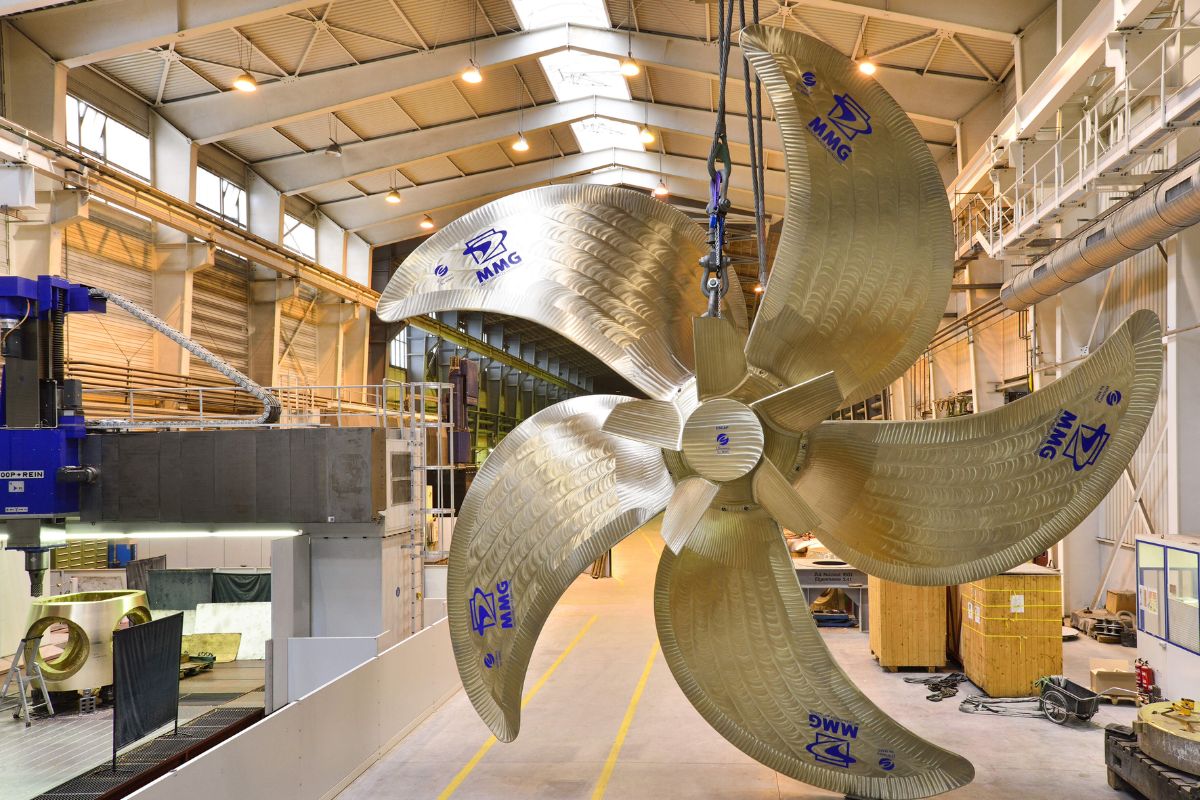


Manufactured by Specialized Companies Like the German Mecklenburger Metallguss (MMG), the Propeller of the Largest Cargo Ship in the World Is a Marvel of Engineering Designed to Move the Giants of 24,000 Containers from MSC and Evergreen with Maximum Efficiency.
At the heart of the largest container ships in the world, cutting through the oceans in 2025, lies a piece of engineering so colossal that it defies imagination. The propeller of the largest cargo ship in the world can weigh over 100 tons, be as tall as a two-story building, and cost up to 4 million dollars. Made from a special alloy of bronze, copper, and nickel, it is the silent engine of the global economy.
This piece is not just large; it is the result of cutting-edge technology, created to optimize fuel consumption and efficiency in an increasingly competitive market. This text unveils the secrets behind the manufacturing, cost, and science that allow these metal giants to move the world’s wealth.
The Age of Giants: How Ships Like the MSC Irina, Launched in 2023, Required Larger and Larger Propellers
The size of the propeller is a direct response to the evolution of the ships themselves. Over the past two decades, the shipbuilding industry has entered a race for ever-larger ships to achieve economies of scale. The hallmark of this new era is the “Megamax” class ships, capable of carrying over 24,000 containers (TEU).
-
The world’s first octopus farm wants to open in the Canary Islands and is already provoking an international reaction: the plan aims to produce 3,000 tons per year.

-
Drought may be creating stronger superbugs in the soil and helping antibiotic resistance reach hospitals, warns a study highlighting a problem that could grow alongside extreme weather.

-
The biggest scam in history: Napoleon’s France deceived the United States by selling them a territory that was Spanish.

-
Why is the Danakil Desert so dangerous? It has unstable terrain and how extreme temperatures and toxic gases turn the region into one of the most hostile environments on Earth.


An example is the MSC Irina, launched in March 2023, which set a new world record with its capacity of 24,346 TEU. With nearly 400 meters in length, these ships need monumental propellers to move efficiently. Another historical example was the Emma Maersk, which in 2006 already used a 131-ton propeller.
The Science Behind the 10-Meter Diameter and the Bronze-Aluminum-Nickel Alloy
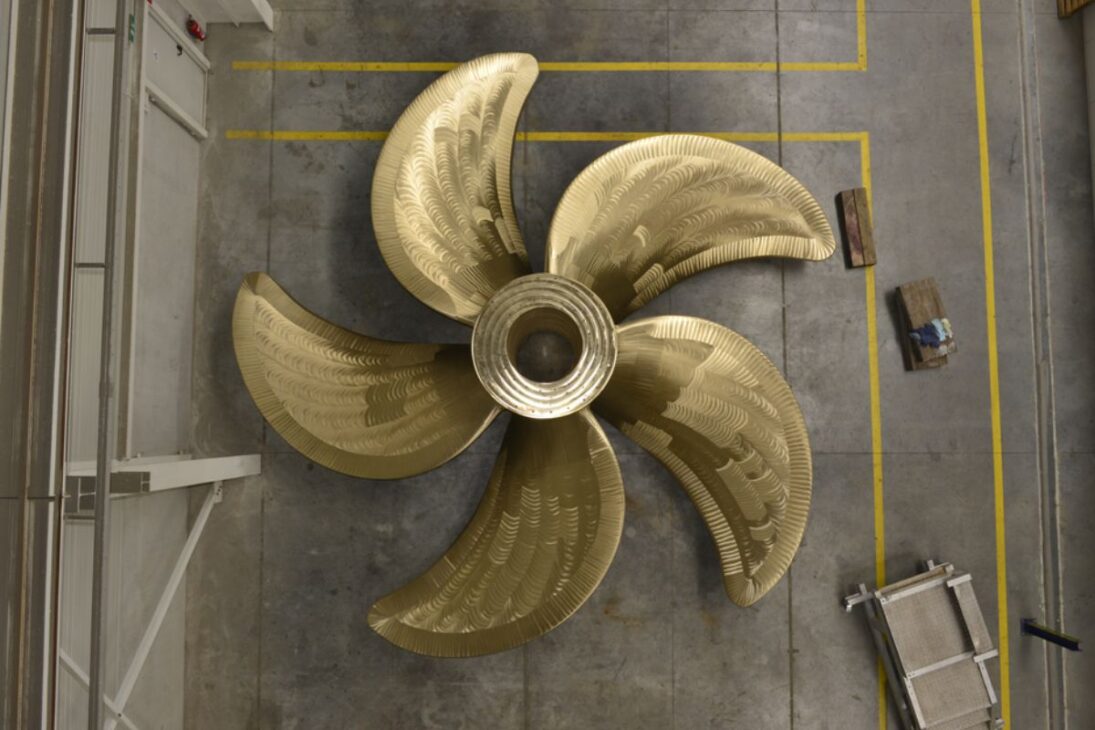
A propeller of the largest cargo ship in the world is a showcase of engineering. Its fixed-pitch design is optimized for maximum efficiency at cruising speed, a practice known as “slow steaming” that became standard after the financial crisis of 2008.
Size and Speed: To be efficient at low speeds, the propeller needs to be huge. Those on the most modern ships have a diameter ranging from 10 to 11.6 meters, equivalent to the height of a three-story building. They rotate slowly, moving a massive volume of water with less effort.
Material: The choice of material is crucial to resist seawater corrosion and cavitation (the phenomenon of bubbles that implode and destroy metal). The alloy used is a bronze-aluminum-nickel (NAB), which forms a protective layer of aluminum oxide, ensuring the durability of the piece.
The Manufacturing Process at German MMG, from 3D Printing the Mold to Manual Polishing
Manufacturing a 100-ton piece is a process that combines cutting-edge technology with craftsmanship. The German company Mecklenburger Metallguss (MMG), a world leader in the sector, masters this process.
The first step is to create a full-size mold. In the past, this was done in wood, but today 3D printing is used to create the pattern. Then, the mold is filled with molten bronze alloy at nearly 1,000°C. The cooling process is slow and controlled, taking up to two weeks.
After casting, the raw propeller goes through a 5-axis CNC milling machine that, guided by the digital model, sculpts the blades with precision to a hundredth of a millimeter. However, the final finish is done manually by artisans who polish the surface until it achieves a mirror-like shine.
The Price of Power: The Cost of US$ 2.5 Million per Propeller and the Return on Investment in Less Than a Year
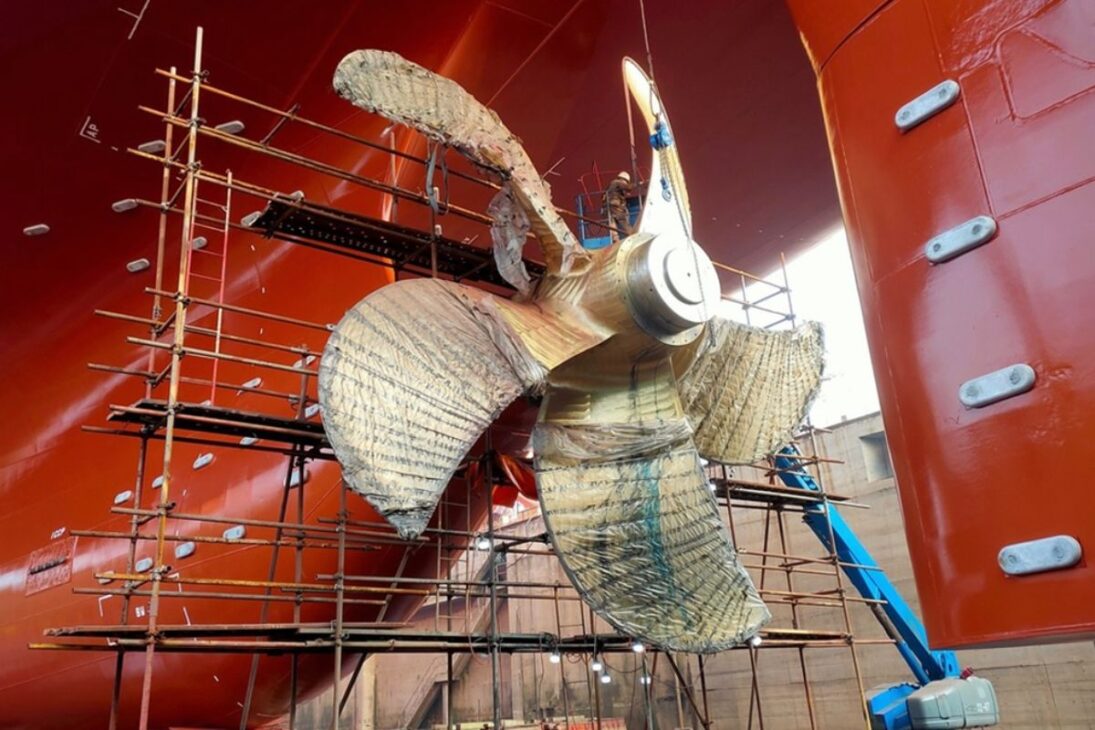
The cost of a propeller of the largest cargo ship in the world is high, but it pays off. Although the price of US$ 4 million is plausible for a complete propulsion package, a propeller alone costs, on average, from US$ 1 million to US$ 2.5 million.
The investment is justified by fuel savings. A small improvement of 3% in efficiency, for example, can save up to US$ 96,000 on a single round trip between Asia and Europe. In some cases of ship modernization (retrofit), a new propeller costing US$ 650,000 generated annual savings of over US$ 1 million, paying off the investment in less than a year.
From Swiss MSC to South Korean Hanwha Ocean, Who Is Behind the Propeller of the Largest Cargo Ship in the World
The creation of a giant ship is a global effort. The ship owner, such as MSC (Switzerland/Italy) or Evergreen (Taiwan), commissions the design. The shipyard, such as South Korea’s Hanwha Ocean or China’s CSSC, builds the hull.
The main engine is designed by a European duopoly: MAN Energy Solutions (Germany) or WinGD (Switzerland/China). However, the manufacturing of the propeller itself is handled by a few specialized foundries in the world. MMG from Germany is the undisputed leader, holding over 60% of the market for propellers over 80 tons, making the propeller of the largest cargo ship in the world a high-tech product with very few capable manufacturers.









Olá! Primeira vez que leio o nome escrito corretamente. Na Marinha, hélice é substantivo masculino! Parabéns ♡
Eu entendo que esse anúncios ajudam a gerar renda, mas PELO AMOR DE DEUS, tá de mais!!!!!!!!! Não dá pra ver a notícia de tanto troço que pula já tela!!!!!!!
Uma ninharia o preço. Os alemães deveriam cobrar pelo ganho marginal em efetividade. Talvez o equivalente a este valor por ano de operação. O Bill Gates faz isso sem poder, com o pacote Office. Alemão não sabe vender. Precisa de Judeu por trás.