





 Portuguese
  English
  Spanish
  6 min of reading
  0 comments


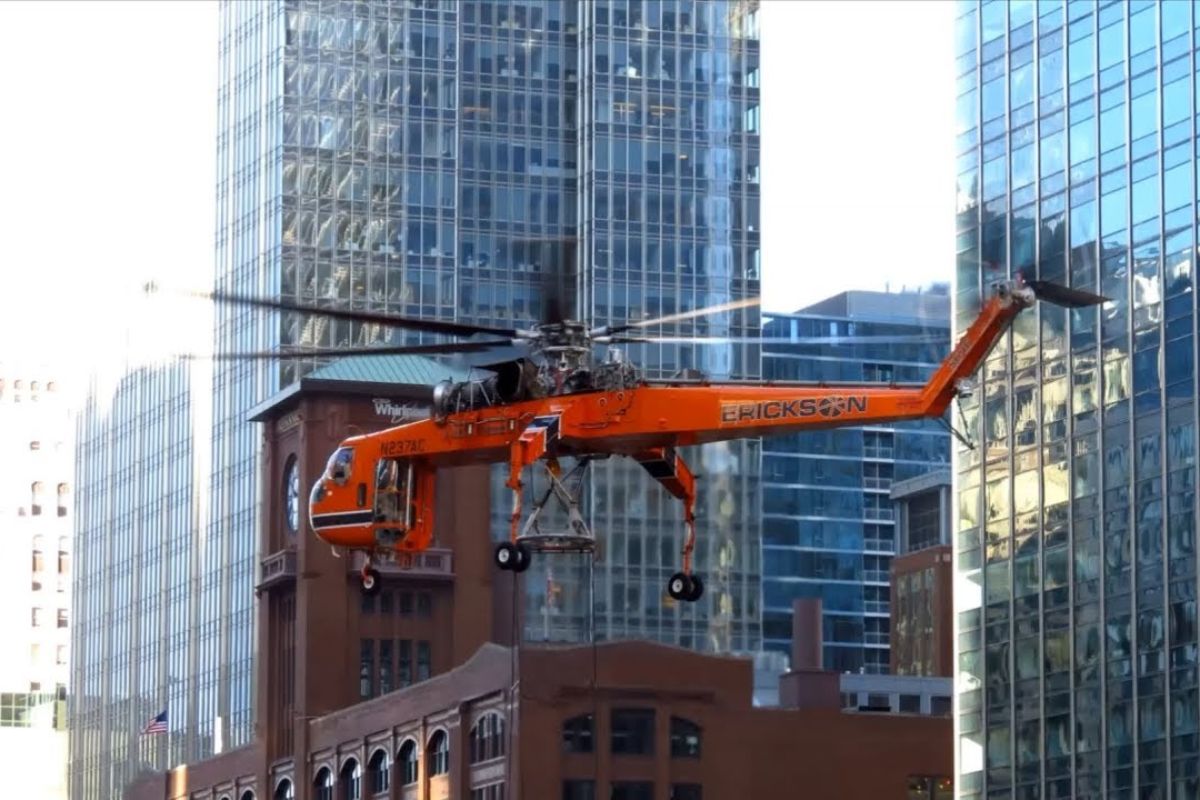
Developed by the United States in the sixties, this skeletal-looking helicopter uses two turboshaft engines, lifts about fifteen tons with an own weight of nineteen, reaches more than ten tons useful, and today serves as an aerial crane in delicate civil missions and special heavy transport operations in continents
The helicopter that caught the world’s attention for lifting entire structures did not originate in a sleek design laboratory, but rather in a Cold War context where power and payload mattered more than aesthetics. Named Sikorsky S-64 Skycrane, this helicopter was designed by the United States in the sixties to transport loads that trucks, planes, or ordinary cranes could not position accurately. The slim fuselage, almost appearing empty, was precisely designed to free space underneath the aircraft and allow the weight to be concentrated on the suspended load.
Today, when talking about a helicopter capable of lifting more than fifteen tons, military and civilian engineers still refer to the same example. With two turboshaft engines delivering around four thousand five hundred shaft horsepower each, an empty weight of about nineteen tons, and the capability of lifting fifteen tons with the hook, the S-64 Skycrane transformed the concept of transport helicopter. The machine appears fragile, but operates in a stress range where small design decisions separate the success of an operation from the collapse of the entire suspended structure.
A Helicopter Designed for War, but Capable of Lifting Entire Buildings

The starting point of the project was clear: to create a helicopter that worked as a kind of flying crane truck, operating in scenarios where there were no road, rail, or prepared runway.
-
Spain surprises the world by erecting 62 artificial dunes, mixing sand with natural remains of posidonia, and causing the structure to lose only 1.4% of its volume in 1 year.

-
With 16 Bulava missiles, improvements in acoustic stealth, and a design focused on silent patrols, Russia’s nuclear submarine was born to ensure Moscow’s invisible retaliation and has become one of the pillars of its maritime strength.

-
‘Populous’ city in Rio among the worst in Brazil in national ranking and exposes silent development crisis.

-
Couple buys house in the South Zone of São Paulo, opens a hidden door in the garage, and finds a secret wine cellar with dozens of old wines forgotten since the 1970s.


In the 1960s, with Vietnam on the horizon and a doctrine of increasing mobility, the S-64 Skycrane emerged as a response to transport heavy parts, structures, and equipment to places that only a helicopter could reach.
The idea of using the machine even to drop bombs was considered, largely due to the free space in the central part and the impression that the helicopter was hollow on the outside, with a large area under the fuselage available for adaptations.
In practice, the helicopter ended up standing out more for its transport capability than for its feasibility as a weapon platform.
With a wingspan of about twenty-seven meters and a slim structure connected directly to the rotor and engine assembly, the S-64 was configured to be one of the few transport helicopters in the world to carry more than ten tons of useful load.
The relationship between empty weight, available power, and suspended load placed this helicopter in an almost unique category, where lifting building modules, prefabricated houses, and large industrial components ceased to be merely a theoretical exercise.
Power, Engines, and Structure: How the Helicopter Reaches Fifteen Tons of Cargo

Behind its strange appearance, the helicopter hides an aggressive engineering logic. Instead of a wide cabin, voluminous compartments, and a closed fuselage, the S-64 Skycrane sacrifices internal volume to gain the capacity to attach large external loads.
The slim fuselage reduces structural weight where it does not bring direct benefit and leaves most of the structured mass to support the load hook and the efforts transmitted by the central suspension.
This choice allows the helicopter to concentrate its resources on what really matters: lifting weight.
The two turboshaft engines, considered capable of delivering about four thousand five hundred shaft horsepower per unit, form the heart of the system.
This power is channeled to the main rotor, responsible for generating enough lift to overcome its own empty weight of nineteen tons and still add fifteen tons of cargo.
In simple terms, the helicopter needs to overcome the sum of all these masses in an environment where any wind oscillation, maneuver error, or load imbalance can push the system to its limit.
The combination of power, rotor diameter, and fine control of blade pitch is what allows a structure equivalent to the weight of a house to literally be lifted off the ground.
Why Such a Powerful Helicopter Ended Up Out of the Military Spotlight
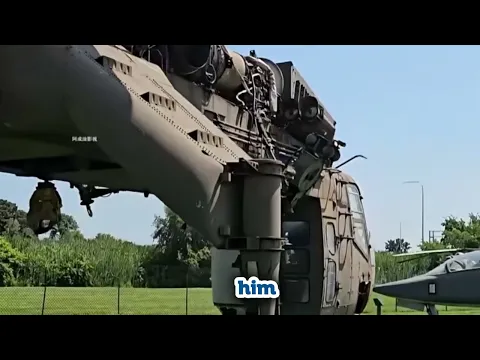

Despite its absurd strength, the helicopter did not remain for long as a protagonist in military operations.
The project itself brought strategic limitations. The bizarre, open shape, without a voluminous fuselage around it, made it difficult to integrate armaments, advanced protection systems, and modules dedicated to combat.
In a scenario where helicopters began to perform multiple functions, from troop transport to attack, the idea of a helicopter primarily dedicated to heavy cargo ceased to be a priority.
Moreover, the high cost of development, operation, and maintenance weighed heavily.
A helicopter of this category requires specific pilot training, ground crews prepared to handle delicate loads, and infrastructure adjusted for high-power parts and engines.
In long-duration wars, with pressured budgets, more versatile helicopters tend to win the internal competition for resources.
Over time, the S-64 Skycrane shifted from the military market to allow its civil version to take center stage in another scenario.
The Transition to the Civil Helicopter That Became an Aerial Crane
When military demand cooled, the helicopter quickly showed its value in civil applications.
The version known as the civil S-64 began to operate in heavy transport missions in urban and remote environments.
Instead of bombs or military equipment, the loads began to be building modules, metal structures, industrial components, and even complete sections of prefabricated houses that needed to be positioned in hard-to-reach locations.
In no time, the helicopter gained a reputation as a tool for construction and maintenance in areas where traditional cranes cannot reach.
Roofs on slopes, structures on hilltops, infrastructure elements in isolated regions, everything began to be seen as a problem that could be solved by hiring a specialized helicopter.
For many engineering companies, the S-64 became synonymous with aerial crane, a piece of equipment that replaces days of ground operation with a few hours of well-coordinated flight.
A Helicopter That Continues to Challenge Engineers Decades Later
Even decades after its creation, engineers still look at this helicopter as a case study in courses, projects, and structural capacity analyses.
Lifting fifteen tons with a nineteen-ton helicopter, maintaining stability in flight, involves safety margin calculations, dynamic load simulations, and rigorous fatigue assessments on critical components.
The very idea of using the machine to lift structures that approach the weight of a house continues to impress, especially when considering that the concept originated about fifty or sixty years ago.
The psychological factor also weighs in. Seeing a slim helicopter, appearing almost empty, suspend something that seems heavier than the aircraft itself challenges the intuition of those observing the operation from the ground.
For those working in design and analysis, this apparent contradiction is a direct reminder that engineering is not limited to appearance, but rather to the distribution of mass, power, and resistance of the whole.
That is why this helicopter continues to be cited in both military and civil environments, even in a scenario dominated by drones and more efficient fixed-wing aircraft.
Conclusion: How Far Would You Trust a Helicopter to Lift Structures Over Your Head?
The helicopter capable of lifting buildings, prefabricated houses, and heavy industrial modules was born to serve a military logic and ended up finding lasting space in civil applications.
With two high-power turboshafts, a slim structure, an empty weight of nineteen tons, and the capacity to suspend fifteen, the S-64 Skycrane has established itself as an example of how engineering can take a simple concept, that of a crane, to the air.
Today, it continues to impress both for its absurd strength and its strange shape, which challenges common sense and forces any observer to reevaluate their own limits of perception about what a helicopter can or cannot do.
Considering all of this, looking at this type of extreme aerial operation, would you feel comfortable seeing a helicopter of this size lifting building modules or entire houses directly above your street, or do you think you would still prefer to see such structures rise only with ground cranes?







-

-

-

-

-

-

15 pessoas reagiram a isso.