





 Portuguese
  English
  Spanish
  4 min of reading
  1 comment


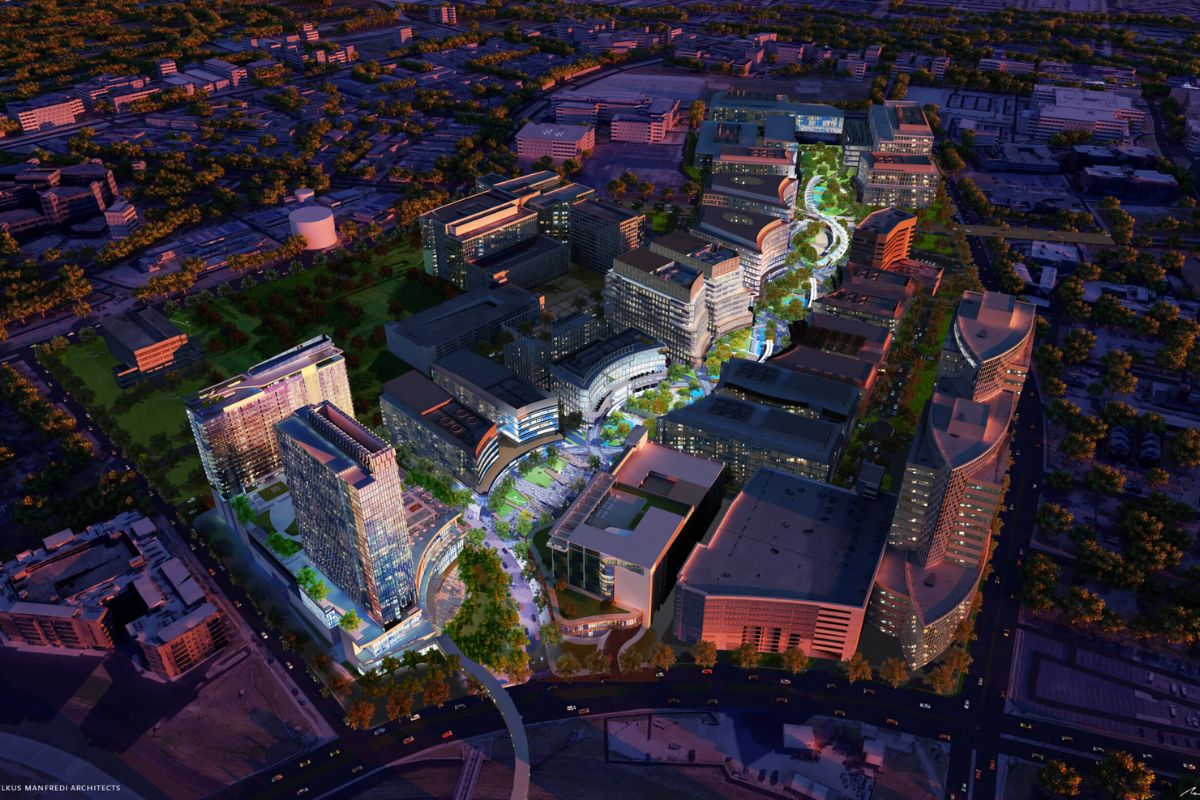


Complex in Houston Brings Together Hospitals, Universities, and Health Research; “City Hospital” Employs Over 100,000 Workers and 10 Million Patient Visits Per Year.
The hospital that many people envision as a single building, in Houston (USA), is actually a whole ecosystem: the Texas Medical Center (TMC). Founded in 1945, it concentrates dozens of health and science institutions in a continuous area that spans over 50 blocks, covering approximately 13 km².
In practice, this “city hospital” functions as a high-complexity district: over 106,000 people work there, encompassing clinical operations, research, and medical education. Every year, about 10 million patientsuse the complex’s services, coming from various parts of the world.
Urban Scale: When the Hospital Becomes a City
Far beyond the imagination of hallways and wards, the TMC occupies block after block with hospitals, surgical centers, laboratories, and academic buildings.
-
Spain surprises the world by erecting 62 artificial dunes, mixing sand with natural remains of posidonia, and causing the structure to lose only 1.4% of its volume in 1 year.

-
With 16 Bulava missiles, improvements in acoustic stealth, and a design focused on silent patrols, Russia’s nuclear submarine was born to ensure Moscow’s invisible retaliation and has become one of the pillars of its maritime strength.

-
‘Populous’ city in Rio among the worst in Brazil in national ranking and exposes silent development crisis.
-
Couple buys house in the South Zone of São Paulo, opens a hidden door in the garage, and finds a secret wine cellar with dozens of old wines forgotten since the 1970s.
The density of health services in a single location is rare in the world, which explains the comparison to an average city in terms of the number of workers.
This densification generates efficiency: physical proximity shortens the path between scientific discovery and clinical application, speeds up complex diagnoses, and facilitates access to cutting-edge therapies.
The size is not just a record, it is a design that favors daily collaboration among multidisciplinary teams.
How This “City Hospital” Works: Who Comprises the TMC

The TMC is not a single entity. It brings together 61 member organizations that operate independently but with strong integration in research, education, and care.
Among the highlights is the MD Anderson Cancer Center, an international reference in oncology and a central piece in the complex’s growth since its early years.
The structure includes high-complexity hospitals, medical schools, and research institutes.
The result is a complete cycle: training professionals, producing knowledge, and patient care all in the same place.
This mechanism explains why the TMC is seen as a global hub of medicine and innovation.
Care and Infrastructure in Numbers

The care dimension of the TMC is impressive: there are more than 9,200 beds and 750,000 emergency visits per year, in addition to 180,000 annual surgeries—figures that help gauge the volume of cases treated daily.
In a single “medical neighborhood,” flows equivalent to those of large state systems circulate.
At the heart of this volume is the capability to coordinate complex lines of care (cardiology, oncology, transplants) with technology, highly specialized teams, and clinical logistics.
When a case requires multiple services in succession, proximity shortens time and improves outcomes.
Innovation, Investments, and the Future of the Hospital
The TMC also organizes itself to convert science into solutions. The TMC Venture Fund finances health startups; the Helix Park campus, inspired by the DNA helix, expands laboratories, offices, and collaboration areas.
There are billions of dollars in ongoing construction projects, consolidating the complex’s role as a biomedical innovation park.
Partner universities expand their presence: Texas A&M announced US$ 550 million for a new academic-scientific complex in the area, while other institutions reinforce translational research centers.
The strategy is clear: bring the laboratory even closer to the bedside and accelerate the clinical adoption of new therapies.
Global Impact and the Access Challenge
The scale of the TMC attracts international specialists and patients and sustains a billion-dollar economic impact in the Houston region, with effects on supply chains, skilled jobs, and talent development.
It is a global magnet for applied science in real life.
At the same time, the American health model still faces access barriers—a recurring theme in the local debate.
Excellence and volume go hand in hand with the challenge of ensuring that innovation reaches everyone, especially in high-cost treatments and chronic demands.
The concentration of services in a “city hospital” accelerates innovation and improves outcomes but also pressures costs and requires fine coordination of access.
In your view, should Brazil invest in integrated medical-scientific hubs, like Houston, or distribute more specialties across the territory? You, who have needed high-complexity care, would you prefer to travel to a large center or receive care close to home, even with fewer resources? Share in the comments real experiences enrich the debate.








I must say this article is extremely well written, insightful, and packed with valuable knowledge that shows the author’s deep expertise on the subject, and I truly appreciate the time and effort that has gone into creating such high-quality content because it is not only helpful but also inspiring for readers like me who are always looking for trustworthy resources online. Keep up the good work and write more. i am a follower.