





 Portuguese
  English
  Spanish
  5 min of reading
  0 comments


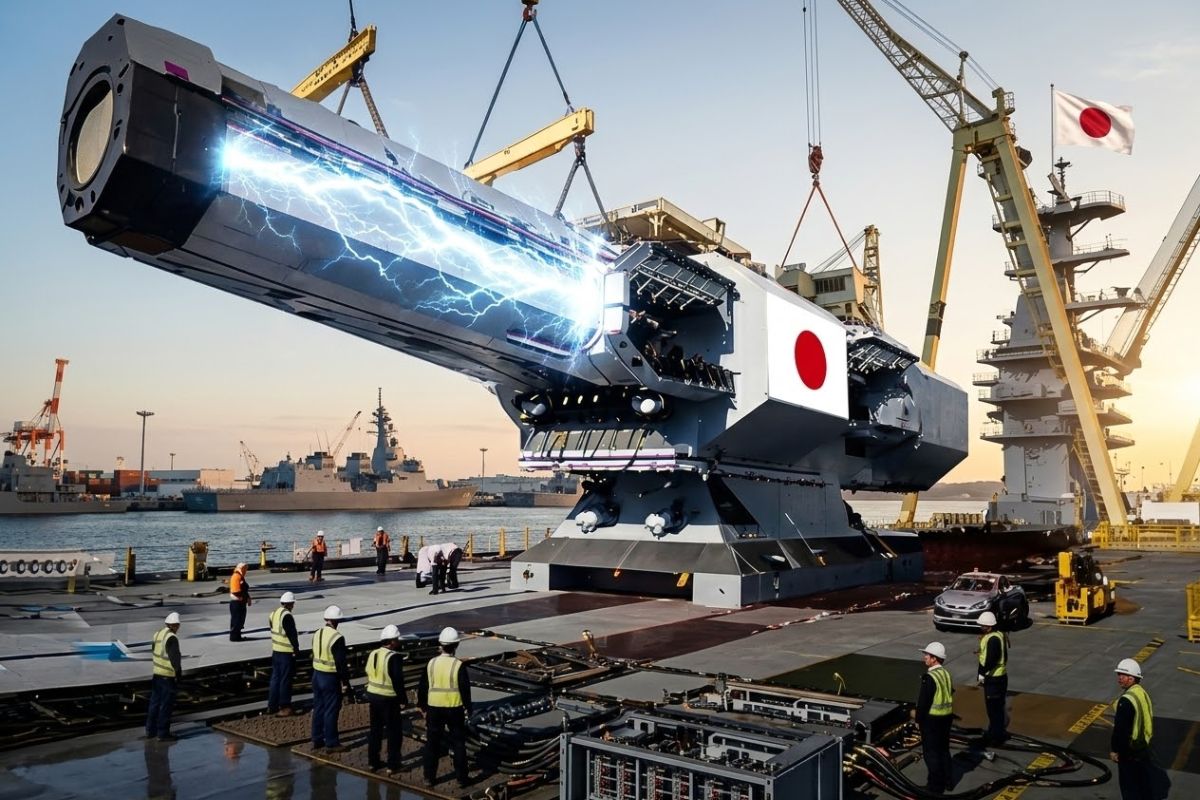
The New Electromagnetic Weapon Tested by Japan Uses Railgun Technology to Accelerate Projectiles Beyond Mach 6 Without Explosives, Aiming at the Interception of Hypersonic Missiles from Ships and Opening a Decisive Stage in Japanese Naval Defense with Kinetic Energy, High Cadence, and Lower Logistical Costs in Regional Scenarios
The new electromagnetic weapon tested by Japan places the country at the center of a military race attempting to respond to the advancement of increasingly faster threats. Based on a railgun capable of launching projectiles at over Mach 6 without gunpowder, the system has been taken to sea with a clear goal: to increase the chances of intercepting hypersonic missiles before they reach Japanese territory.
The focal point of this bet lies not only in the visual impact of the technology, but in the strategic role it can fulfill. Instead of relying solely on traditional interceptors, Tokyo wants a solution capable of reacting in extremely short windows, reducing cost per shot, and operating onboard ships with an inert metal projectile, without explosive payload.
How the Railgun Transforms Electricity into Extreme Speed
The technical basis of the new electromagnetic weapon lies in the Lorentz force, one of the central principles of electromagnetism.
-
In Mexico, a 3,000-year-old Maya site with the dimensions of an entire city may have been built as a colossal map of the cosmos, created to represent the order of the universe and reveal how this people organized space, time, and rituals.

-
Japan wants to build a solar ring of 10,900 kilometers on the Moon to continuously send energy to Earth.
-
Weighing almost 1 ton, with temperatures of up to 3,000°C, the ability to launch 10,000 fragments within a radius of 1 km, capable of penetrating concrete and melting steel, Turkey’s terrifying bomb emerges as one of the most destructive non-nuclear weapons ever presented.

-
After a submarine disappeared beneath the “Doomsday Glacier,” scientists announce a new monstrous machine capable of operating at 3,000 meters depth to return to the heart of the ice and investigate a threat that could raise sea levels worldwide.

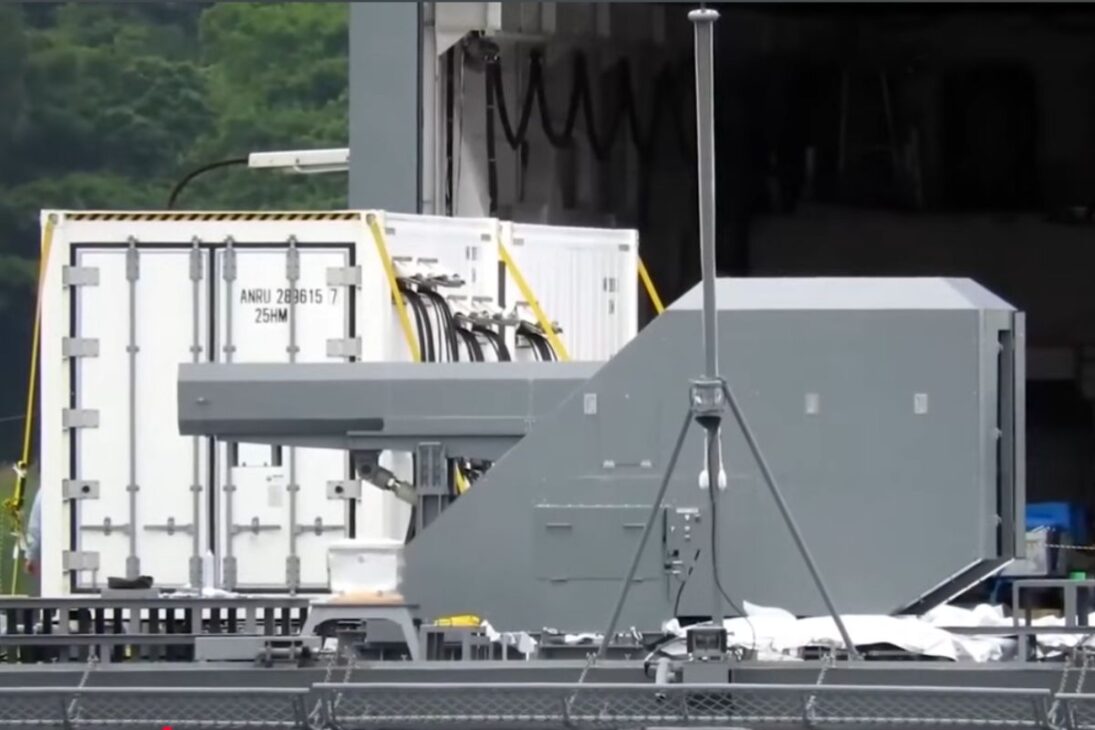
The system developed by ATLA, the Japanese defense acquisition and logistics agency, operates with a caliber of around 40 mm and uses two parallel metal rails connected to an extremely intense pulsed energy source.
When electric current passes through the structure, a magnetic field forms that pushes the conductive armature and launches the projectile along the tube.
In the configuration already demonstrated, the railgun achieved speeds close to 2,230 meters per second, approximately Mach 6.
The firing energy mentioned is on the order of 5 MJ, and the official roadmap supported by the 2024 defense budget aims to raise this level to 20 MJ per shot.
This leap is not a minor technical detail: it can expand the effective range, terminal velocity, and kinetic impact capacity, in addition to making room for heavier munitions.
Why Sea Tests Change the Weight of the Japanese Project
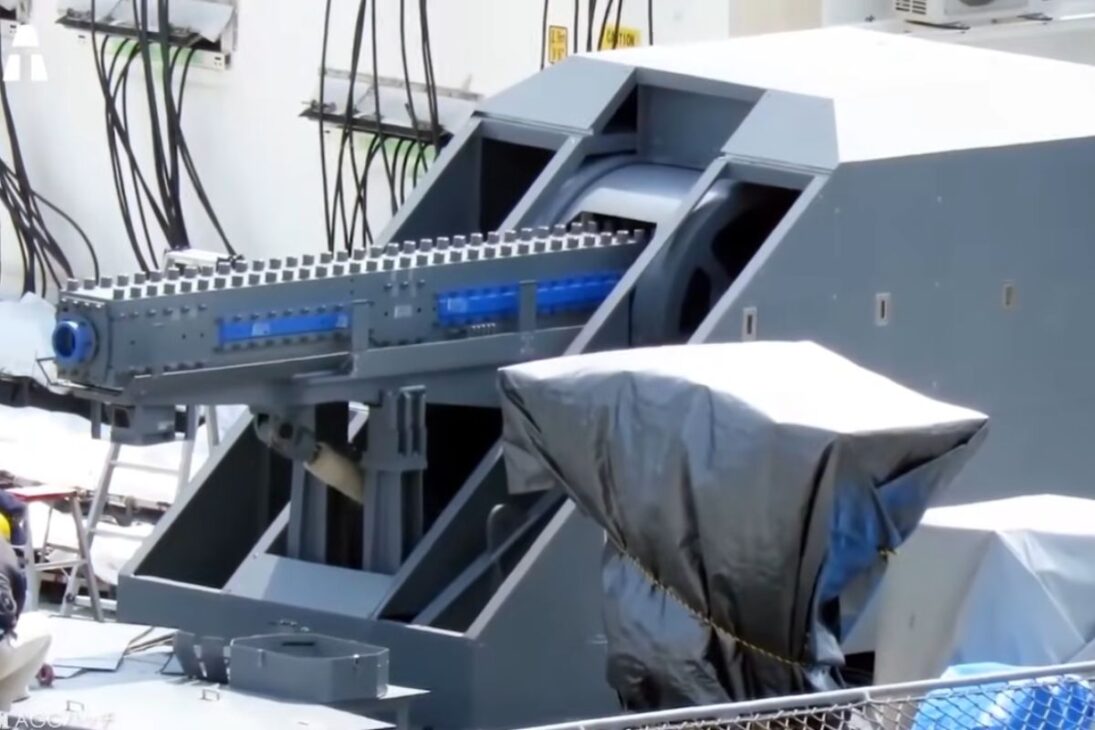
Between 2016 and 2025, Japan gradually validated the technological blocks necessary to take the project out of the laboratory.
The most significant milestone came in 2023 when the country announced the world’s first shot from a medium-caliber railgun from a maritime platform, in cooperation with the Japanese Self-Defense Maritime Force.
This showed that the weapon was no longer limited to static tests and could face real naval operation conditions.
In 2025, tests advanced at sea aboard the experimental ship JS Asuka. The installation began to involve a set of 8 to 9 tons, mounted on its own tower and integrated into the vessel’s electrical system.
This step was decisive because the problem was never just firing, but managing massive capacitors, pulsed power in real-time, platform stability, and the safety of equipment working with currents of 3 to 5 million amperes.
Where the New Electromagnetic Weapon Fits into Japan’s Defense
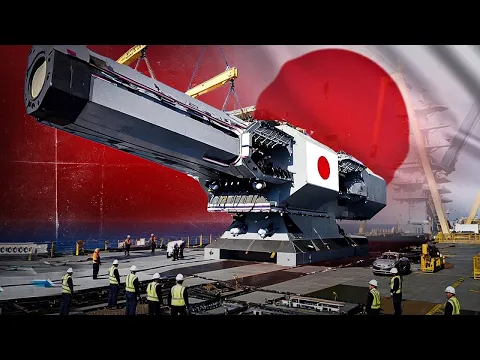

The interest of Japan in this new electromagnetic weapon is directly linked to the difficulty of facing maneuverable and very fast vectors.
Against hypersonic missiles, every second counts, and the initial speed above Mach 6 drastically shortens the time between detection, firing, and potential interception.
Instead of a classic interceptor missile, the railgun launches a projectile on a ballistic trajectory, simplifying part of the firing chain.
In the Japanese defensive architecture, this technology is conceived as an intermediate layer between already known systems.
The first layer remains linked to high-altitude interceptors, such as SM3; another layer involves Aegis systems with SM6; and short-range defense continues associated with the Patriot PAC3.
The railgun would fit precisely in the space between the sophisticated missile and classic artillery, providing a rapid and potentially more economical response to advanced aerial threats.
What Makes the System Cheaper and More Discreet in Combat
One of the strongest arguments in favor of the new electromagnetic weapon is the cost of use.
According to the data provided, an inert projectile can cost a few thousand dollars, while a traditional interceptor missile can reach several million.
In a saturation scenario, when an adversary launches multiple vectors almost simultaneously, this difference ceases to be merely accounting and becomes a strategic factor.
If the attack is massed, the cost per response weighs as much as accuracy.
There is also an important operational advantage: since the projectile does not carry explosives and the shot does not rely on classic chemical propulsion, the infrared signature tends to be lower.
For a ship that needs to intercept hypersonic missiles without exposing itself more than necessary, this helps reduce the thermal visibility of the launch.
The combined effect of low cost, cadence, and discretion explains why Japan views the railgun as a possible piece of a more flexible missile defense shield.
What Still Prevents the Weapon from Becoming a Ready Solution
Despite the progress, the project is not free from bottlenecks. The main difficulty remains in managing the thermal and mechanical stresses produced by firing.
The rails need to withstand gigantic currents, extreme friction, and accelerated wear. The erosion of the barrel still limits the lifespan of the tube, requiring the use of composite materials and advanced metal alloys.
Without solving durability, there is no reliable operational scale.
This history helps explain why the United States halted its own program in 2021, assessing the technology as too demanding in energy and still immature for rapid deployment.
Japan, however, chose a different path: instead of pursuing a naval piece with ultra-long range, it focused the railgun on a more specific mission aimed at missile interception.
The declared goal is no longer to prove that the idea works but to accelerate the timeline for use in the second half of the 2020s.
The new electromagnetic weapon from Japan is not yet a mass-produced system, but it has already surpassed the phase where it could only be treated as a futuristic experiment.
What exists now is a naval program that has demonstrated real firing at sea, integration with a test ship, speeds above Mach 6, and a clear proposal to respond to hypersonic missiles with lower costs per shot and a different logic of military employment.
At the same time, the project continues to depend on advances in durability, energy, and systemic integration to move beyond the experimental stage.
This is exactly why the Japanese case draws so much attention: the country is trying to turn a technology seen by many as risky into a concrete tool for regional defense.
Do you believe that Japan’s railgun stands a real chance of becoming the standard against hypersonic missiles, or does it still seem early to treat this weapon as a definitive change?







Seja o primeiro a reagir!