





 Portuguese
  English
  Spanish
  6 min of reading
  26 comments


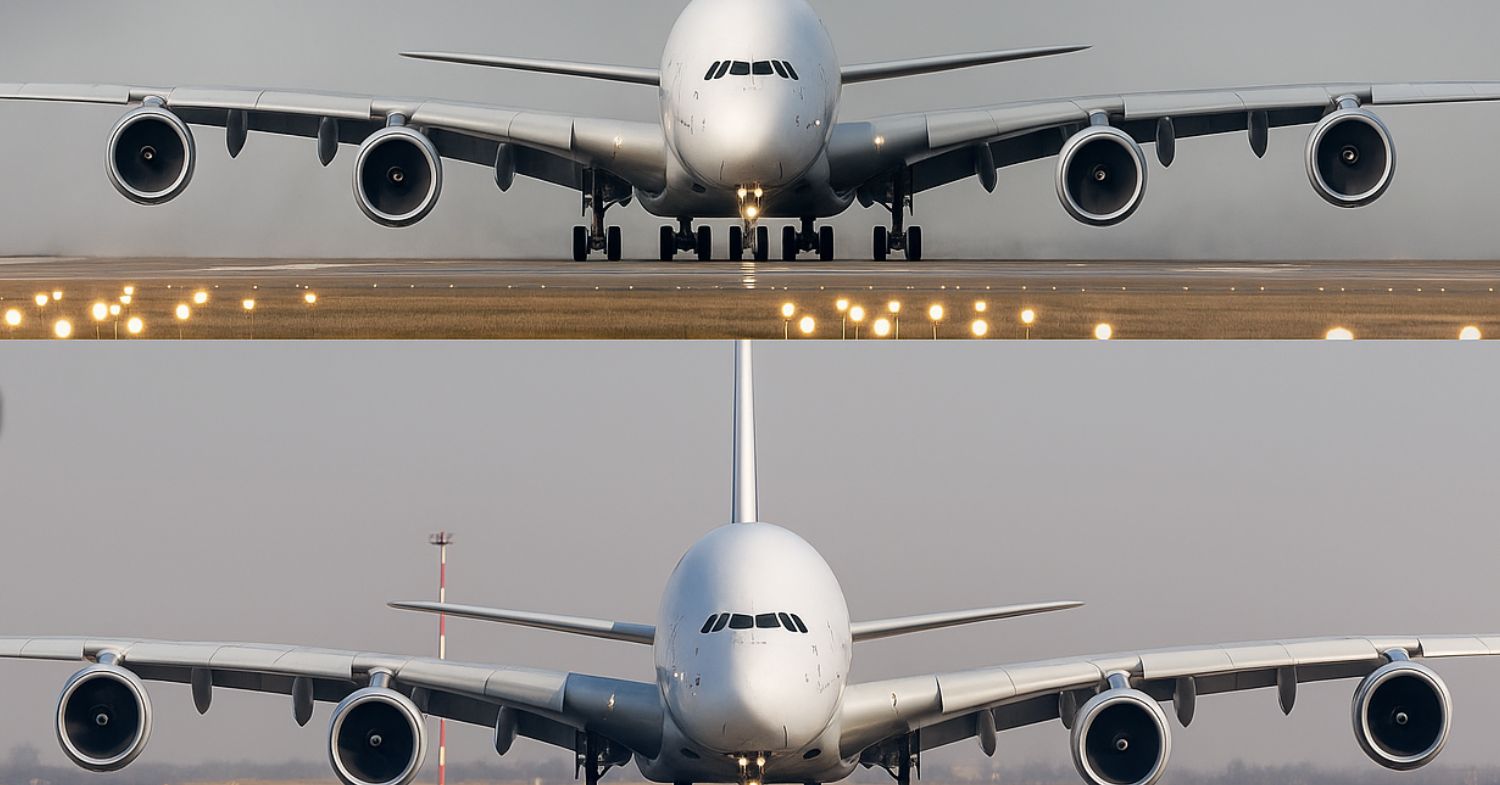

With Two Full Decks and Capacity for Over 800 Passengers, the Airbus A380 Was the Largest Commercial Airplane Ever Built. But Why Did This Giant of the Skies Become a Billion-Dollar Loss for Airbus?
When the Airbus A380 took to the skies for the first time in 2005, the world witnessed the birth of a new era in commercial aviation. With two full decks, four engines, and the ability to carry up to 853 passengers, the A380 immediately became the largest commercial airplane in the world. It was a symbol of ambition, luxury, and cutting-edge technology from Airbus — a direct response to the reign of the Boeing 747.
However, two decades later, the A380 entered the history books not as a commercial success but as one of the largest financial failures in the aviation industry, with losses estimated at over US$ 25 billion. Production was halted in 2021, with only 251 units delivered — less than half of what was projected.
But why did the Airbus A380 incur losses? How did an airplane with unprecedented size and innovation become economically unviable? In this article, we will explore the behind-the-scenes of the A380’s creation, its impressive specifications, Airbus’s strategic errors, and the reasons that led to the decline of this giant of the skies. We also have with over 30 meters in length and capacity for 350 passengers, the longest bus in the world was a landmark of modern urban engineering
-
How to build a floating island from scratch with reeds, giant blocks, and stakes in the lake in a process that needs to be repeated almost every day.

-
A forgotten cord on the floor of a basement in Vienna leads a plumber to a box containing 30 kilograms of gold with Mozart’s face, hidden before World War II. The treasure, worth 2.3 million euros, was just centimeters away from a worker who ignored the sign a day earlier.

-
A couple buys an old chalet, breaks the kitchen floor for renovation, and finds over a thousand coins of gold and silver hidden since the English Civil War over 4 centuries ago.

-
Rigid bags with their days numbered: new trend prioritizes comfort in 2026.


Airbus A380: The Largest Commercial Airplane in History
Officially launched in 2000, the Airbus A380 was developed to face the Boeing 747, then the largest passenger aircraft. The proposal was bold: to build a two full-deck aircraft, capable of carrying twice the number of passengers and operating at major international hubs.
Technical Specifications of the Airbus A380:
- Length: 72.7 meters
- Wingspan: 79.8 meters
- Height: 24.1 meters
- Maximum Takeoff Weight: 575 tons
- Engines: 4 Rolls-Royce Trent 900 or Engine Alliance GP7200 turbofans
- Capacity: Up to 853 passengers in a single-class configuration; typical configuration: 555 passengers (three classes)
- Range: 15,200 km (non-stop)
These dimensions placed the A380 in a category of its own — the only passenger aircraft with two full decks.
The Promise: More Efficiency and Fewer Flights
Airbus was betting on the “hub-and-spoke“ concept, where large airplanes would transport hundreds of passengers between major central international airports, connecting them later to smaller destinations. With this, the A380 would offer:
- Reduction in flights per route (fewer takeoffs and landings);
- Lower cost per seat;
- Higher profitability on dense routes, such as London-Dubai, New York-Singapore, and Paris-Hong Kong.
The proposal seemed solid on paper, and major companies like Emirates, Singapore Airlines, Lufthansa, and Air France bet heavily on it.
The Luxury Onboard: An Unmatched Experience
The A380 was not just a technical feat, but also a symbol of air luxury. Some airlines implemented:
- Private cabins with double beds;
- Showers in first class;
- Lounges with bar, lounge, and exclusive services;
- State-of-the-art entertainment, with individual screens and Wi-Fi connectivity.
The onboard experience was unique, especially for those traveling in premium classes. Emirates’ marketing, for example, used the A380 as its “calling card.”
The Real Cost of the Project: US$ 25 Billion
Despite all its innovation, the Airbus A380 became one of the most expensive and problematic projects in aviation. The total development cost exceeded US$ 25 billion, which Airbus hoped to recover through the sale of over 600 units.
But only 251 aircraft were built, a number insufficient to cover fixed costs and generate profit.
Reasons for the Financial Failure:
- Miscalculated market: the growth of the hub-and-spoke model was outpaced by the point-to-point model, with direct flights on smaller, more efficient aircraft.
- Aircraft limited to few airports: the A380 required special infrastructure, such as reinforced runways and two-story gates, limiting its operation to major hubs.
- Extremely high operating costs: the fuel consumption and maintenance costs of the A380 were significantly higher than those of modern twin-engine models like the Boeing 787 or Airbus A350.
- Delay in financial return: few airlines managed to operate the A380 with occupancy rates above 80%, making operation sustainable only for companies like Emirates.
- Change in consumer profile: with the popularity of direct flights and shorter wait times for connections, the A380 ceased to be attractive, even with onboard comfort.
Emirates: The Largest Operator and Main Supporter
If the A380 had not been adopted by Emirates Airlines, its failure would have come even sooner. The Emirates company acquired 123 units, nearly half of the total production.
Emirates established a specific operational structure for the A380, even building dedicated terminals at Dubai airport.
But even the program’s largest supporter announced in 2019 a gradual replacement of the A380 with smaller, more efficient models, such as the Boeing 777X and the Airbus A350.
Production Came to an End
In 2021, Airbus officially halted the production of the A380, with the delivery of the last unit to Emirates. The assembly line in Toulouse was decommissioned, and the company announced a focus on newer, lighter, more economical, and environmentally sustainable models.
The decision marked the end of an era — the largest commercial airplane in the world became an icon of a market vision that never materialized.
What Will Happen to the A380s in Operation?
Despite the end of production, around 150 units of the A380 are still in operation, mainly by Emirates, Singapore Airlines, British Airways, and Qantas.
Some aircraft were stored or decommissioned during the pandemic, but with the recovery of international demand, part of the fleet has been reactivated on high-density routes.
However, keeping the A380 flying incurs high costs, which is expected to accelerate the gradual retirement of the remaining units over the next decade.
Why Did the Airbus A380 Incur Losses?
Summary of Key Factors:
| Factor | Impact on Losses |
|---|---|
| Overestimation of Demand | Highly Negative |
| Shift to Direct Flights (Point-to-Point) | Made the Model Obsolete |
| Limited Infrastructure at Airports | Operational Restrictions |
| High Operating Costs | Reduced Profitability |
| Competition with Efficient Twin-Engine Aircraft (787, A350) | Loss of Competitiveness |
| Few Airlines Operating at Scale | Lack of Commercial Viability |
The Airbus A380 did not fail due to a lack of technology — it failed because the aviation world evolved faster than its business model.
Legacy of the A380: Commercial Failure, Engineering Icon
Even being a financial failure, the Airbus A380 solidified its place as a milestone in the history of aeronautical engineering. It challenged the limits of physics, logistics, and commercial operation.
Its construction involved:
- Over 1,500 suppliers in 30 countries;
- Final assembly in Toulouse (France);
- Transport of gigantic parts by air, sea, and land;
- Innovative solutions for aerodynamics, comfort, and connectivity.
The A380 is admired by pilots, engineers, and passengers as one of the most impressive flying machines ever built.
The Airbus A380 is still considered the largest passenger aircraft in history — and one of the most ambitious projects in the aviation industry. But its size, luxury, and power were not enough to overcome the harsh realities of a constantly changing market.
It became a US$ 25 billion commercial failure, a victim of strategic errors, overestimated demand forecasts, and an industry that began to value efficiency, flexibility, and sustainability.
Still, its legacy remains. Whenever an A380 takes off, it carries with it not only hundreds of passengers but also the weight of a dream that soared too high for the reality of modern skies.








É uma pena que um avião ✈️ como o A380 não tenha dado certo.
O legado dele vai ficar eternizado mundo afora!!!
Ainda vou voar num deles antes da virarem museus.
João Luiz Silva – Santana- Paulo
Acho que o erro foi não avaliar seu pouso e sua decolagem.
Temos a sabedoria criatividade . Uma persceverança gradual, com base seria o critério pera que desse certo esse empreendimento, nunca jamais podemos alcançarmos performance gradualmente duplicando e sim aos poucos crescendo 10 a 15% o materialismo o obsurdo foi o espetáculo dessa catastrófica realidade agora resta esperar ,e reduzir esse empreendimento 75 %, sem tecnologia e de forma básica com seus fornecedores .