





 Portuguese
  English
  Spanish
  4 min of reading
  0 comments


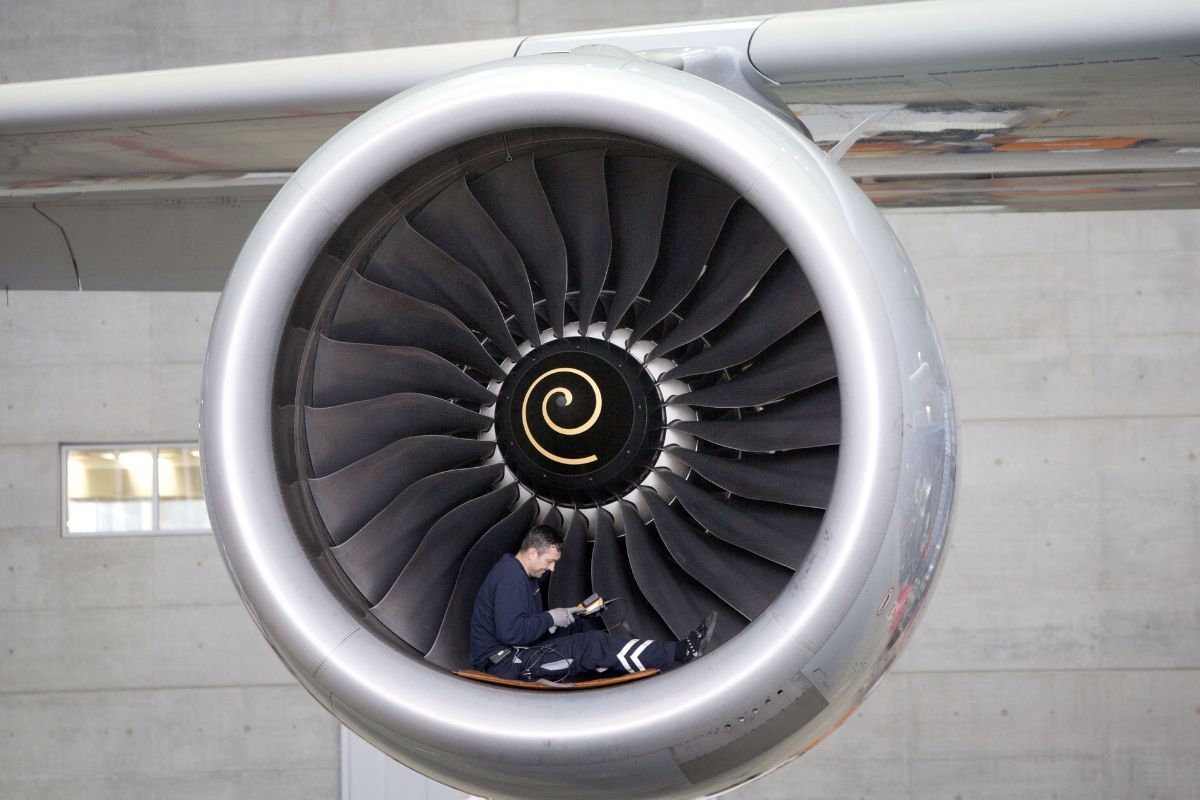


With Four Engines Adding Up to the Power of 3,500 Cars, the Engineering of the Largest Passenger Airplane in the World, the Airbus A380 Was a Landmark, but Its Fuel Consumption Defined Its Destiny.
The story of the Airbus A380, the largest passenger airplane in the world, is a tale of extremes in engineering. To lift its 575 tons off the ground and carry over 800 passengers, Airbus had to create a propulsion system of colossal power. Its four engines, the heart of the giant, represented the peak of technology of its time.
However, this same engineering that allowed the A380 to fly higher and further was also responsible for its main challenge: fuel consumption. Understanding the engineering of the engines and the economy of the A380 is to unravel the paradox of an aircraft that was, at the same time, a technological wonder and a giant with a voracious appetite.
The Two Engine Options: The Power of the Rolls-Royce Trent 900 and the Engine Alliance GP7200
To power the largest passenger airplane in the world, airlines could choose between two high-bypass turbofan engine options, both true engineering feats.
-
Drought may be creating stronger superbugs in the soil and helping antibiotic resistance reach hospitals, warns a study highlighting a problem that could grow alongside extreme weather.

-
The biggest scam in history: Napoleon’s France deceived the United States by selling them a territory that was Spanish.

-
Why is the Danakil Desert so dangerous? It has unstable terrain and how extreme temperatures and toxic gases turn the region into one of the most hostile environments on Earth.

-
With a height of 221 meters and a capacity for trillions of liters, Hoover Dam still holds a trick that makes water defy logic.


Rolls-Royce Trent 900: a derivative of the successful Trent engine family, was the choice of airlines such as Singapore Airlines (launch customer), Lufthansa, and Qantas.
Engine Alliance GP7200: developed by a joint venture between General Electric and Pratt & Whitney, this engine combines technologies from two of the most famous American engines, the GE90 and the PW4000. It was the choice of Emirates, the largest operator of the A380.
Each of these engines is capable of generating a thrust of approximately 70,000 pounds-force, which is equivalent to over 30 tons of force per engine. Together, the four engines of the A380 produce a combined power equivalent to that of about 3,500 cars.
The 11 Tons of Fuel per Hour and Efficiency per Passenger
The A380 is famous for its immense fuel consumption. Its tanks, located in the wings and under the fuselage, can carry up to 320,000 liters of aviation kerosene. During a cruise flight, the aircraft burns about 11 tons of fuel per hour.
However, the A380’s large scale creates a paradox where, despite the total consumption being extremely high, the efficiency per passenger is remarkable. With a full cabin, the fuel consumption per person can reach 3 liters per 100 km, a figure comparable to that of a modern hybrid car. This means that on high-demand routes, the A380 can be more efficient per seat than many smaller aircraft.
The Use of Composite Materials and the Wiring Challenge
The construction of the A380 was an unprecedented engineering challenge. The project was groundbreaking in its extensive use of composite materials, which make up over 20% of its structure. The central wing box, for example, was made of carbon-fiber-reinforced plastic, an innovation that helped reduce the weight of the giant.
However, this complexity also brought problems. The A380’s electrical wiring, with its 530 km of cables, became the Achilles’ heel of the project. Differences in design software used by the factories in Germany and Spain led to incompatibilities in assembly, causing delays of almost two years and a budget overruns that jumped from €9.5 billion to around €25 billion.
Why Four Engines Became a Problem for the Largest Passenger Airplane in the World?
The end of A380 production did not occur due to a technical failure, but rather due to a strategic miscalculation. Airbus bet on a future of large hubs, but the industry evolved toward the point-to-point model, driven by more efficient twin-engine aircraft.
Aircraft like the Boeing 787 and the Airbus A350, with only two next-generation engines, can fly the same long-distance routes as the A380 but with a 20% to 25% lower fuel consumption. In an industry where fuel is one of the largest costs, this efficiency difference made the operation of the A380 economically unviable for most airlines, especially on routes that could not fill all their seats.
The Lessons of the A380 for Modern Aviation
Although it was a commercial failure that never recovered its development costs, the largest passenger airplane in the world left an important technological legacy. The experience gained from the A380 in the use of composite materials and in the integration of complex systems was immense. This knowledge was directly transferred to the design of the Airbus A350, a sales success.
The A380 served as an expensive research and development laboratory that paved the way for the next generation of aircraft. Its legacy lies not only in its imposing size but also in the engineering lessons that helped shape the most modern airplanes flying today.








A380, um marco na Engenharia Aeronáutica. Embora o A350 seja mais economicamente viável pelo menor consumo transporta menos passageiros. Parabéns à AirBus pelos projetos.