





 Portuguese
  English
  Spanish
  3 min of reading
  1 comment


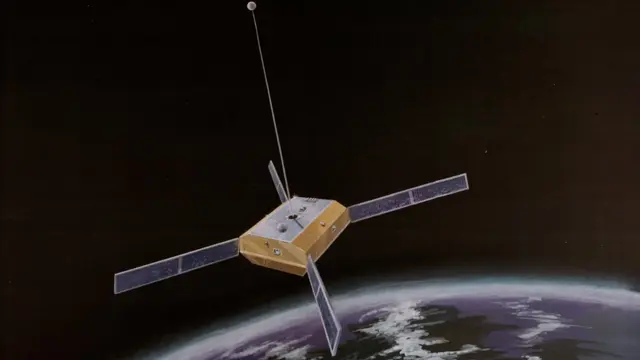


During The Cold War, An Ultra-Secret Spy Satellite Remained Hidden For Decades. Now, Its Story Comes To Light!
During the Cold War, the world lived under the constant threat of nuclear war. Amidst this tension, the United States developed highly sophisticated espionage strategies to monitor the movements of the Soviet Union. Among these initiatives was the ultra-secret project Parcae, a spy satellite that remained hidden for over 30 years.
This advanced system provided the U.S. with a crucial strategic advantage, allowing detailed surveillance of Soviet military operations and ensuring the principle of mutually assured destruction (MAD).
According to engineer Lee M. Hammarstrom, a Cold War technology expert: “We were under MAD at that time, so if the Soviets had a way to deny our attacks, they might have considered attacking first.”
-
Motorola launched the Signature with a gold seal from DxOMark, tying with the iPhone 17 Pro in camera performance, Snapdragon 8 Gen 5 that surpassed 3 million in benchmarks, and a zoom that impresses even at night.

-
Satellites reveal beneath the Sahara a giant river buried for thousands of kilometers: study shows that the largest hot desert on the planet was once traversed by a river system comparable to the largest on Earth.

-
Scientists have captured something never seen in space: newly born stars are creating gigantic rings of light a thousand times larger than the distance between the Earth and the Sun, and this changes everything we knew about stellar birth.

-
Geologists find traces of a continent that disappeared 155 million years ago after separating from Australia and reveal that it did not sink, but broke into fragments scattered across Southeast Asia.

The Context And Development Of Parcae
In the 1970s, the expansion of the Soviet Navy, driven by the launch of the powerful nuclear cruisers of the Kirov class, put the U.S. in a critical situation.
The existing Poppy satellite-based intelligence system had significant limitations, especially in data processing speed, which could take weeks.
In light of this, in 1971, during extensive naval exercises, it became clear that the U.S. needed a more effective and agile system. Thus, Parcae was born, an advanced orbital electronic intelligence system designed to monitor Soviet naval activity in real-time.
Revelation Of A Military Secret
The Parcae project remained classified until July 2023, when the National Reconnaissance Office (NRO) finally confirmed its existence in a document from a page.
This acknowledgment occurred during the centenary celebration of the U.S. Naval Research Laboratory (NRL), where the project was developed.
Despite official secrecy, information about Parcae leaked over the years through investigative reporting and even comments from a Russian military advisor.
These revelations demonstrated not only the program’s importance but also the high level of creativity and innovation of American engineers in the Cold War technological race.
Predecessors Of Parcae
Parcae built on the experience of earlier U.S. intelligence satellite programs. In 1960, the GRAB was launched, the world’s first spy satellite, under the pretext of a scientific experiment called Galactic Radiation and Background. Its real objective, kept secret until 1998, was to capture Soviet radar emissions.
Then came the Poppy program in 1962, which enhanced intelligence capabilities with multiple satellites, allowing for more precise location of emission sources.
This evolution paved the way for the development of Parcae, which would reach a new level in naval surveillance.
The Impact Of The Parcae Satellite
The first satellite of the Parcae project was launched in 1976, and the program extended until 2008. During its operation, it received codenames such as White Cloud and Classic Wizard.
The initial launches used Atlas F rockets but later included the more powerful Titan IV-A.
One of the most relevant technological innovations of Parcae was the use of gravity gradient stabilization, an orientation control system based on a long retractable arm with a weight at the end.
This technology allowed the satellite’s antennas to remain constantly pointed at the Earth, ensuring efficient data collection.
The Parcae satellites operated in groups of three, simulating the triads of Roman mythology. Using highly precise and synchronized clocks, they were able to detect and triangulate Soviet naval emissions with extreme accuracy. This method significantly increased the intelligence capabilities of the U.S. Navy.
The Revolution Of Real-Time Intelligence
Parcae not only captured signals but also processed them quickly. Equipped with advanced minicomputers like the SEL-810 and SEL-86, it was one of the first systems to integrate real-time interruption capabilities, allowing for instantaneous incorporation of new data without interrupting processing.
According to retired Navy Captain Arthur “Art” Collier, Parcae reduced the time between signal interception and report generation to just a few minutes. This speed was crucial for military decisions in tense situations.
With information from NRO.








Se ficou fora do radar por 30 anos, o que devem ter hoje kkkkk