





 Portuguese
  English
  Spanish
  5 min of reading
  0 comments


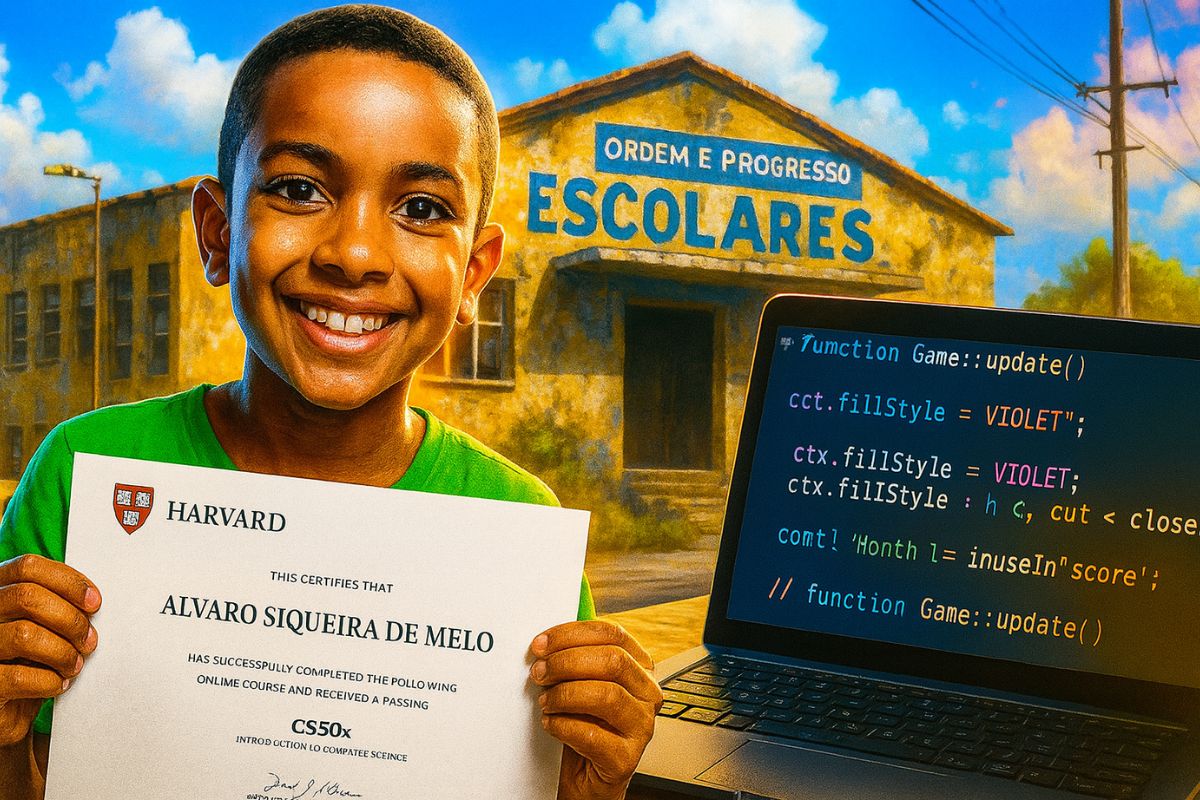
Case of the Brazilian Gifted Boy Who Created an Autobiographical Game After Completing Programming at Harvard Exposes Gaps in School Support, Shows the Strength of Self-Directed Learning, and Rekindles the Debate on Public Policies for Giftedness
The Brazilian Gifted Boy, Adriano Álvaro S. de Melo, became a symbol of a rare combination of talent, discipline, and opportunity when he completed a Harvard programming course at the age of seven and turned his learning into an autobiographical game. The project, created in a visual language, narrates real obstacles from the school routine and the territory where he lives, revealing a child capable of translating complex experiences into code, narrative, and social purpose.
Around the technical achievement, an uncomfortable diagnosis about the educational ecosystem emerges. The story highlights how the trajectory of a student with giftedness may depend more on family support, autonomy with technology, and doors occasionally opened by universities than on systematic support in schools, a point that places the issue of giftedness policies back at the center of the debate.
Who Is the Prodigy Adriano Álvaro S. de Melo and What Sets Him Apart

The Brazilian Gifted Boy showed early signs of intellectual autonomy even during literacy, using educational apps to learn quickly based on his own goals.
-
A collector bought a black stone in Morocco in 2011 without knowing that he had in his hands a Martian meteorite 4.45 billion years old with ten times more water than any other fragment of Mars ever found on Earth.

-
European cities are building public climate refuges to cope with extreme heat.

-
Excavations for a highway uncovered an intact Celtic city with gold, jewelry, and ancient production structures.

-
Every pineapple you eat is actually up to 200 different fruits fused into one: discover the fascinating process in which each flower opens for just one day and produces the pieces that form the whole fruit over the course of 3 weeks.


The same strategy enabled his functional English, allowing him to understand classes, fill out forms, and take programming courses on international platforms, something unlikely for the average student his age.
Another distinctive trait is the ability to transform knowledge into meaningful products.
After completing the course, he developed a game that weaves biographical elements, a critical reading of the environment, and technological ambition.
It was not just a technical exercise but a social commentary in the form of a game, with characters, conflicts, and objectives that resonate with real life.
What It Meant to Complete Programming at Harvard at Age 7
On a pedagogical level, the course offered foundations of computing with a blocks interface, an introductory stage designed for beginners.
At seven, mastering basic concepts, organizing logic, and delivering a functional final project requires sustained attention, technical vocabulary, and debugging skills, competencies that are uncommon at this age.
The most difficult barrier was not just cognitive.
There were linguistic and administrative challenges, such as understanding instructions, formulating responses, and organizing documents.
This set of tasks shows that learning was not limited to code, but involved planning, autonomy, and communication.
The Autobiographical Game as a Mirror of School and Territory
In the game, the protagonist faces obstacles that reflect the school and neighborhood reality.
The narrative articulates frustration with the absence of pathways for English, programming, robotics, and chess, areas in which the student sought content on his own.
The central message is clear: when the school does not differentiate, the high-potential student may feel excluded even when enrolled.
The scenario also records tensions from the surroundings, incorporating challenges that mirror concerns about safety and routine into the gameplay.
By converting these experiences into mechanics and objectives, the Brazilian Gifted Boy uses the game as a language to elaborate emotions and communicate demands, bringing technology closer to emotional health and civic expression.
Why the Case Exposes Systemic Failures of Education
The story illustrates a frequent inversion in Brazil.
Instead of the school providing specialized educational support, acceleration, or enrichment, the family and external institutions end up filling the gaps, creating a parallel pathway.
Without ongoing teacher training and clear identification protocols, students with giftedness remain invisible in regular classrooms.
This gap has cumulative effects.
Without a flexible curriculum, resources, and mentorship, talents lose engagement and the school misses the chance to develop strategic human capital, especially in science, technology, and engineering fields.
The case highlights the urgency of turning guidelines into real routines in the classroom.
Self-Directed Learning, Technology, and Access to Opportunities
The trajectory reinforces the role of technology as means and content.
Apps served for literacy, language study, and programming, shortening distances with cutting-edge platforms.
When the family environment validates the interest and organizes resources, the learning curve accelerates, but this cannot depend solely on individual heroism.
The Brazilian Gifted Boy also represents a portrait of emerging polymathy.
In addition to computing, he accumulated certificates in various areas and approached robotics, chess, and agriculture topics, connecting purpose to technical repertoire.
This breadth suggests intrinsic motivation and a vision of social application of knowledge, especially in technology for food production and distribution.
What Public Policies and Education Networks Can Do
There are actionable measures that convert discourse into practice.
Active identification of giftedness with validated instruments, ongoing teacher training, specialized educational support with tutoring, and personalized pathways can be implemented network-wide.
Partnerships between schools, universities, and robotics labs during off-hours expand access to equipment and mentors.
Another focus is to flexibilize curriculum and assessment to allow for acceleration by area, guided projects, and participation in technical challenges.
The goal is to ensure appropriate challenges without severing the bond with the home school, avoiding situations where the student has to leave the system to develop.
What This Case Teaches Families and Administrators
For families, the message is to document evidence of interest and performance, negotiate goals with the school, and seek support ecosystems such as programming clubs and university extension initiatives.
Recording projects, portfolios, and public presentations helps guide enrichment pathways, both inside and outside school.
For administrators, the priority is to institutionalize routines.
Without screening protocols, criteria, and protected time for support, everything becomes an exception, dependent on individual will.
The case of the Brazilian Gifted Boy proves that potential exists and thrives when it finds structure, not just inspiration.
The Brazilian Gifted Boy who completed programming at Harvard at age seven and created an autobiographical game offers a powerful reflection of the country.
He shows what talent does when it finds tools and support, and what the system fails to do when it does not provide pathways for those who learn faster.
Transforming this example into daily policy is the difference between celebrating exceptions and ensuring opportunities for thousands of children with high potential.










Seja o primeiro a reagir!