





 Portuguese
  English
  Spanish
  6 min of reading
  0 comments


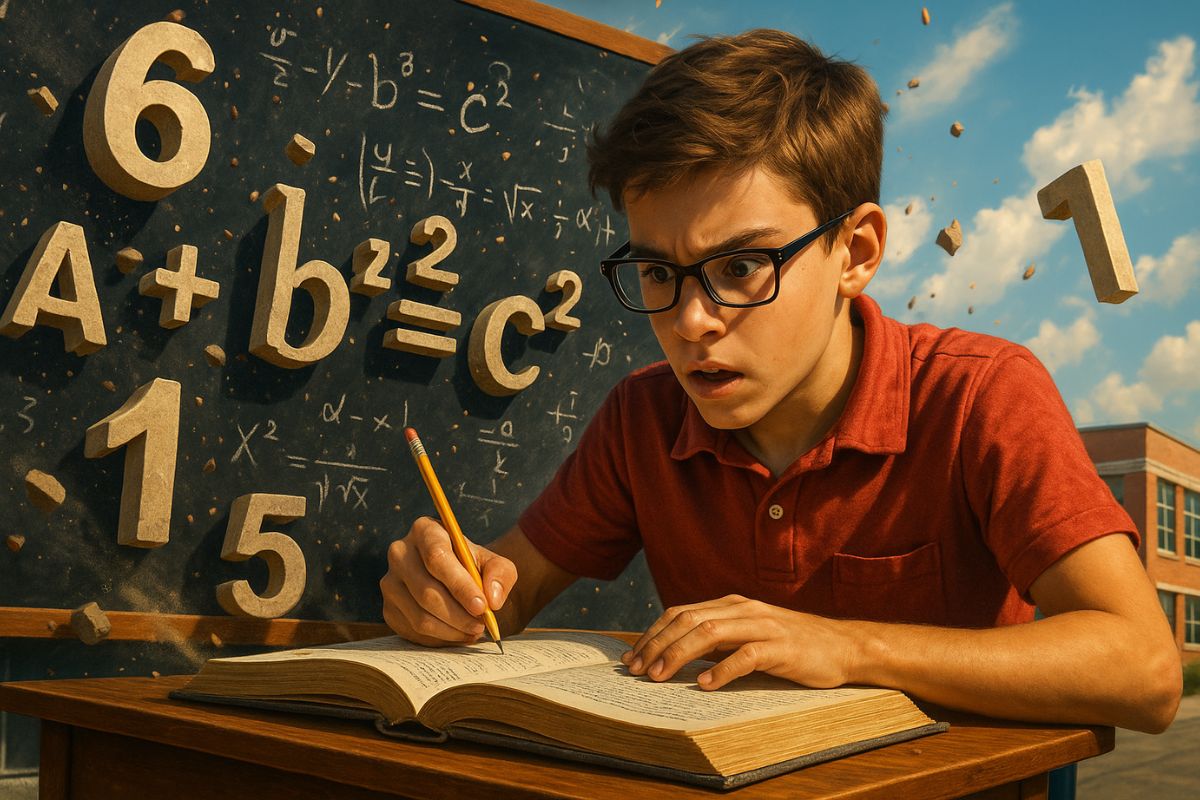
At 19, He Solved An Enigma Over Two Millennia Old, But The Signs Of His Genius Emerged Much Earlier; Meet The Journey Of The Gifted Boy Carl Friedrich Gauss, Who Redefined Science.
The history of science is marked by brilliant minds, but few manifested themselves as early and impactfully as Carl Friedrich Gauss. Considered the “Prince of Mathematicians”, this gifted boy, born into a humble family in 18th Century Germany, not only demonstrated extraordinary intellectual capacity from childhood but also revolutionized nearly every field of knowledge he touched. His journey begins in a classroom, where, at less than ten years old, he independently rediscovered a fundamental principle of arithmetic, a feat that foreshadowed the genius that would lead him to solve problems that had challenged the greatest thinkers for millennia.
Gauss’s trajectory is a demonstration of the power of a mind capable of seeing hidden structures in seemingly complex problems. From his decision to pursue mathematics, sealed by the resolution of an ancient geometric enigma, to the creation of tools that became the foundation of modern statistics by calculating the orbit of a lost celestial body, his career was a succession of transformative advances. He refounded number theory, created differential geometry from practical work mapping a kingdom, and formulated eternal laws of electromagnetism, leaving a legacy that still underpins modern physics and mathematics.
A Genius Discovered In The Classroom
Johann Carl Friedrich Gauss was born in 1777, in Brunswick, Germany, in a landscape of limited opportunities. His father, a hard-working and austere man, saw his son’s future in manual trades and was skeptical of formal education.
-
After 14 years of waiting, a rammed earth mansion built in 1702 in the North Zone of São Paulo will become a park with leisure facilities and green areas, with a million-dollar investment.
-
With 2 unfinished nuclear reactors, up to 25 billion in costs, and proven fraud, the Nukegate case has left 800,000 consumers still paying today for energy that will never be produced.

-
The household appliance that consumes the most energy in Brazilian homes is not the air conditioner; it is located in the smallest room of the house, is used daily, and can account for up to 25% of the electricity bill, while an alternative in the same outlet can reduce this cost by up to 75%.

-
Son of a seamstress from the rural area of Ceará who did not speak English wins a scholarship of over 2 million reais at Williams College, one of the top 10 universities in the United States, covering everything including dormitory, meals, and annual trips to Brazil.


In contrast, his mother, though illiterate, recognized her son’s exceptional intelligence and became his greatest advocate, nurturing a talent that soon became impossible to ignore.
This tension between the practical world and the realm of abstract genius would mark Gauss’s career, who would later stand out precisely for his ability to apply pure mathematics to concrete problems.
The most famous anecdote from his childhood, which became a legend in the history of mathematics, occurred when his teacher asked the students to sum all the numbers from 1 to 100 to keep them busy.
While his classmates struggled with the task, young Gauss presented the correct answer, 5050, in an instant. He didn’t add the numbers one by one; instead, he noticed he could pair the first number with the last (1+100=101), the second with the second-to-last (2+99=101), and so on.
Since there were 50 pairs that summed to 101, the total would simply be 50 times 101. This ability to see patterns and symmetry where others saw merely a tedious calculation was the essence of his brilliant mind.
The Discovery That Sealed A Destiny
Despite his mathematical talent, upon entering the University of Göttingen, Gauss was undecided between pursuing mathematics or philology, a field in which he was also extremely talented.
The decision came suddenly, driven by a discovery that broke a stalemate of over two thousand years in the history of geometry.
Since Ancient Greece, mathematicians had known how to construct certain regular polygons, such as the triangle and pentagon, using only a ruler and compass, but knowledge on the subject had not advanced since then.
On March 30, 1796, at 19, Gauss proved that it was possible to construct a regular polygon with 17 sides, the heptadecagon, with the same tools.
His solution was revolutionary not for a geometric innovation but for translating the problem into algebra.
He forged a deep and unexpected link between classical geometry and the theory of equations, demonstrating that the constructibility of a polygon was tied to the nature of the solutions of a specific equation.
The impact of this discovery was so profound that he decided right there to dedicate his life to mathematics, the realm where he would become the prince.
The Refoundation Of The “Queen Of Sciences”
Gauss’s first major work, Disquisitiones Arithmeticae (Arithmetic Investigations), published in 1801, transformed number theory. Before him, the area was a collection of fascinating but disorganized results.
Gauss, at just 21 years old when he completed most of the work, transformed it into a rigorous and systematic discipline.
His main innovation was the introduction of modular arithmetic, expressed through congruence notation, a tool that allowed treating whole classes of numbers as unique algebraic objects.
This new language revealed underlying cyclical structures in the integers, laying the foundation for modern abstract algebra.
In the book, he provided the first complete proof of the Law of Quadratic Reciprocity, a theorem he called the “gem of arithmetic”, and established the complete theory behind the construction of the heptadecagon.
With this single work, Gauss not only solved ancient problems but also provided the tools and standard of rigor that would define mathematics for the next century.
From Heaven To Earth: Solving Practical Problems
In the same year of his great publication, Gauss applied his genius to a practical challenge that puzzled Europe. An astronomer had discovered a new celestial body, Ceres, but lost sight of it in the Sun’s glare after just 40 days of observation.
With such scarce data, calculating its orbit was deemed impossible. While the greatest astronomers failed, Gauss, at 24, devoted himself to the problem. He approached it not as an astronomy question but as a problem of analyzing imperfect data.
Using a method he developed himself, the method of least squares, he processed the limited data and accurately predicted where Ceres would reappear in the sky.
Months later, astronomers pointed their telescopes to the indicated position and found the celestial body exactly where he had predicted. The feat made him a celebrity.
Later, seeking a theoretical justification for his method, he developed the concept of the normal distribution (or Gauss Curve), which became one of the most fundamental tools in statistics, used today in almost every field of knowledge.
Mapping The World And Creating New Geometries
Gauss’s career was marked by this symbiosis between the theoretical and the practical. For over a decade, he dedicated himself to the task of conducting a geodetic survey of the Kingdom of Hanover.
This fieldwork, which forced him to deal with the curvature of the Earth, led him to profound reflections that gave birth to a new field of mathematics: differential geometry.
In his 1828 work, he introduced the concept of Gaussian curvature and proved, in his “Remarkable Theorem”, that curvature is an intrinsic property of a surface.
His investigations led him to an even more radical conclusion that he kept secret throughout his life: the existence of consistent non-Euclidean geometries, where the famous parallel postulate of Euclid did not apply.
He anticipated by decades one of the greatest revolutions in mathematical thought, but never published his findings, fearing controversy and the “clamor of the ignorant”.
This caution reveals the tension between his revolutionary intellect and his conservative public persona, a trait that perhaps delayed the advancement of science.
The legacy of Carl Friedrich Gauss extends across the entire spectrum of science, from the most abstract number theory to engineering and physics.
Guided by his motto “Pauca sed Matura” (“Few, but Mature”), he published only works he deemed perfect, but what he published changed the world. His influence is so intertwined in the structure of modern science that it has become almost invisible.
He was not just a problem solver; he was an architect of systems, a unifier of intellectual worlds who embodied the ideal of a complete genius.
What impresses you most about Gauss’s journey: his genius as a gifted boy or his ability to apply mathematics to real-world problems? We want to know your opinion in the comments.







-

-

-

-

-

-

126 pessoas reagiram a isso.