





 Portuguese
  English
  Spanish
  6 min of reading
  0 comments


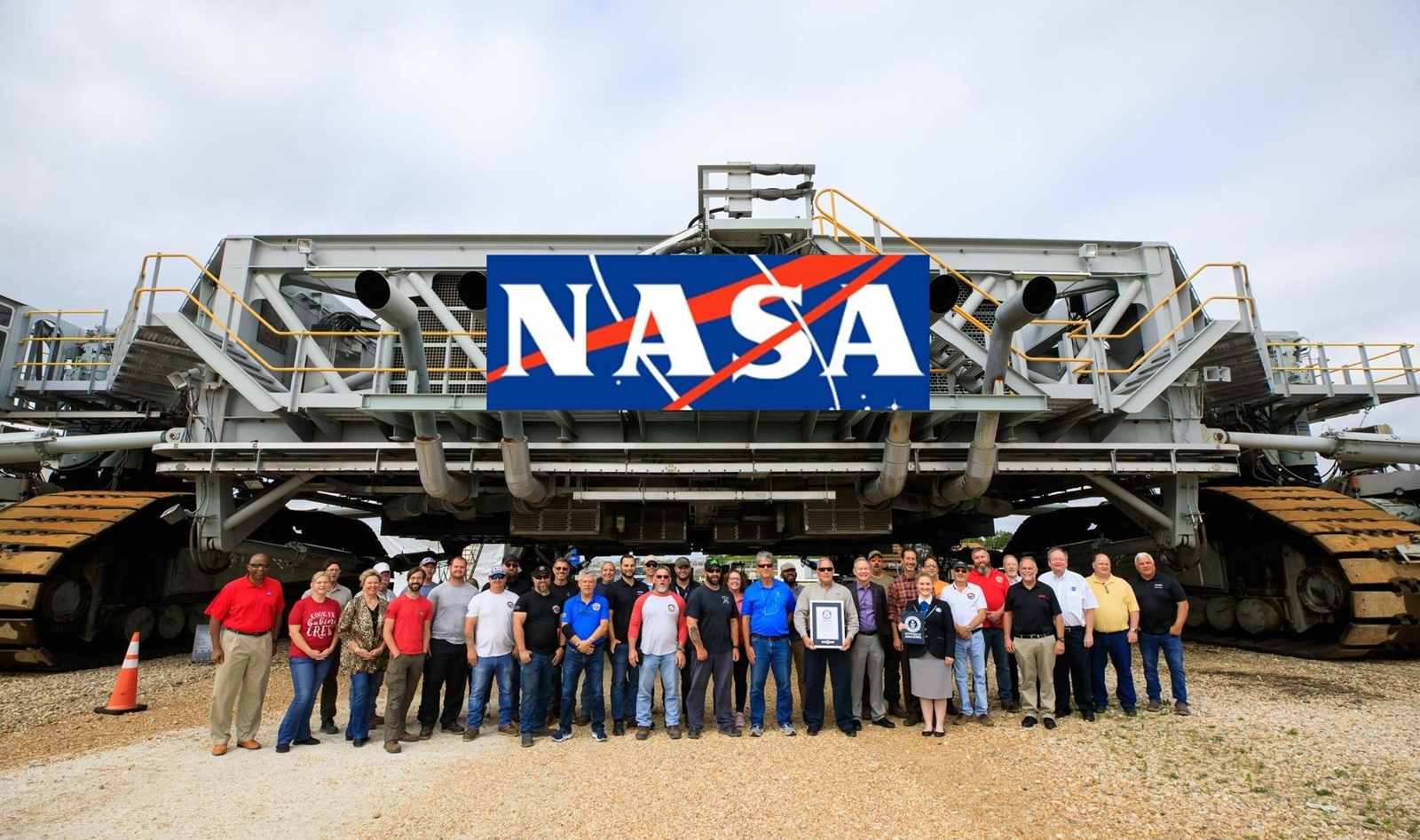
Recognized by Guinness, the Heaviest Vehicle on the Planet Carries NASA Rockets and Weighs an Amazing 2,700 Tons on Giant Tracks.
When we think of NASA’s great feats, rockets slicing through the skies and astronauts floating in space usually come to mind. Little do people imagine, however, that before taking off, each rocket needs to be slowly transported to the launch pad.
This is where the legendary Crawler-Transporters come in, two gigantic vehicles built in the 1960s to transport spacecraft and their mounting supports.
Although little known to the public, these vehicles have played a crucial role in almost every manned mission of the United States since the Apollo era.
-
China has created a mass-produced hypersonic missile that costs the same as a Tesla, and this is changing everything in modern warfare because the United States cannot defend itself without spending millions.

-
100% Brazilian technology transforms agricultural waste into a meat-scented ingredient using fungi from the Amazon rainforest. The process does not use excessive water or chemicals, and it also increases the nutritional value of the final product.

-
Psychology reveals that adults who avoid conflicts at all costs are not balanced individuals, but rather children who learned in the worst way that expressing emotions brought punishment and now live paralyzed by the fear of expressing themselves.

-
Goodbye pet hair on clothes: a washer with an internal filter promises to remove up to 5 times more hair than regular machines and uses an XL trap dryer system to capture what remains.


Their task is Herculean: to carry structures that can weigh over 8 million kilograms and transport them for kilometers to the launch point without shaking or tilting too much.
This feat, however, comes at an extremely high cost in fuel and energy — which makes the crawlers some of the thirstiest wheeled machines on the planet.
What Are NASA’s Crawler-Transporters
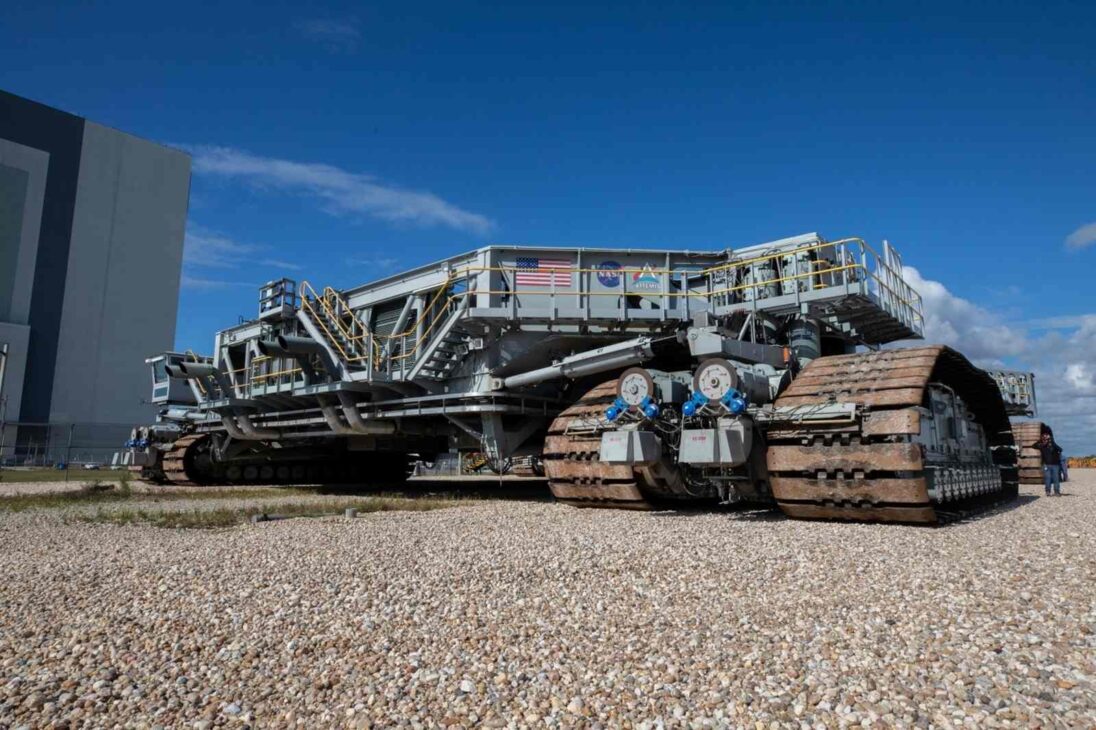
NASA has two identical Crawler-Transporters, simply known as CT-1 and CT-2. They were built between 1963 and 1965 by Marion Power Shovel Company, originally to support the Apollo Program, which would take humans to the Moon.
Each measures about 40 meters long by 35 meters wide, with an adjustable height between 6 and 8 meters.
Recognized by Guinness World Records, NASA’s Crawler-Transporter is the heaviest self-propelled vehicle on the planet.
Its empty weight reaches an impressive 2,700 tons, and its maximum load capacity reaches 8,200 tons. To put that in perspective, it’s like transporting the weight of over 100 locomotives at the same time.
With its 2,700,000 kilograms, the NASA Crawler-Transporter carries a weight that impresses even the most experienced engineers: it is equivalent to about 450 adult African elephants lined up side by side.
This comparison helps to scale the colossal challenge of moving such a heavy structure with millimeter precision — and explains why its fuel consumption is so enormous.
The crawlers do not have ordinary wheels. They move on eight giant tracks, similar to those of armored tanks, but much larger: each track has 57 metal shoes, and each shoe weighs about one ton. This distributes the colossal weight and prevents the ground underneath them from sinking.
The Slow Journey: Speeds and Performance
Despite their colossal size, the crawlers move with a calculated slowness. The maximum speed without load is approximately 3.2 km/h. When loaded with a rocket and the entire support structure, the speed drops to about 1.6 km/h (1 mph).
This slowness is intentional: the load must remain absolutely stable, as any vibration can cause structural damage or misalignment.
The path to the launch pad at Kennedy Space Center in Florida is about 5.6 kilometers long and requires meticulous leveling, monitoring, and tilt control at every meter traveled.
Over the decades, each crawler has already traveled thousands of kilometers. The CT-2, for example, has logged over 3,800 km of operation since its construction, a remarkable feat considering the short distance of each trip.
Engines and Energy Systems: A Complex Heart of Steel
To move this colossal mass, the crawlers rely on an intricate combination of diesel engines, generators, and electric motors. The system is divided into two main subsystems: traction and auxiliary power.
Traction System
- Each crawler has 16 locomotive-style traction motors, with 375 horsepower each, powered by electricity.
- The electricity that powers them comes from four direct current (DC) generators, each with 1,000 kilowatts of power.
Auxiliary Power System
- Two alternating current (AC) generators of 1,500 kilowatts each power auxiliary systems such as steering, platform elevation, hydraulic, and electronic systems.
- These AC generators are driven by two 16-cylinder Cummins diesel engines with 2,200 horsepower each.
This combination ensures enough gross power to move the gigantic load while simultaneously providing energy for support and control systems.
Fuel Consumption: NASA’s Diesel Devourers
The fuel consumption of the crawlers is, without exaggeration, astronomical. Each vehicle has a tank with a capacity of about 19,000 liters of diesel.
When loaded, the crawler consumes approximately 2.94 liters of diesel for every 10 meters traveled — which is equivalent to about 390 liters per kilometer.
This fuel consumption rate is thousands of times greater than that of a regular car and even much higher than that of heavy trucks.
In simple terms, while a car can travel dozens of kilometers on a single liter of fuel, a crawler consumes almost 3 liters to move just 10 meters.
To put the scale of this consumption in perspective, the 390 liters it consumes to travel 1 kilometer would be enough for about 4,680 regular cars to cover the same distance.
With a full tank, the theoretical range is about 48 kilometers when loaded, but in practice, they never reach that far.
This is because the crawlers rarely operate for long continuous periods. Additionally, part of the fuel needs to be reserved for maneuvers and unforeseen events, and there is extra consumption from auxiliary systems even when the vehicle is not moving.
Why So Much Energy Is Needed
The reason for the gigantic consumption is directly linked to physics: moving colossal masses requires colossal force.
The crawlers carry structures that can exceed 8 million kilograms over sloped and compacted gravel terrain.
To avoid vibrations, the movement is extremely slow, but that does not mean the effort is small — quite the opposite.
It is necessary to overcome the friction of the tracks against the ground, keep the platform leveled with millimeter precision, and compensate for any tilt or sinking of the ground in real-time.
Furthermore, the electric propulsion system powered by diesel generators is not very efficient: much of the thermal energy from the combustion engines is lost as heat before it becomes useful movement.
All of this combined explains why each meter traveled consumes such enormous amounts of fuel.
Operational and Environmental Impacts
Each movement of a crawler represents a considerable cost for NASA, both financial and environmental.
With this high consumption, everything leads to significant greenhouse gas emissions. For this reason, each transport is carefully planned to minimize repetitions or unnecessary trips.
In recent years, NASA has undergone a process of modernization of the crawlers, replacing old engines with more efficient and less polluting models.
These updates have increased the load capacity to support the new rockets of the Artemis program, but they also aim to reduce the specific fuel consumption and associated emissions.
Even so, no matter how modern they become, the crawlers will remain high-consumption machines — simply because there is no other way to transport such heavy loads with safety and millimeter precision.
An Engineering Feat That Spans Generations
Even with all the limitations, the Crawler-Transporters continue to be fundamental pieces of American space infrastructure.
Since 1965, they have already transported to the launch point the Saturn V rockets of the Apollo Program, all the space shuttles of the Space Shuttle program, and, more recently, the gigantic Space Launch System (SLS) that will propel the new race to the Moon.
The longevity of these machines is impressive: after more than half a century of use, they remain fully operational, now with updated systems.
This durability demonstrates the robustness of the original design and the extreme care taken with maintenance over the decades.
In addition, the crawlers have become cultural and tourist icons. Many visitors to the Kennedy Space Center are fascinated to see the giants moving slowly along the gravel paths, as if they were ambulatory buildings gliding across the ground.










Seja o primeiro a reagir!