





 Portuguese
  English
  Spanish
  4 min of reading
  7 comments


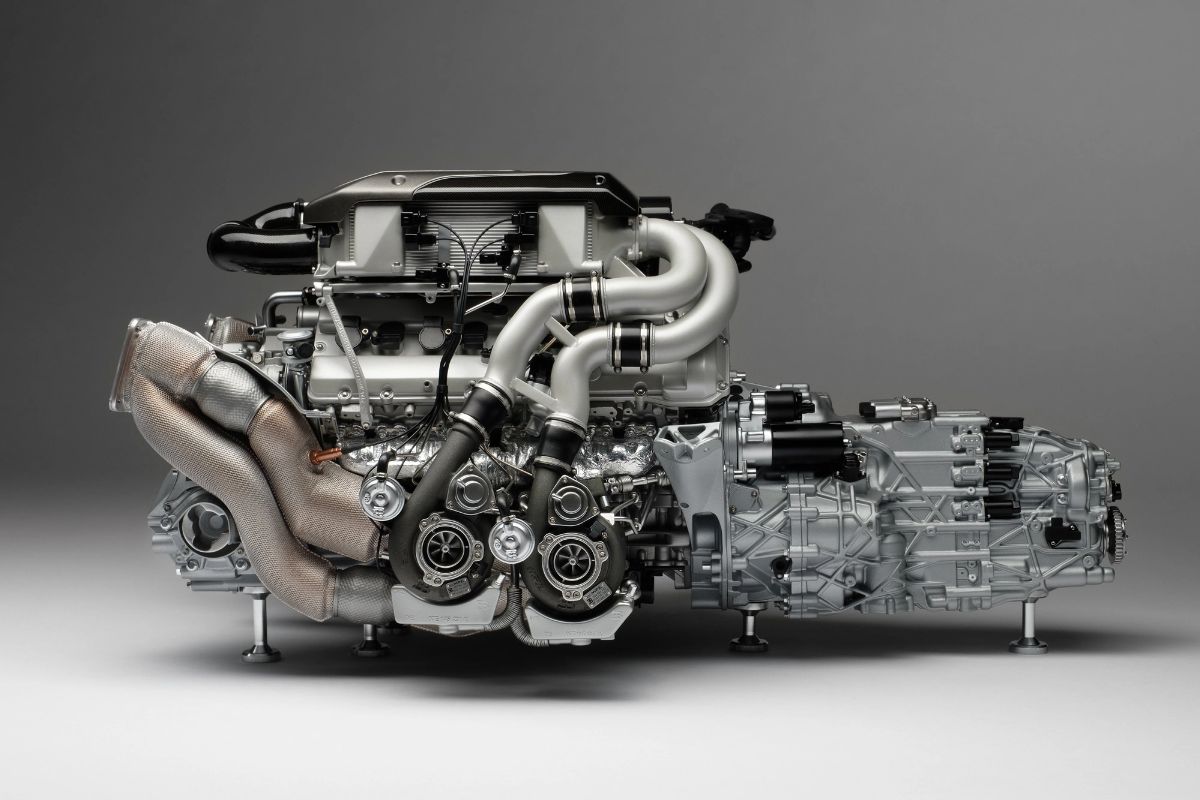


With 1,600 Horsepower, The Colossal W16 Engine Requires 10 Radiators to Function and Consumes 60,000 Liters of Air per Minute at Maximum Speed.
The Bugatti Chiron’s engine is more than just a car part; it is a monument to engineering. With a unique architecture of 16 cylinders in “W”, 8.0 liters, and four turbos, it represents the pinnacle of the internal combustion era. This powerhouse generates an impressive 1,600 horsepower, but to do this, it needs extreme solutions to avoid overheating.
The production of this mechanical work of art, which began in 2005 with the Veyron, will conclude in 2025, making each unit a museum piece. Understand how this engineering legend works, why it needs such a complex cooling system, and what its legacy will be.
How the 8.0-Liter, 1,600 HP W16 Engine Was Built
The complexity of the Bugatti Chiron’s engine begins in its design. It is not a traditional V16. Its W16 architecture is, in practice, the combination of two VR8 engines with a narrow angle, mounted on a single crankshaft. This ingenious solution allowed for the creation of a 16-cylinder engine with the dimensions of a conventional V12, which is essential for the project.
-
A forgotten cord on the floor of a basement in Vienna leads a plumber to a box containing 30 kilograms of gold with Mozart’s face, hidden before World War II. The treasure, worth 2.3 million euros, was just centimeters away from a worker who ignored the sign a day earlier.

-
An irregular parking case gains attention after a Mercedes Classe A was removed in such a strange way that it even raised doubts about damage to the car.

-
A couple buys an old chalet, breaks the kitchen floor for renovation, and finds over a thousand coins of gold and silver hidden since the English Civil War over 4 centuries ago.

-
Rigid bags with their days numbered: new trend prioritizes comfort in 2026.


Its assembly is a handmade process. Each engine is assembled by hand by only two technicians at Volkswagen’s factory in Salzgitter, Germany. The process takes six days to unite its 3,712 individual parts. For the Chiron, Bugatti upgraded the design of its predecessor, the Veyron, with turbos 69% larger and a sequential system. Below 3,800 rpm, only two turbos operate for quick response. Above that, the other two are activated, delivering the maximum power of 1,600 HP and 1,600 Nm of torque.
Why Is the System with 10 Radiators Essential to Avoid Melting?
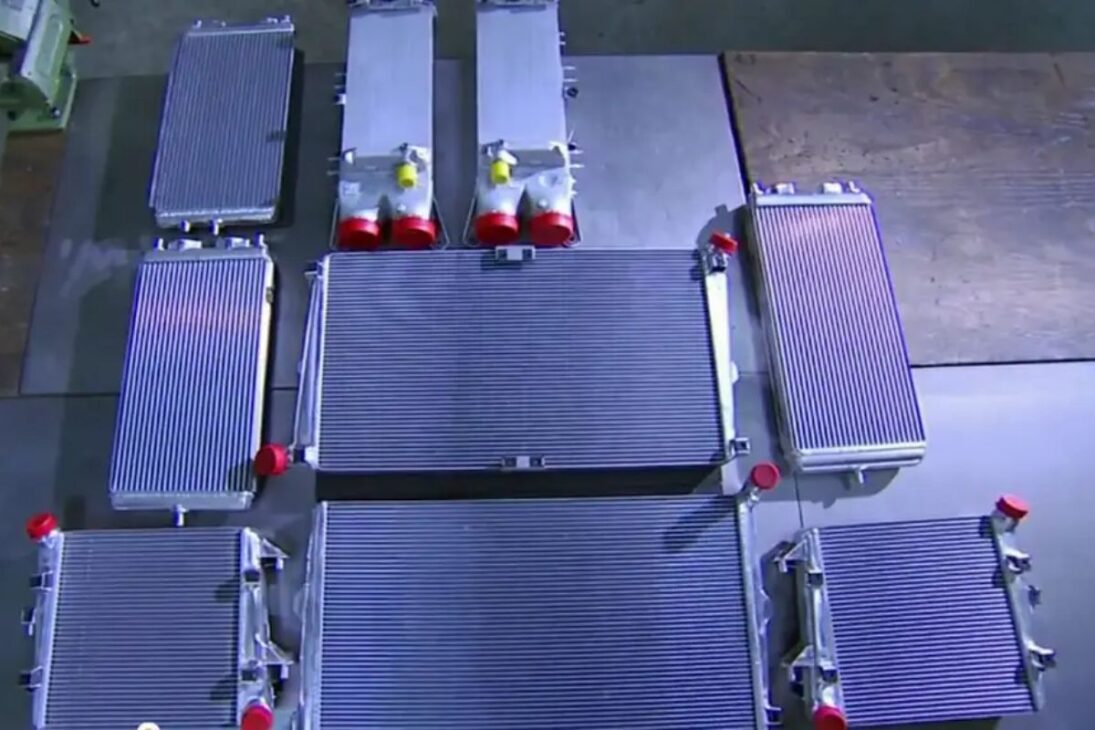
Generating 1,600 horsepower has an inevitable consequence: extreme heat. For every horsepower used to move the car, the engine generates nearly two in wasted thermal energy, totaling over 3,000 horsepower in heat. Without a cooling system up to the task, the engine would fail in seconds.
Bugatti’s solution was to create a complex system with 10 radiators. This network is not an exaggeration but a physical necessity. It consists of:
- Three radiators for the engine: They handle the main cooling circuit.
- Three intercoolers: They cool the air that the turbos push into the engine.
- One radiator for the engine oil.
- One radiator for the transmission oil.
- One radiator for the differential oil.
- One condenser for the air conditioning.
The main water system, with 37 liters, is so powerful that it circulates all the coolant through the engine every three seconds.
The Need to Consume 60,000 Liters of Air per Minute
One of the most impressive facts about the Bugatti Chiron’s engine is its air requirement. At maximum acceleration, it inhales over 60,000 liters of air per minute. To put this into perspective, this is the amount of air that an average human would take more than three days to breathe.
This immense air intake is the reason the engine requires four turbochargers. It essentially operates as a high-performance air pump, and it is this ability to “breathe” that allows for the fuel combustion necessary to generate such extraordinary power and overwhelming performance.
The 490 km/h Record: The Overwhelming Performance Achieved on August 2, 2019
All this engineering translates into numbers that challenge physics. The Chiron Super Sport accelerates from 0 to 100 km/h in 2.4 seconds and from 0 to 300 km/h in just 12.1 seconds.
On August 2, 2019, a prototype of the Chiron Super Sport, driven by Andy Wallace at the Ehra-Lessien track in Germany, made history. It became the first production car to break the 300 mph barrier, reaching a verified top speed of 490.484 km/h. In the cars sold to the public, speed is electronically limited to 440 km/h for safety reasons, primarily due to the tires.
The End of Production in 2025 and the Legacy of a Work of Engineering Art


The era of the W16 is officially coming to an end. Bugatti has confirmed that the last units of the engine will be installed in the W16 Mistral, a roadster, and the Bolide, a track-exclusive car, with production concluding in 2025. The last Chiron, named ‘L’Ultime’, was completed in May 2024.
The Bugatti Chiron’s engine will leave a legacy as an engineering feat likely unmatched. With increasingly strict emissions regulations and the industry’s shift toward electrification, an internal combustion engine of this scale and complexity is unlikely to be produced again. It was not only powerful but also the heart of a luxurious and comfortable car, proving that extreme performance and civility could go hand in hand. Its successor has already been announced: a naturally aspirated hybrid V16 engine that will equip the new Bugatti Tourbillon, beginning a new chapter for the brand.








He mais fácil colocar um motor AP BILLIT anda sem água e seus 1500 CVS
Cabe no celta esse motor?
Feito de engenharia? Um motor que perdeu 3.000 CV ficando só com 1/3 chegando nas rodas, um autêntico absurdo, só comparável a motores da década de 30, existem motores que perdem muito menos e entregam potência nas rodas.
Mas todo carro a combustão tem eficiência inferior a 30% não tem novidade nenhuma nisso, pra mim não é nada pra se gabar. Sou bem resolvido nesta questão, carro é um meio de transporte/locomoção, não tem que empinar dar RL, fritar pneu, fazer drift e nem andar a 500km/h. O meu marca 220km/h no painel e acho que nunca passei de 130 e em raras ocasiões. Não louvo esse tipo de engenharia. É inútil e pra rico se exibir e fazer ****….
Tentar explicar a paixão por velocidade a quem não entende é como jogar xadrez com pombos. Vão **** no tabuleiro, derrubar as peças e ainda achar que ganhou!
pois é, né…… não precisa falar mais nada!
Se é um **** cara, faz um melhor 🤣🤣