





 Portuguese
  English
  Spanish
  4 min of reading
  0 comments


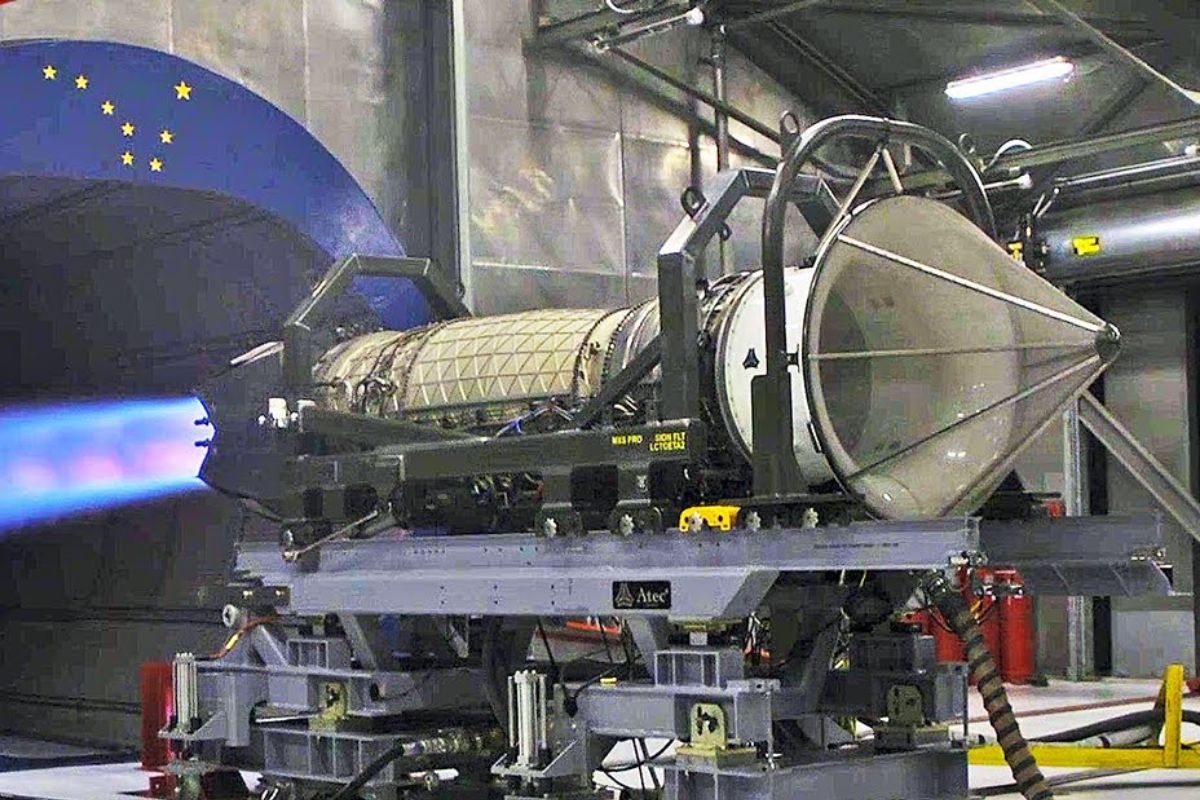
Equipped with Nozzles That Direct the Blast, the Engine of the F-22 Raptor Performs Impossible Maneuvers for Other Aircraft, Ensuring Air Supremacy
Invisibility to radars and agility that borders on the impossible. These are the two characteristics that define the Lockheed Martin F-22 Raptor. At the heart of this super maneuverability, which allows the fighter to defy gravity, is the revolutionary technology of the engine of the F-22 Raptor, the Pratt & Whitney F119.
This engine not only generates colossal power but also features thrust vectoring nozzles. Instead of simply pushing the aircraft forward, they direct the exhaust jet upward or downward. It is this capability that allows the Raptor to execute high angle of attack maneuvers, redefining what is possible in aerial combat.
The Origin of Power, the Development of the Pratt & Whitney F119
The story of the F119 began in the early 1980s. The U.S. Air Force launched the JAFE (Joint Advanced Fighter Engine) program to create the engine for its future Advanced Tactical Fighter. Pratt & Whitney presented its prototype, the YF119, to compete with General Electric’s YF120.
-
China has deployed more than 1,400 fishing boats in formation, creating a barrier of 320 kilometers at sea, and the whole world wants to know if this is fishing, a military exercise, or a message of war.

-
Spain surprises the world by erecting 62 artificial dunes, mixing sand with natural remains of posidonia, and causing the structure to lose only 1.4% of its volume in 1 year.

-
With 16 Bulava missiles, improvements in acoustic stealth, and a design focused on silent patrols, Russia’s nuclear submarine was born to ensure Moscow’s invisible retaliation and has become one of the pillars of its maritime strength.

-
‘Populous’ city in Rio among the worst in Brazil in national ranking and exposes silent development crisis.


The final decision came on April 23, 1991. The Air Force chose Pratt & Whitney’s YF119. The reason was clear: although GE’s engine was technologically more complex, the F119 proved to be more reliable and mature during the testing phase. The bet on safety and simplified maintenance, with 40% fewer parts than its predecessors, turned out to be the right choice.
The Fourth Control Surface, How the Nozzles Direct the Blast to Maneuver
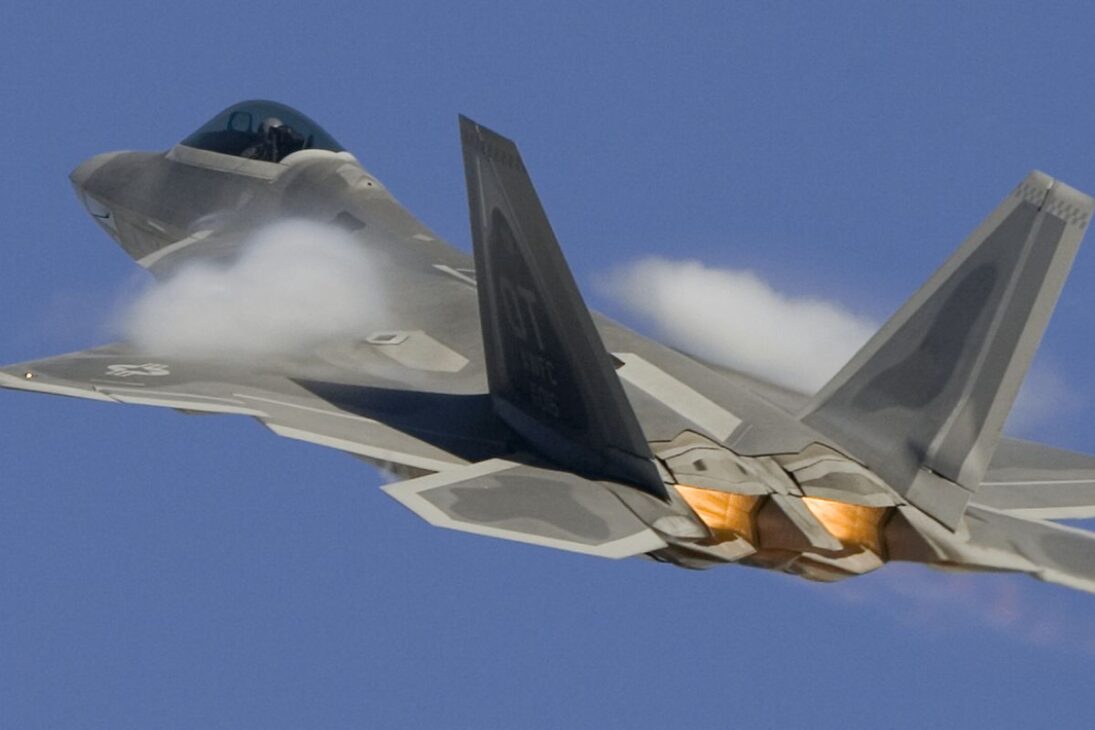
The real secret of the engine of the F-22 Raptor lies in its nozzles. They are the technology that enables thrust vectoring. Unlike conventional fighters, whose nozzles are fixed, the F119’s nozzles are bidimensional (2D) and movable.
They can move on the pitch axis, that is, up and down, at an angle of up to 20 degrees. When the nozzle points down, the tail of the aircraft is pushed up, and vice versa. This acts as a “fourth control surface,” adding to the traditional wings and rudders. The most impressive part is that the pilot does not have a separate control for the nozzles.
The pilot simply points the aircraft with the stick, and the flight computer takes care of orchestrating a symphony of movements between the wings, rudders, and the engine nozzles to perform the maneuver perfectly.
Flying Above Mach 1.5 Without Afterburner
One of the most revolutionary capabilities that the F119 engine provides is “supercruise.” It is the ability to sustain supersonic flight (above Mach 1.5) without needing to use the afterburners, which consume an absurd amount of fuel.
This represents a crushing tactical advantage. The F-22 can reach the combat zone much faster and stay longer. Moreover, when launching a missile while flying in supercruise, it transfers much more kinetic energy to the weapon. In practice, this increases the range and lethality of its missiles, giving the enemy less time and space to try to escape.
The Maneuver That the Engine of the F-22 Raptor Can Do, But Does Not Use
Thanks to its thrust vectoring, the F-22 is physically capable of executing high angle of attack maneuvers, including the famous “Pugachev’s Cobra.” In this maneuver, popularized by the Russian Su-27 fighter, the aircraft raises its nose to over 90 degrees, acting like a full-body aerodynamic brake.
Despite being able to perform it, the doctrine of the U.S. Air Force considers it tactically useless and dangerous. The “Cobra” causes such a significant loss of energy that it leaves the aircraft practically stationary in the air, making it an easy target for modern missiles.
It is a maneuver for air shows, not for combat where speed is life. Therefore, the F-22 doctrine focuses its agility on tactically useful maneuvers, like the ‘Herbst Maneuver,’ which allows for quick direction reversal and weapon repositioning.
How Agility and Stealth Dominate Combat
The two main qualities of the F-22, stealth and agility, do not work in isolation. They create a lethal synergy. The stealth allows the F-22 to go undetected, ensuring the philosophy of “see first, shoot first, kill first” in beyond-visual-range (BVR) combat.
If, for some reason, the confrontation evolves into close-range combat (WVR), the agility guaranteed by the engine of the F-22 Raptor comes into play. Its ability to point the nose in any direction almost instantaneously ensures victory in a “dogfight.”
This combination creates an ‘aerial checkmate’: the enemy cannot defend against what they do not see and cannot win in maneuvers against an opponent who already dominates the combat before it even begins.








-

Uma pessoa reagiu a isso.