





 Português
  Inglês
  Espanhol
  4 min de leitura
  5 comentários


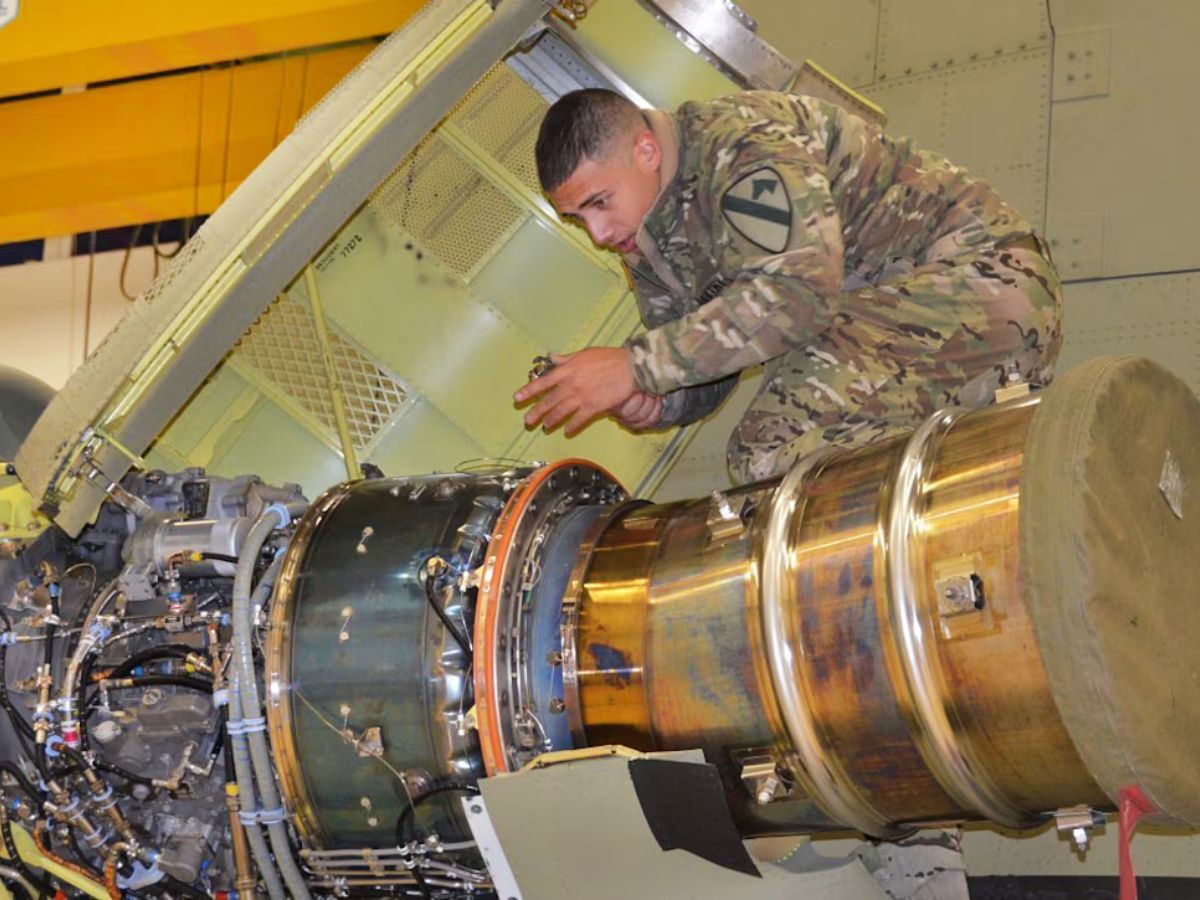


Learn About the Technology of the Chinook Helicopter Engine and How Its Unique Tandem Rotor Design Transformed It Into an Icon of Heavy-Lift Aviation
The secret to its strength and stability lies in the design of its rotors and the powerful Chinook helicopter engine. Unlike conventional helicopters, the Chinook uses all of its power to generate lift, allowing it to perform feats such as lifting an entire truck. This is the engineering behind one of the most durable aircraft in history.
The Boeing CH-47 Chinook is one of the most recognized helicopters in the world, famous for its dual-blade appearance and incredible capability to lift heavy loads. Since its first flight in 1961, it has become an indispensable tool for both military and civilian operations, transporting everything from troops and artillery to containers and construction equipment.
How Counter-Rotating Rotors Cancel Torque Since 1961
The most striking design feature of the Chinook is its two large rotors, one in the front and one in the back. This configuration, called tandem rotor, is key to its efficiency. The two blades rotate in opposite directions, one clockwise and the other counterclockwise. This synchronized movement cancels out the torque that, in a conventional helicopter, would cause the fuselage to rotate.
-
The world’s first octopus farm wants to open in the Canary Islands and is already provoking an international reaction: the plan aims to produce 3,000 tons per year.

-
Drought may be creating stronger superbugs in the soil and helping antibiotic resistance reach hospitals, warns a study highlighting a problem that could grow alongside extreme weather.

-
The biggest scam in history: Napoleon’s France deceived the United States by selling them a territory that was Spanish.

-
Why is the Danakil Desert so dangerous? It has unstable terrain and how extreme temperatures and toxic gases turn the region into one of the most hostile environments on Earth.


With the torque canceled, the Chinook does not need a tail rotor. This allows all the power generated by the engines to be used to lift the aircraft and propel it forward. The concept was tested during the inaugural flight of the prototype on September 21, 1961, and proved to be such a success that it remains in use today.
The Chinook Helicopter Engine Lycoming T55 and Its 6,000 Horses
The heart of the Chinook is its two Honeywell T55 turboshaft engines (originally Lycoming T55). The evolution of these engines is what has allowed the helicopter to remain relevant for more than 60 years. The early versions of the CH-47A were equipped with 2,200 horsepower engines.
Over the decades, the engines have been refined. The most recent variant, the T55-714C, which equips the modernized Chinooks, delivers an impressive 6,000 horsepower. This nearly threefold increase in power is what allows newer versions, such as the CH-47F, to operate more efficiently in high-altitude and temperature environments, lifting even heavier loads.
How the Chinook Can Lift a 5-Ton Truck
The question of lifting a truck is answered by its immense external load capacity. Thanks to the efficiency of the Chinook helicopter engine and the rotor system, the aircraft can lift up to 11,793 kg (or 26,000 pounds) on its central hook.
This capacity is more than enough to lift many types of trucks. For example, a 5-ton military M939 truck weighs about 9,979 kg, a value that is comfortably within the Chinook’s limit. It can also carry two Humvee vehicles at once, suspended by cables.
A Design From the 50s Still in Service Today, the Modernization of the CH-47F
The Chinook is one of only two military aircraft designed in the 1950s that are still in production, along with the C-130 cargo plane. This is only possible due to a continuous modernization program. The current version in service with the U.S. Army is the CH-47F.
This variant, introduced in the early 2000s, features significant improvements, such as a fully digital cockpit, a new fuselage that reduces vibration, and more powerful engines. These upgrades ensure that the Chinook remains a cutting-edge platform, capable of meeting the demands of modern operations.
Why Pilots Consider It Easier to Fly Than It Seems
Despite its size and complexity, many pilots find the Chinook surprisingly easy to fly. The automatic flight control system intuitively translates the pilot’s commands, making the experience similar to that of a conventional helicopter.
Mechanically, the tandem rotor system offers a significant advantage: it does not suffer from a lack of “pedal power”, a common limitation in single-rotor helicopters under certain wind conditions. This, combined with its superior hover stability, makes the Chinook helicopter engine and its overall design a combination of strength and precision admired by its operators.









Infelizmente esse tipo de reportagem é pobre de imagens.
Fiz o meu pedido e até agora não recebi nada
Um assunto interessante, atual, mas com somente uma foto? E ainda de um detalhe? Não tem fotos em arquivo?
Normalmente esse tipo de reportagem é pobre de imagens, é uma pena!