





 Portuguese
  English
  Spanish
  4 min of reading
  0 comments


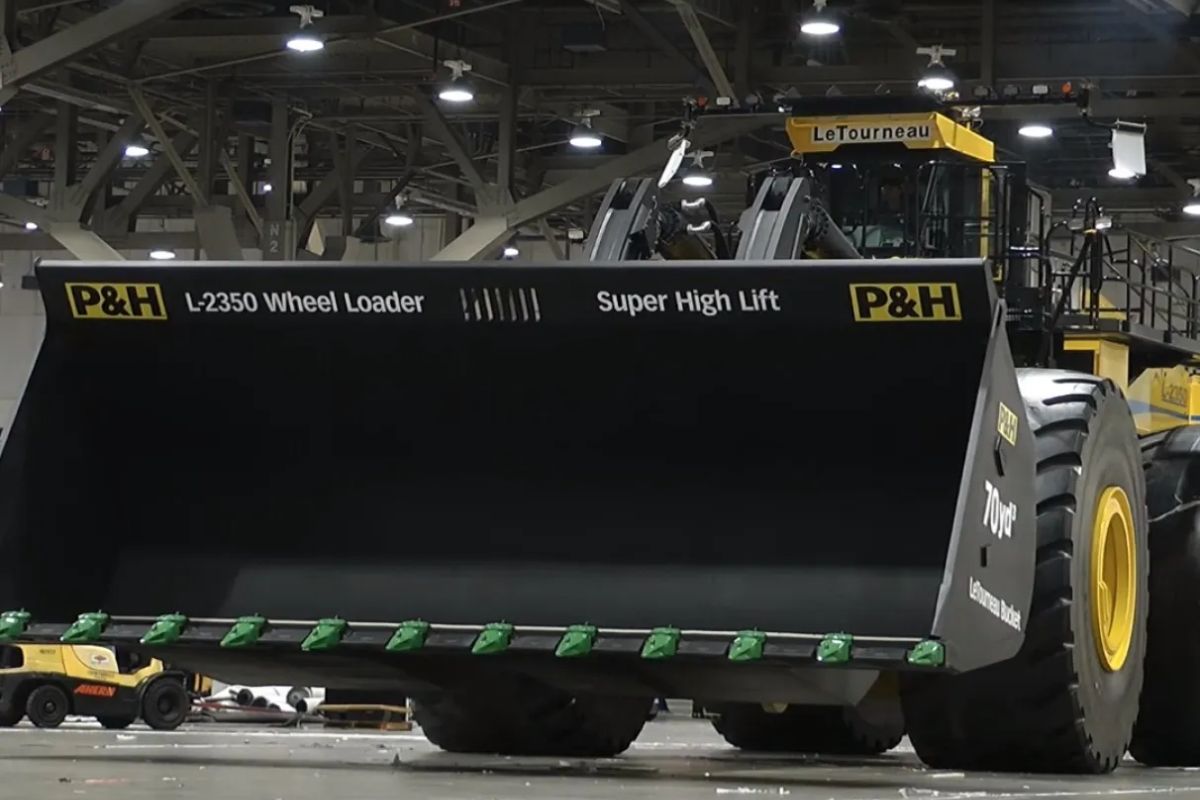
With A Hybrid Technology And A Diesel-Electric Engine Of The World’s Largest Wheel Loader, The LeTourneau L-2350 Generates 2,300 HP To Lift The Weight Of 10 Elephants At Once.
In the gigantic open-pit mines, where trucks look like ants, a titan of steel operates that holds the Guinness World Record: the diesel-electric engine of the world’s largest wheel loader. This colossal machine was designed for a single and impressive task: to load trucks weighing over 400 tons with relentless efficiency. To achieve this, it lifts 72 tons of rocks at once.
The secret of its strength lies not only in its size but in a piece of brilliant engineering: the diesel-electric engine of the world’s largest wheel loader. Unlike any conventional vehicle, its gigantic diesel engine is not connected to the wheels. It works like a power plant, generating the electricity that powers four independent motors, one inside each tire, in a system that is the pinnacle of heavy equipment engineering.
A Legend Of Engineering: The Story Of The LeTourneau L-2350
The technology behind this machine was born from the mind of Robert Gilmour “R. G.” LeTourneau, a brilliant inventor who, as early as the 1950s, pioneered the concept of electric wheel hub motors. He envisioned a system without complex mechanical transmissions, offering unparalleled control of power and traction.
-
Spain surprises the world by erecting 62 artificial dunes, mixing sand with natural remains of posidonia, and causing the structure to lose only 1.4% of its volume in 1 year.

-
With 16 Bulava missiles, improvements in acoustic stealth, and a design focused on silent patrols, Russia’s nuclear submarine was born to ensure Moscow’s invisible retaliation and has become one of the pillars of its maritime strength.

-
‘Populous’ city in Rio among the worst in Brazil in national ranking and exposes silent development crisis.

-
Couple buys house in the South Zone of São Paulo, opens a hidden door in the garage, and finds a secret wine cellar with dozens of old wines forgotten since the 1970s.

The L-2350, the culmination of this vision, was unveiled to the world at the World Mine Expo in 2000, in Las Vegas. Originally manufactured by LeTourneau, Inc., the machine proved to be such a robust design that, even after the company was acquired by Joy Global and later by the Japanese giant Komatsu (which renamed it WE2350), its core design and propulsion technology remained, continuously improved.
How Does The 2,300 HP Diesel-Electric Engine Work?
The heart of the L-2350 is a colossal 16-cylinder, 65-liter diesel engine — which can be a Detroit Diesel or a Cummins — producing an impressive 2,300 horsepower. However, the function of this primary engine is solely to spin a massive alternator.
It is this generator that produces the electrical energy to power the four independent traction motors, housed within the hub of each of the gigantic 4-meter diameter wheels. The diesel-electric engine of the world’s largest wheel loader is therefore a mobile power plant. This architecture eliminates the need for axles, differentials, and gearboxes, parts that simply could not withstand the extreme forces involved in operation.
Lifting 10 Elephants: The 72 Ton Load Capacity
All this power translates into a working capacity that defies imagination. The standard payload of the L-2350 is 72,574 kg. Considering that an adult African elephant weighs, on average, about 6,000 kg, the machine actually lifts the equivalent of the weight of 10 to 12 elephants in its bucket of over 40 cubic meters.
The loading cycle is incredibly fast for a machine of this size. Thanks to a massive hydraulic system, it can lift its maximum load in less than 17 seconds and dump it into the truck in just 3 seconds. This speed is crucial for the productivity of the mine, where every second counts.
More Than Strength, Efficiency: The SR Hybrid Drive Technology
The latest models of the L-2350 incorporate a technology called SR Hybrid Drive. The system is based on regenerative braking, a concept similar to that of electric cars. When the loader brakes or lowers its loaded bucket, the electric motors reverse their function and act as generators, capturing the energy from inertia.
This recovered energy is fed back into the system, helping to alleviate the load on the diesel engine. The result is a reduction of up to 45% in fuel consumption and 35% in CO2 emissions compared to similarly sized mechanical drive machines. It is the perfect combination of brute strength with energy intelligence.
The Digital Brain: The LINCS II Control System
Managing all this power requires a sophisticated electronic brain. The LINCS II system is the machine’s nerve center. In the cabin, the operator has access to a touchscreen that monitors in real-time every aspect of operation: the height and angle of the bucket, the exact weight of each load, and the status of all vehicle components.
This system not only controls the machine but also optimizes the operation of the mine. By measuring the weight of each load, it helps prevent overloading the trucks, and its productivity data allows mine management to analyze performance and plan maintenance, ensuring that the steel giant continues operating at maximum efficiency.







-

-

-

-

-

-

68 pessoas reagiram a isso.