





 Portuguese
  English
  Spanish
  9 min of reading
  2 comments


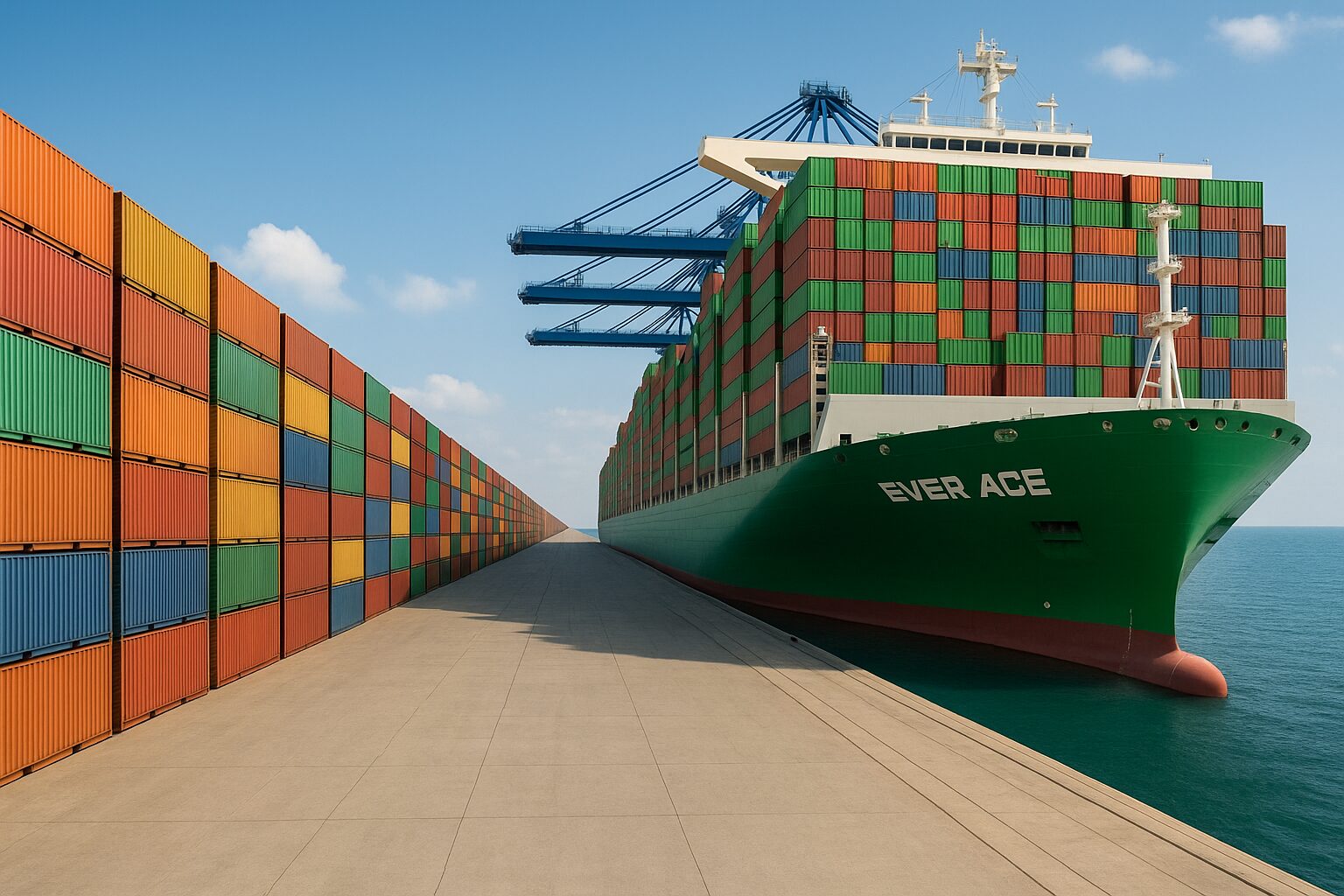

It Is Bigger Than Four Football Fields And Carries Enough Cargo To Supply An Entire Country. The Ever Ace Is One Of The Largest Container Ships On The Planet — And Transforms Global Trade With Every Voyage.
Imagine a ship capable of transporting, at one time, the equivalent of 20,000 containers. Each about 6 meters long. If these containers were lined up, they would form a line over 120 kilometers long — a distance capable of crossing cities or disappearing on the horizon.
This is the Ever Ace, the green colossus of Evergreen Marine, launched in 2021 to revolutionize maritime transport. With its impressive 400 meters in length, 61.5 meters in width, and a cargo capacity of 23,992 TEUs (20-foot units), it holds the title of one of the largest container ships in operation in the world. — Meet the Ship That Consumes Daily The Equivalent Of A Thousand Truckloads And Crosses Oceans Non-Stop
Designed in South Korea and built at the Hudong-Zhonghua shipyard in China, the Ever Ace is part of the new generation of ULCVs (Ultra Large Container Vessels), created to increase logistical efficiency, reduce costs, and meet the growing demand of international trade.
-
Spain surprises the world by erecting 62 artificial dunes, mixing sand with natural remains of posidonia, and causing the structure to lose only 1.4% of its volume in 1 year.

-
With 16 Bulava missiles, improvements in acoustic stealth, and a design focused on silent patrols, Russia’s nuclear submarine was born to ensure Moscow’s invisible retaliation and has become one of the pillars of its maritime strength.

-
‘Populous’ city in Rio among the worst in Brazil in national ranking and exposes silent development crisis.
-
Couple buys house in the South Zone of São Paulo, opens a hidden door in the garage, and finds a secret wine cellar with dozens of old wines forgotten since the 1970s.

Since its maiden voyage, the Ever Ace has crossed the planet several times, connecting ports in Asia, Europe, and America, practically without long stops between loadings. The ship operates on optimized routes with support from state-of-the-art navigation technologies and automated logistics, allowing its journey around the world to be completed with minimal interruptions and maximum energy efficiency.
With a daily fuel consumption of thousands of liters, it still manages to be more efficient than dozens of smaller freighters making the same route. This is because its size allows for economies of scale — reducing the cost per ton transported, a decisive factor in today’s globalized world.
At the bow, the imposing inscription “EVER ACE” stands out against the light green hull, a visible symbol of maritime power. At the stern, the main engine — one of the largest in the world — smoothly moves its nearly 240,000 tons of displacement, even in rough seas. And despite being a giant, the Ever Ace is agile enough to meet tight deadlines in limited docking spaces, thanks to tugs, port pilots, and AI-assisted route software.
What Are Mega Container Ships?
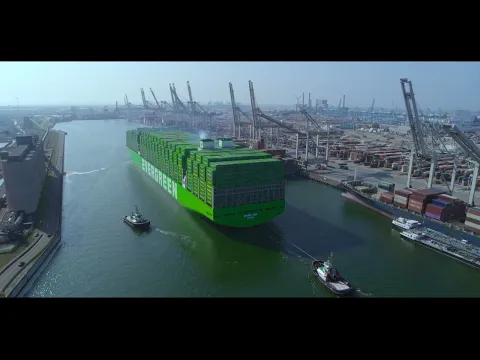

ULCVs (Ultra Large Container Vessels) are the largest cargo ships in the world. Created to meet the growing demand of global trade, they are designed to maximize cargo space, reduce logistical costs per ton, and increase efficiency on international maritime routes.
These ships typically measure between 400 and 430 meters in length (longer than a lying Eiffel Tower) and have the capacity to carry over 20,000 TEUs (20-foot containers). For comparison, a common cargo ship carries about 2,000 to 3,000 containers.
Famous Models: From Ever Given To Ever Ace — Both Known As Ships That Carry 20 Thousand Containers
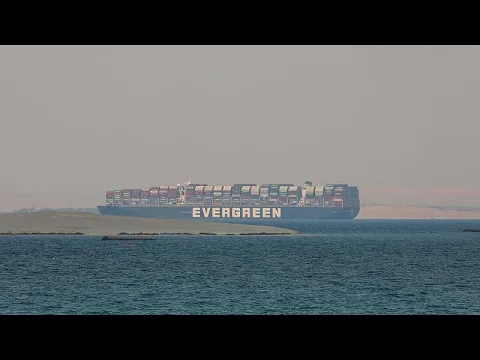
The world witnessed the power — and the risk — of these giants in March 2021, when the Ever Given, from Evergreen Marine, ran aground in the Suez Canal, blocking one of the planet’s main trade routes for almost a week. With its 400 meters in length and over 200,000 tons, the ship became stuck during a maneuver, generating an estimated loss of US$ 9 billion per day to global trade.
Another impressive model from the same company is the Ever Ace, launched in 2021. With a capacity of 23,992 containers, it is one of the largest ships ever built. The Ever Ace measures 400 meters in length and 61.5 meters in width, with a height equivalent to a 20-story building.
Other ships of this class include:
- MSC Gülsün (Mediterranean Shipping Company)
- HMM Algeciras (Hyundai Merchant Marine)
- CMA CGM Jacques Saadé (fueled by LNG — liquefied natural gas)
These vessels are true logistical revolutions at sea.
How Is Embarkation And Disembarkation Logistics Conducted? The Ship That Carries 20 Thousand Containers
The loading and unloading operation of a mega ship is a meticulously planned choreography. Each container needs to be in the exact position to ensure the ship’s balance, the quick unloading, and the compliance with logistical deadlines.
At the ports, gigantic cranes operate 24 hours a day. A modern terminal like those in the Port of Rotterdam (Netherlands) or Shanghai (China) can move over 100 containers per hour using automated equipment and trained operators. The entire process depends on advanced software, intermodal logistics, and integration with railways and trucks.
Additionally, there is the challenge of identifying each unit, as the cargo varies from electronics to food, chemicals, and vehicles.
What Are The Major Routes Of Mega Ships?
The mega container ships follow fixed trade routes, determined by logistics hubs and ports with adequate infrastructure. The main routes are:
- Asia – Europe: via Suez Canal
- Asia – North America: crossing the Pacific to the west coast of the USA (Los Angeles, Long Beach, Seattle)
- Asia – South America: passing through ports like Santos (Brazil) and Buenos Aires (Argentina)
- Transatlantic Routes: between Europe and North America
Trips can last from 15 to 45 days, depending on the distance and stops. The route between Shanghai and Rotterdam, for example, takes about 30 days.
How Do These Giants Maneuver And Avoid Accidents?
Maneuvering a ship with hundreds of meters and thousands of tons requires technology and experience. In ports, the process is assisted by tugs and pilots — professionals who know every local curve and depth in detail.
Aboard, the ship is equipped with:
- Satellite Navigation Systems (GPS and AIS)
- Depth Sensors
- Long-Range Marine Radar
- Assisted Propulsion And Special Rudders
Even so, the margin for error is small. In the Suez Canal, for example, the canal has about 200 meters of width in certain stretches, making it nearly impossible for ships to pass.
Moreover, climate changes, crosswinds, and human errors continue to be challenges. Therefore, contingency plans, constant training, and artificial intelligence are increasingly present in navigation.
Curiosities About Mega Container Ships
- The longest ship ever built was the Seawise Giant, measuring 458 meters — but it was an oil tanker.
- Modern container ships are capable of carrying refrigerated cargo in containers called “reefers.”
- Over 90% of all global trade occurs via ships — and a large portion is through container ships.
- On average, a single ship can carry 200 million items, from iPhones to toys and automotive parts.
- The cost to operate one of these giants is around US$ 40,000 to 100,000 per day, including fuel, crew, and maintenance.
Historical Incidents That Marked The Industry
In addition to the famous grounding of the Ever Given, other incidents have drawn the attention of the maritime industry:
- Maersk Honam (2018): A fire destroyed part of the cargo and caused fatalities onboard. This led to discussions about poorly declared hazardous cargo.
- MSC Zoe (2019): During a storm in the North Sea, the ship lost 342 containers at sea, some with toxic materials.
- Yantian Express (2019): Also affected by a fire, it led to a salvage operation and partial unloading in Canada.
Maersk Honam (2018): The Fire That Exposed The Invisible Risks In Mega Freighters
On March 6, 2018, the mega ship Maersk Honam, operated by the Danish giant Maersk Line, suffered a catastrophic fire in the Indian Ocean, about 900 nautical miles off the coast of India. The vessel, with a capacity of over 15,000 containers (TEUs), was sailing from China to Egypt when the fire broke out in one of the forward holds, spreading rapidly.
The incident resulted in the death of five crew members and severe damage to the ship’s structure. Rescue operations were complicated by the intensity of the flames and the remote location. Only days later, specialized tugs managed to contain the fire.
The tragedy gained significant attention in the maritime sector and raised a critical alert about poorly declared hazardous cargo. The investigation revealed that flammable chemicals — poorly identified in the shipping documentation — may have triggered the fire.
Maersk intensified its protocols following the incident, including manual inspections of suspicious cargo and penalties for shippers omitting hazardous substances. Additionally, the case pressured the International Maritime Organization (IMO) to revise its safety guidelines on chemical containers and fire-fighting regulations.
The Maersk Honam was partially rebuilt and renamed Maersk Halifax. To this day, the case is cited as one of the most serious incidents involving mega freighters in modern times, highlighting the hidden challenges of global maritime logistics.
MSC Zoe (2019): When The Sea Took Hundreds Of Containers — And Environmental Safety Became The Debate
On the night of January 1 to 2, 2019, the MSC Zoe, from Mediterranean Shipping Company, faced an intense storm while sailing through the North Sea. During the crossing between Portugal and Germany, the mega ship — measuring 396 meters in length and capable of carrying over 19,000 containers — was violently rocked by waves and winds exceeding 10 Beaufort.
As a result, 342 containers were thrown overboard, scattering tons of products — including automotive parts, toys, furniture, lithium batteries, and even hazardous materials like organic peroxides, highly flammable.
The accident had a direct impact on the coast of Friesland, between the Netherlands and Germany, where dozens of tons of cargo reached the beaches. Local populations mobilized to clean up the debris, but the dispersal of toxic materials concerned environmental authorities, leading to investigations about the potential ecological risk in protected areas.
Maritime authorities in the Netherlands and Germany demanded answers from MSC and requested improvements in mooring practices and cargo verification. The IMO (International Maritime Organization) also began discussing new protocols to prevent container losses in open sea, especially on large ships.
The MSC Zoe incident reinforced the alert regarding the fragility of moorings in severe storms and the importance of tracking and recovering lost cargo at sea, both for safety and environmental protection.
Yantian Express (2019): A Massive Fire In The Heart Of North Atlantic Winter
In January 2019, the Yantian Express, a German-flagged ship operated by Hapag-Lloyd, suffered a devastating fire onboard while crossing the North Atlantic, en route from the United States to Europe. The fire started in one of the containers positioned at the bow and rapidly spread to other compartments.
The ship, which was carrying about 7,500 TEUs, had part of its cargo compromised before rescue efforts could be organized. The crew of 23 had to evacuate amidst extreme cold and adverse maritime conditions. Specialized tugs took days to control the flames and escort the ship to the port of Halifax, Canada.
The causes of the fire pointed to spontaneous combustion or failure in chemical cargoes, once again raising the issue of the accurate declaration of hazardous materials. Although no fatalities were recorded, the logistical and financial damage was significant, with the loss of hundreds of containers and weeks of delays in the supply chain.
Hapag-Lloyd declared general average, a legal mechanism requiring all cargo owners onboard to share the rescue costs — which led to protests among clients.
The Yantian Express case highlighted the vulnerability of mega freighters to the risk of poorly contained chemical fires, even on modern vessels, and expanded discussions on automation, thermal sensors, and global inspection standards in cargo ships.
Why Are These Ships So Important To The World?
Mega container ships are the invisible engines of globalization. They allow a product manufactured in China to reach Brazil in just a few weeks, with logistic costs diluted by their high cargo capacity.
Without them, the price of everything — clothing, electronics, imported food — would be significantly higher. They also enable the “lean inventory” model used by large retail chains.
With the growth of online trade and global supply chains, the role of these ships is likely to increase even further.
Mega container ships, like the Ever Ace and the Ever Given, are icons of the modern age. Steel giants that traverse the oceans with loads that sustain entire economies. They not only connect continents — but also remind us of the reach, complexity, and dependence the world has on maritime transport.
The next time you look at an imported product on a shelf, remember: it may have crossed the planet inside one of these sea colossi.







Foto montada, ERROR grave os portainers para carga e descargas estão sobre o navio , LUGAR DELES E NO PIER
Esse tipo de navio não faz escala em Bueno’s Aires em virtude das restrições de calado oferecida a este Porto como a todos do Rio Paraná.