





 Portuguese
  English
  Spanish
  6 min of reading
  0 comments


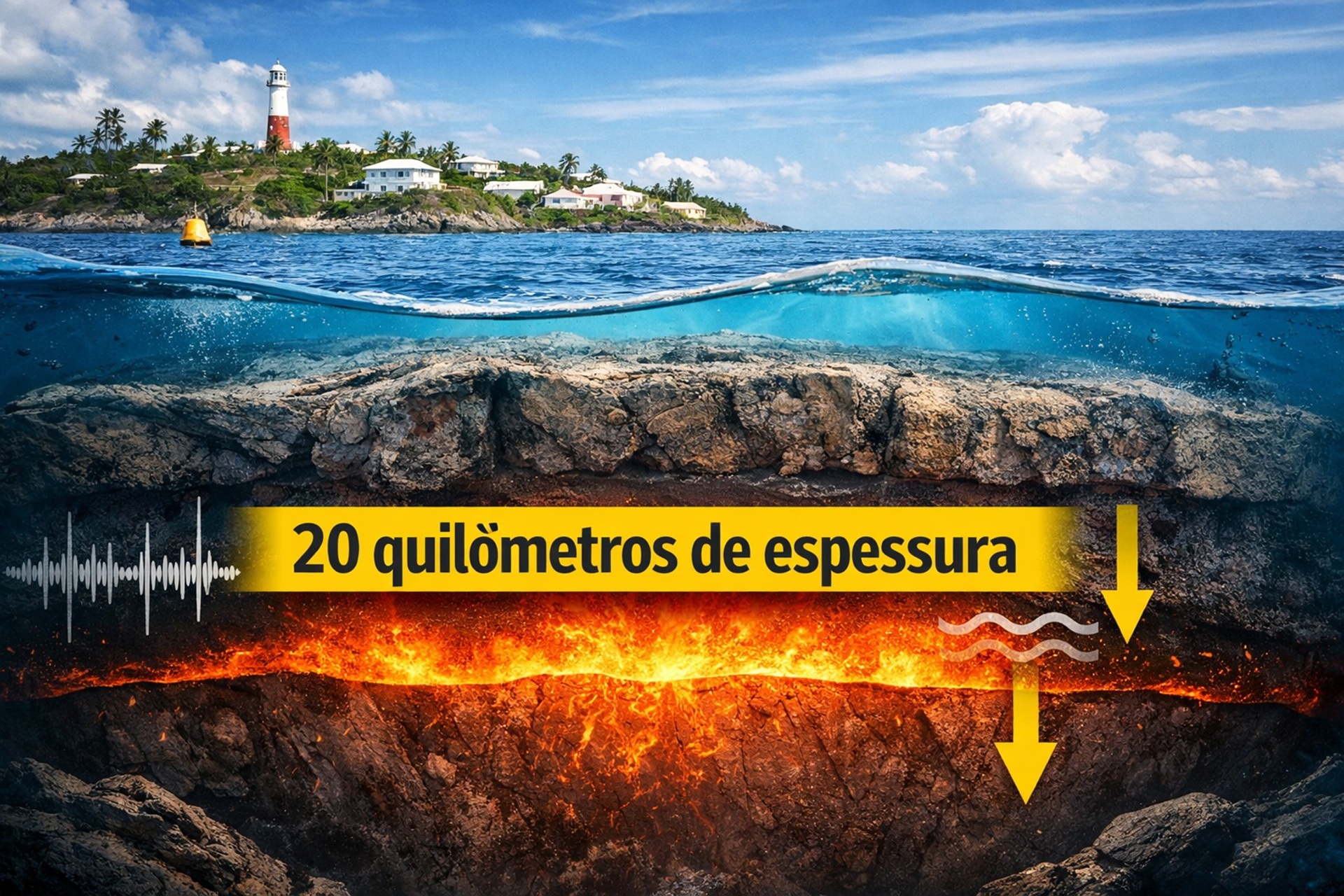
Discovery Of 20 Kilometer Rock Layer Below The Bermuda, Identified By Analysis Of 396 Earthquakes, Explains Oceanic Elevation Maintained For 30 To 35 Million Years Without Active Mantle Plume.
Researchers have identified a 20-kilometer-thick rock layer beneath the Bermuda, detected through seismic analysis of 396 earthquakes, capable of sustaining sea floor elevation for over 30 million years without active volcanic activity, altering classic geological models.
The Bermuda archipelago harbors an unusual geological structure beneath the North Atlantic Ocean, distinct from the oceanic crust and the mantle, which supports regional elevation even after the end of volcanism that occurred between 30 and 35 million years ago.
The discovery results from a study led by researchers from the Carnegie Institution for Science and Yale University, published in the journal Geophysical Research Letters, based on detailed seismic analyses conducted from the BBSR station located in the Bermuda.
-
The Moon holds billions of years of frozen water in dark craters that could provide fuel, oxygen, and drinking water for astronauts, and a new study finally explains how that ice got there.

-
Pirita, the “fool’s gold,” deceived prospectors for centuries and today helps science uncover the origin of Earth’s magma.
-
The largest volcanic event in Earth’s history may have changed everything beneath the Pacific: a study shows that eruptions 110 to 120 million years ago reshaped the oceanic plate of the Ontong Java Plateau, the largest oceanic plateau on the planet.

-
The world’s largest acid geyser awakens in Yellowstone and reaches record heights after years of dormancy.
Unlike archipelagos such as Hawaii or Galápagos, associated with active hot spots, the Bermuda show no evidence of current mantle plume, even though they remain over a stable oceanic elevation, a condition considered anomalous by geophysics for decades.
The new work identifies an additional layer beneath the oceanic crust, described as an internal structure of the tectonic plate, about 20 kilometers thick, which acts as a mechanical support for the underwater relief.
According to the authors, this layer functions as a buoyant base, preventing the progressive sinking of the ocean floor, behavior expected after the cessation of the volcanic activity responsible for the initial formation of the archipelago.
A Seismic Anomaly Below The Oceanic Crust
The identification of the structure occurred through the analysis of seismic waves generated by distant earthquakes, a method used to investigate inaccessible regions of the Earth’s interior, where direct drilling is technically unfeasible.
The researchers applied the P-to-S receiver function technique, which analyzes the conversion of seismic waves as they navigate across interfaces between materials with distinct physical properties within the planet.
Data from 396 earthquakes with a magnitude of 5.5 or greater, recorded in different regions of the world and captured by the seismic station located in the Bermuda, were examined.
The analysis revealed four main interfaces below the island, with the deepest corresponding to the anomalous layer located approximately 20 kilometers deep beneath the local oceanic crust.
This structure had not been detected in previous conventional seismic surveys, nor recorded in global models of oceanic island formation, making the finding an unprecedented case.
According to the study, the layer exhibits physical properties compatible with solidified magmatic rock, distinct from both the upper oceanic crust and the underlying lithospheric mantle.
Magmatic Sublithosphere And Density Difference
The authors classify the structure as a sublithospheric layer, formed from magmatic material that did not reach the surface during the period of volcanic activity, remaining trapped beneath the crust.
In more extensively studied volcanic islands, such as Hawaii or Reunion, similar layers usually have thicknesses between 5 and 10 kilometers, a value significantly lower than that observed in Bermuda.
In the case of Bermuda, the layer reaches approximately 20 kilometers, double the thicknesses normally associated with sublithospheric processes in comparable oceanic environments.
The article published in Geophysical Research Letters indicates that the density of this layer is about 50 kg/m³ less than that of the lithospheric mantle that was displaced during its formation.
This density difference provides sufficient buoyancy to support the elevation of the sea floor without the need for additional heat from an active mantle plume.
Thus, the study demonstrates that a current thermal anomaly is not a necessary condition for maintaining long-term oceanic undulations, contradicting traditional geodynamic assumptions.
Origin Associated With Ancient Volcanism
Seismic evidence indicates that the layer formed during the period of greatest volcanic activity in the region, over 30 million years ago, when the archipelago emerged in the Atlantic.
During this stage, the ascending magma would have accumulated at the base of the crust, solidifying before reaching the surface, forming a kind of internal rocky pillow.
After cooling, this structure remained stable, showing no signs of collapse, compaction, or significant sinking over tens of millions of years, according to the analyzed data.
Recent geochemical studies mentioned in the work indicate that the magma associated with Bermuda was rich in volatiles and originated from deep regions of the Earth’s mantle.
This deep magma possibly relates to ancient processes linked to the fragmentation of the supercontinent Pangaea, helping to explain its atypical composition and behavior.
The ability of this material to modify the surrounding rocks may have contributed to the formation of a thick and mechanically efficient layer capable of supporting the underwater relief.
Persistence Of Oceanic Elevation
One of the main geological enigmas of the Bermuda has always been the persistence of oceanic elevation even after the cessation of regional volcanism, which occurred between 30 and 35 million years ago.
In similar contexts, the interruption of magmatic activity usually leads to cooling and gradual sinking of the crust, a process that has not occurred under the archipelago.
The presence of the sublithospheric layer offers a coherent explanation for this persistence, acting as structural support independent of current thermal sources.
The seismic records do not indicate signs of contemporary mantle activity beneath the Bermuda, reinforcing the hypothesis that the support derives exclusively from the solid structure identified.
This finding broadens the understanding of alternative mechanisms for maintaining oceanic relief over extensive geological time scales.
Limitations And Extension Of The Structure
Despite the robustness of the data, the study acknowledges inherent limitations in using a single seismic station to characterize the structure on a regional scale.
Based on interpretative models, the researchers estimate that the layer may extend between 50 and 100 kilometers beyond the main island, although this dimension cannot yet be confirmed precisely.
The absence of a broader seismic network hinders the exact determination of the lateral limits of the structure and its continuity beneath the adjacent ocean floor.
Nevertheless, the authors emphasize that the observed properties are sufficient to explain the detected regional elevation and its stability over millions of years.
New seismic surveys in nearby areas may clarify the actual extent of the layer and verify whether similar structures exist at other points in the Atlantic.
A Unique Case In Oceanic Geodynamics
So far, there are no records of layers with similar characteristics beneath other known oceanic archipelagos, as emphasized by the published study.
While some islands in the Pacific and Indian Oceans show signs of sublithosphere, none exhibit a structure so thick, stable, and with sufficiently low density to sustain prolonged elevation.
The authors assert that the Bermuda represents, for now, a unique documented case of this type of internal geological configuration.
This uniqueness raises the possibility that other oceanic systems considered anomalous may be reinterpreted in light of similar mechanisms, still undetected.
The team involved in the study has already begun analyses in regions with unexplained oceanic elevations, seeking to identify patterns comparable to those observed in Bermuda.
Beyond Popular Narratives
The finding shifts the focus from the mysteries associated with Bermuda from the realm of speculation to that of deep geology, revealing complex processes hidden beneath the sea floor.
The 20-kilometer-thick layer represents a physical record of events that occurred tens of millions of years ago, preserved beneath the current oceanic crust.
More than explaining the origin of the archipelago, the discovery provides relevant information about the behavior of the mantle, crust, and tectonic plates in ancient oceanic contexts.
The study reinforces that regions considered well-known may still harbor unknown structures, accessible only through advanced geophysical techniques.
By revealing an invisible structure that supports the relief of Bermuda, the research expands the understanding of the planet’s internal dynamics and shows that some of the greatest geological enigmas remain concealed, well below the ocean surface.






Seja o primeiro a reagir!