





 Português
  Inglês
  Espanhol
  3 min de leitura
  0 comentários


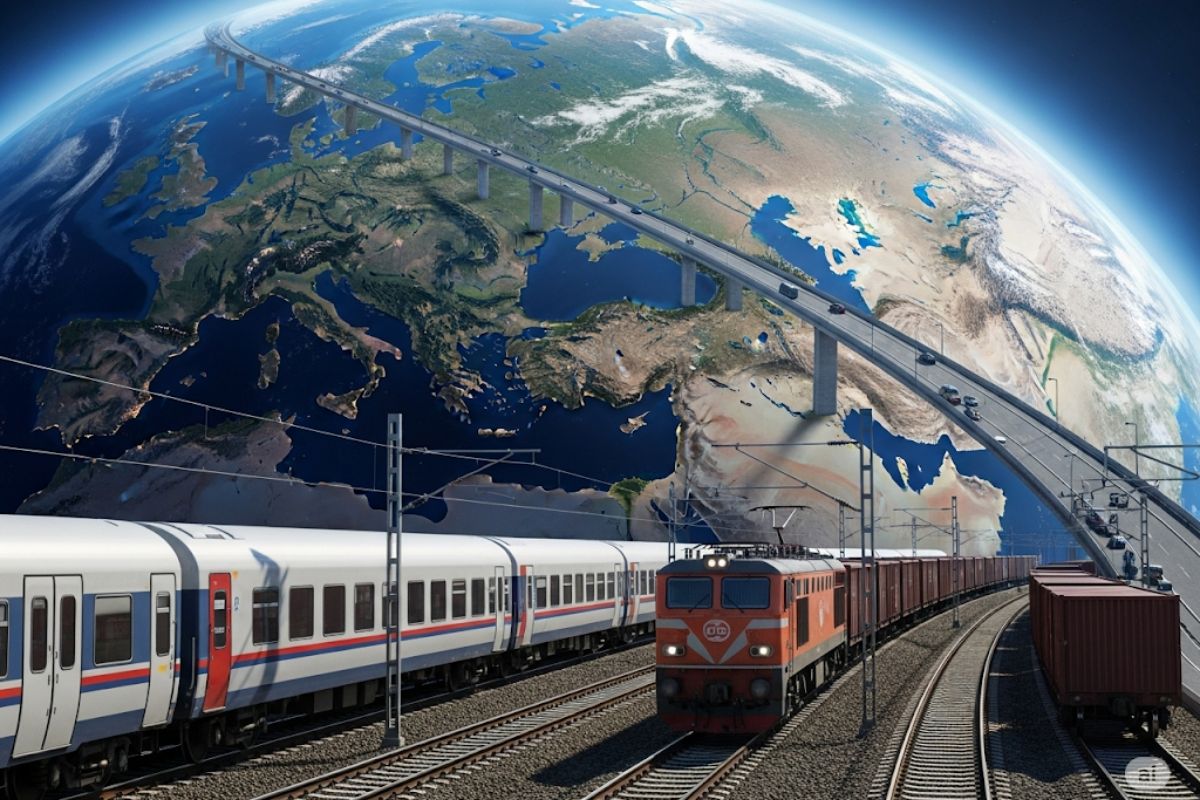
Announced at the G20, the India-Middle East-Europe Economic Corridor (IMEC) is an ambitious multimodal plan. Learn about its architecture, strategic partners, and the challenges for its realization.
An ambitious plan to create a new railway and highway to connect India to Europe, crossing the Middle East, has been launched. The India-Middle East-Europe Economic Corridor (IMEC) is a geoeconomic initiative seeking to transform global trade and strengthen strategic ties among the participating countries.
Launched at the G20 Summit in 2023, the project aims to be an alternative to China’s Belt and Road Initiative (BRI). This article explores the details of the IMEC, its architecture, the partners involved, the challenges, and the future of what could be one of the most important trade routes of the century.
What Is the IMEC? The Plan for a New Trade Artery Connecting Three Continents
The IMEC is a multimodal corridor for transport, energy, and data. Its memorandum of understanding was signed by India, the USA, Saudi Arabia, the European Union, the UAE, France, Germany, and Italy. The initiative is part of the Partnership for Global Infrastructure and Investment (PGII), a G7 effort to counter the Chinese BRI.
-
The world’s first octopus farm wants to open in the Canary Islands and is already provoking an international reaction: the plan aims to produce 3,000 tons per year.

-
Drought may be creating stronger superbugs in the soil and helping antibiotic resistance reach hospitals, warns a study highlighting a problem that could grow alongside extreme weather.

-
The biggest scam in history: Napoleon’s France deceived the United States by selling them a territory that was Spanish.
-
Why is the Danakil Desert so dangerous? It has unstable terrain and how extreme temperatures and toxic gases turn the region into one of the most hostile environments on Earth.


The goals of the IMEC are ambitious. The aim is to increase efficiency, reduce costs and transit times, and ensure the stability of supply chains. Additionally, it seeks to foster economic cooperation, generate jobs, promote energy security, and drive digital transformation.
Much More Than a New Railway and Highway
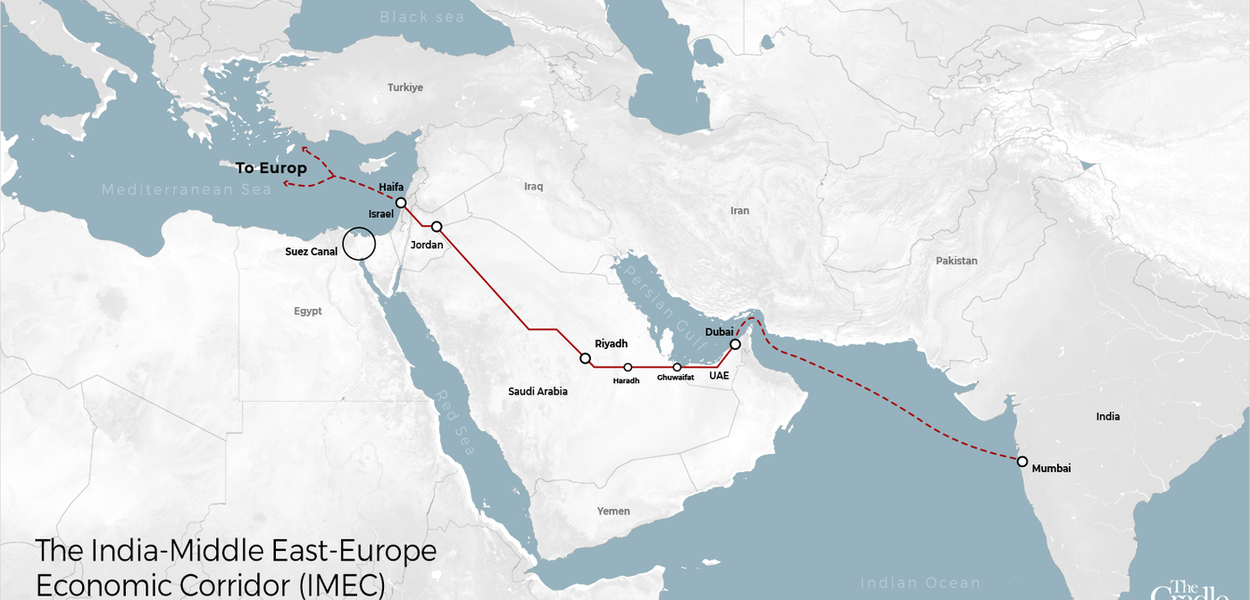
While the focus is on a new railway and highway, the architecture of the IMEC is more complex and integrated, with four pillars:
Land Transport Pillar: Envisions the creation of a rail and road network connecting the UAE, Saudi Arabia, Jordan, and Israel, with high-speed freight trains.
Maritime Pillar: Includes the modernization and development of strategic ports, such as Vadhavan in India, Jebel Ali in the UAE, and Haifa in Israel, as well as European ports.
Energy Pillar: Plans to construct pipelines for exporting green hydrogen and cables to interconnect power grids across continents.
Digital Pillar: Includes high-speed data cables and fiber optics, such as the Blue-Raman system, to enhance connectivity and cybersecurity.
A Strategic Alliance for a New Global Balance
The IMEC is widely viewed as a Western-backed alternative to China’s Belt and Road Initiative (BRI). The corridor seeks to promote a rule-based approach to infrastructure development, with more transparency and financial sustainability.
For the main actors, the interests are strategic:
- India: Seeks to boost exports and strengthen its image as a global player.
- United States: Aims to counterbalance China’s influence in the Middle East.
- European Union: Seeks to diversify trade routes and reduce dependence on China.
- Saudi Arabia and UAE: See an opportunity to diversify their economies.
The Status of the Project in 2025 and Next Steps for the New Railway and Highway
Despite the challenges, diplomatic engagement with the IMEC continues. A framework agreement between India and the UAE was signed in February 2024 for cooperation on the corridor, focusing on logistics and ports. Other countries, like Italy and France, have appointed special envoys for the project.
Regional crises, such as Houthi attacks in the Red Sea, although have slowed some negotiations, also reinforced the strategic need for alternative routes like the IMEC. The initiative aligns with other global efforts, such as the G7’s Partnership for Global Infrastructure and Investment (PGII). The advancement of the corridor, although still in planning stages, remains a priority for its members.






Seja o primeiro a reagir!